In the landscape of Swiss horology, few brands have navigated the delicate balance between heritage and accessibility as adeptly as Geneva-based Raymond Weil. Established in 1976—a year defined by both the "quartz crisis" and the resilience of traditional watchmaking—the maison has consistently championed a design language that favors understated elegance over aggressive, trend-chasing aesthetics.
As of 2026, the brand celebrates its 50th anniversary. To commemorate this half-century milestone, Raymond Weil took a bold, unexpected step: the release of the "Millesime The Fifty" Chronograph. Limited to a mere 50 pieces, this timepiece represents more than just a celebratory accessory; it serves as a masterclass in how a heritage brand can synthesize its foundational history with modern collector sensibilities.
Main Facts: The Anatomy of a Limited Edition
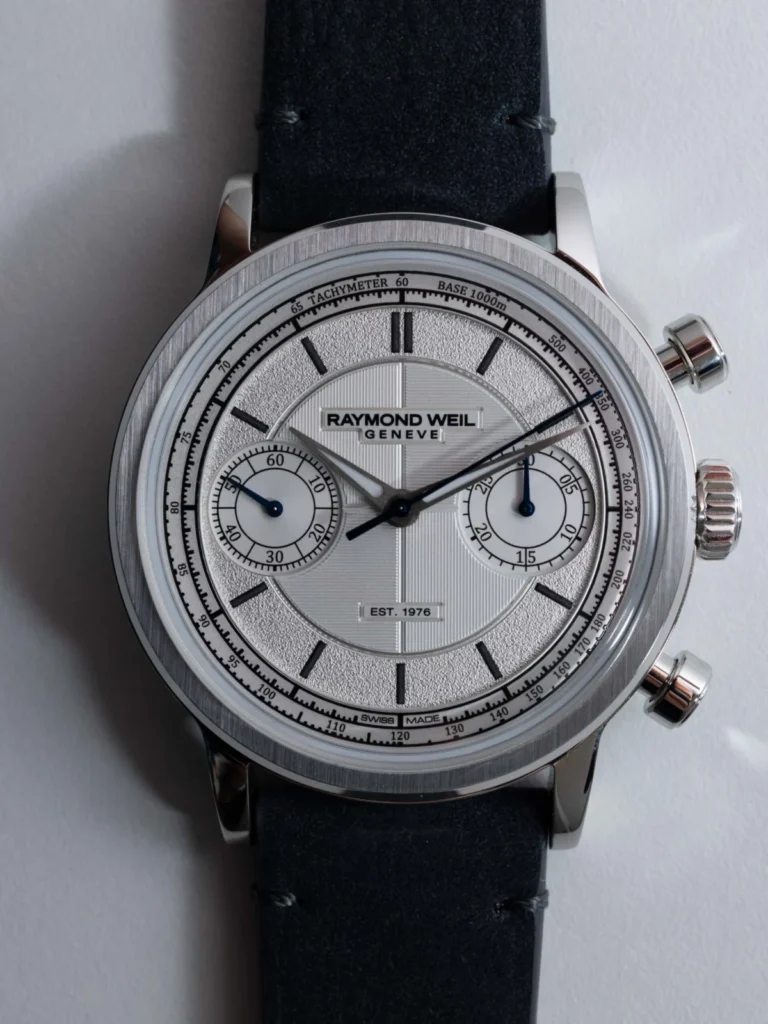
The Raymond Weil Millesime The Fifty (Reference 1976-SGC-65001) is a horological bridge between the brand’s origins and its future. Retailing at $9,990 USD, the watch immediately sold out upon release, confirming the market’s appetite for "accessible luxury" that carries genuine mechanical gravitas.
At its heart lies the caliber RW1976, a name that honors the brand’s founding year. Rather than utilizing a standard off-the-shelf automatic movement, Raymond Weil opted for a labor-intensive, enthusiast-driven approach: the sourcing, restoration, and rigorous decoration of vintage Valjoux 23-6 manually wound chronograph movements originally manufactured in 1976. This decision provided the watch with a "soul" that modern industrial production rarely replicates.

Key Technical Specifications:
- Case Dimensions: 37mm in diameter, 10.75mm in thickness.
- Movement: Caliber RW1976 (Restored Valjoux 23-6 base).
- Frequency: 3Hz (21,600 vph).
- Power Reserve: Approximately 48 hours.
- Water Resistance: 50 meters.
- Materials: Stainless steel case with an 18k white gold bezel.
- Functions: Bi-compax chronograph with 30-minute counter and subsidiary seconds.
A Chronology of the Millesime Success
The trajectory of the Millesime collection has been nothing short of a phenomenon. When Raymond Weil first introduced the Millesime line, it was lauded for its "neo-vintage" charm—a design language that felt familiar yet fresh. It avoided the "bloat" that often plagues legacy brands, focusing instead on clean lines, balanced proportions, and a price-to-value ratio that invited both the novice collector and the seasoned enthusiast to the table.
In April 2026, the watch world caught wind of "The Fifty." The announcement was met with immediate intrigue. By utilizing the 1976-dated Valjoux movements, the brand created a direct, tactile link to its inception. The watch was not merely inspired by 1976; it was, in a very literal sense, born from it.
Following the successful unveiling, the brand facilitated a "hands-on" experience for select critics and collectors, revealing that the watch was more than a vanity project. It was a refined instrument. The subsequent sell-out of the 50-piece allocation within months solidified the Millesime’s position as the brand’s flagship series, setting the stage for a new era of Raymond Weil design.

Supporting Data: Why "The Fifty" Resonates
To understand why a nearly $10,000 Raymond Weil sold out instantly, one must look at the intersection of rarity and craftsmanship. In the current secondary market, collectors are increasingly fatigued by mass-produced "limited editions" that offer little more than a unique dial color.
"The Fifty" succeeded because it offered three distinct value propositions:
1. The Vintage Movement Narrative
The decision to use the Valjoux 23-6 is the primary driver of the watch’s allure. The Valjoux 23-6 is a legendary column-wheel chronograph movement, celebrated for its robust architecture and reliability. By stripping down these 50-year-old movements and re-finishing them to modern standards, Raymond Weil elevated them into the caliber RW1976. This requires not just engineering capability, but a massive investment in time and historical sourcing.
2. Proportional Harmony
At 37mm, the case size is a deliberate nod to the golden era of the 1970s. While modern market trends have favored larger cases (40mm to 44mm), the 37mm diameter of "The Fifty" allows the watch to sit with an elegance that larger chronographs often lack. It is a "purposeful" size—comfortable, balanced, and historically accurate to the era of its movement.

3. Material Refinement
The use of an 18k white gold bezel is a subtle, almost secret detail. To the casual observer, it mimics the appearance of stainless steel, but to the wearer, the heft and the specific luster of gold provide a sensory experience that justifies the premium price point. It demonstrates that Raymond Weil is capable of "stealth wealth" design, catering to collectors who value quality over ostentation.
Official Perspectives and Strategic Implications
While Raymond Weil has remained tight-lipped regarding specific future product roadmaps, the success of "The Fifty" has sent a clear signal to the brand’s executive team. Conversations with company representatives suggest that the "Millesime" moniker will continue to be the primary engine for growth.
The primary takeaway from the brand is that collectors are craving "unboring" vintage-inspired sports watches. The "Est. 1976" branding on the dial is a prime example of this; it is a tasteful, integrated nod to the past that avoids the clunky, oversized anniversary text often found on competitor models.
Looking forward, Raymond Weil is expected to:

- Expand the Millesime Chronograph range: Leveraging the design success of "The Fifty," the brand is expected to introduce broader, non-limited iterations of the Millesime chronograph, likely featuring modern automatic movements to maintain price accessibility while retaining the aesthetic language of the 50th-anniversary model.
- Adjust Case Sizing: While the 37mm size was perfect for this specific limited edition, the brand has acknowledged that many modern buyers prefer a slightly larger footprint. Future iterations will likely hover between 38mm and 39mm, finding a "sweet spot" that accommodates the modern wrist without sacrificing the vintage-inspired silhouette.
- Deepen the "Collector" Tier: The success of this $10,000 experiment proves that the Raymond Weil customer base is willing to spend more for high-end finishing and storytelling. We can expect to see more "Millesime Special Editions" that focus on movement complexity and artisanal dial work.
Conclusion: The Path Ahead
The Raymond Weil Millesime "The Fifty" Chronograph is a watershed moment for the brand. It has effectively shed any lingering perceptions of being an entry-level fashion watchmaker, instead positioning itself as a serious horological house capable of satisfying the most discerning collectors.
By anchoring their 50th anniversary in a piece that is as much about mechanical history as it is about modern aesthetics, Raymond Weil has proven that they understand the pulse of the market. They have successfully navigated the "anniversary trap"—avoiding the common pitfalls of excessive branding and hollow design—in favor of a thoughtful, limited production that honors their past while clearly defining their path forward.
As the brand moves into its next half-century, the lessons learned from "The Fifty" are clear: stay true to the proportions that made the 1970s an iconic era for watches, invest in the emotional connection between the brand’s heritage and its current output, and never underestimate the collector’s desire for a timepiece that feels like it was crafted with a purpose. Raymond Weil has not just celebrated 50 years of business; they have laid the foundation for the next 50.