In the quiet, clinical atmosphere of Chapter NY’s gallery space this past January, visitors were greeted by an environment that felt less like a traditional art exhibition and more like a climate-controlled vault. For his solo show, titled I Want to Love with No Fear, artist Craig Jun Li meticulously altered the gallery’s physical parameters—blocking radiators and recalibrating the HVAC system—to simulate the crisp, biting chill of a rare books room or a museum’s long-term storage facility.
This sensory disruption was the first indication that Li, a practitioner who operates the artist-run space Benny’s Video, is not merely interested in displaying objects, but in interrogating the very systems that define memory, preservation, and historical legitimacy. Through a curation of faded photographs, personal correspondence, and salvaged buttons, Li invites his audience into a meditation on what it means to keep—and what it means to lose—the artifacts of human existence.
The Archival Impulse: A Study in Materiality
For Li, the act of exhibiting is a form of “show-and-tell,” though one stripped of its childlike innocence. His work is deeply rooted in the concept of ephemera: the discarded, the forgotten, and the mundane items that slip through the cracks of institutional history.
“I want to show the effect these materials have had on me,” Li explained during an interview, underscoring the personal stakes of his methodology. However, the exhibition’s title, I Want to Love with No Fear, hints at a more profound, existential project. The “cold” he enforced in the gallery was, in part, an inside joke—a satirical jab at the art world’s fixation on “Archive Fever,” a term popularized by Jacques Derrida to describe the psychoanalytic compulsion to store and categorize human memory.
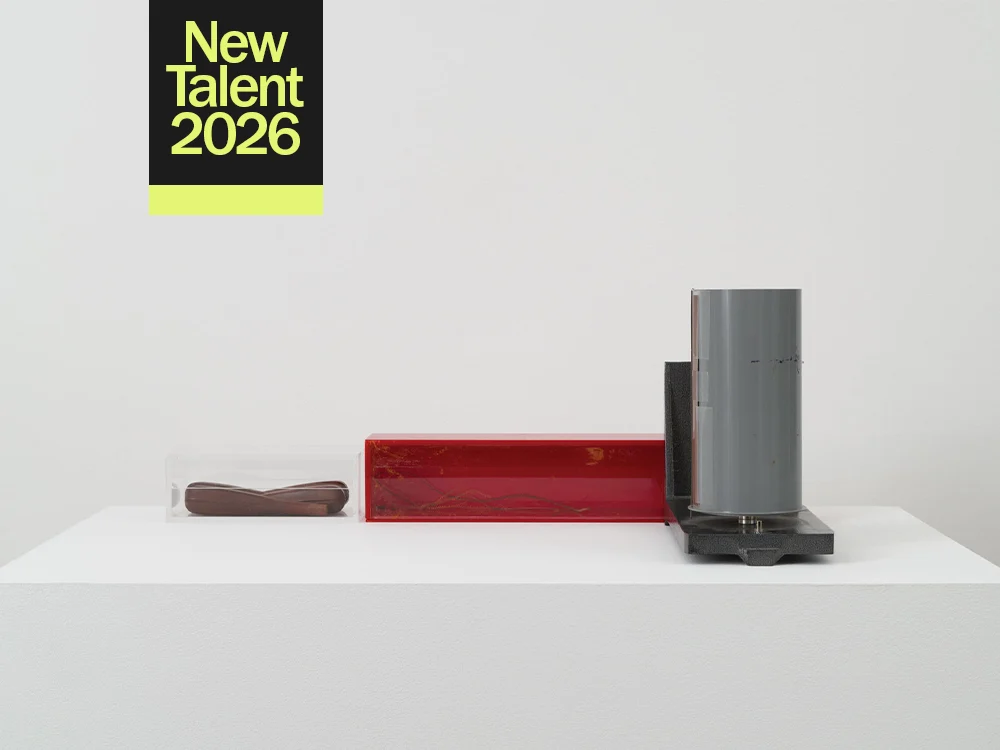
By physically chilling the room, Li forced visitors to confront the sterility of preservation. In one striking installation, buttons salvaged from his own shirts were arranged into miniature, tactile archives perched atop foreboding metallic cooling units. The juxtaposition suggested a paradoxical preparation: these everyday objects were being readied for an eternal, frozen preservation, even as they remained tethered to the intimate, lived reality of the artist’s own history.
Intellectual Lineage and the Politics of Omission
Li’s practice is heavily informed by the scholarly traditions of Achille Mbembe and Miwon Kwon, both of whom have interrogated the power dynamics inherent in the creation of archives. Who holds the power to curate history? Who is systematically excluded?
These questions of omission form the bedrock of Li’s approach. He is particularly drawn to materials found in the periphery of institutional reach: photographs sourced from thrift stores rather than state archives, and letters between artists that capture only one side of a dialogue. By displaying these items in a precise, rhythmic row of rectangular frames, Li creates a viewing experience that is simultaneously austere and deeply intimate. The presentation of rephotographed grayscale papers, installed both behind and in front of the glass, forces the viewer to navigate layers of transparency and obstruction.
This is the central tension of Li’s work: the acknowledgment that the archive is not a static repository of truth, but a fractured record of what survived. By highlighting the “one-sided” nature of his found letters, he underscores the reality that an archive is always a collection of fragments—a testament to the voices that have been silenced or lost to time.
Chronology: From Childhood Tragedy to Conceptual Practice
The trajectory of Craig Jun Li’s career reflects an evolving engagement with grief and testimony. Born in China in 1998, Li’s formative years were marked by a specific local tragedy: he was raised in a region where a significant number of children were infected with HIV due to medical malpractice. This early, visceral encounter with death and systemic negligence served as a crucible for his later work.
As he matured, Li became obsessed with the artistic response to the AIDS crisis of the 1980s and 90s. He found a kinship with the conceptualists of that era—artists who prioritized testimony in the face of widespread erasure. He began to see the archive not as a neutral tool, but as a site of mourning.
“Archival materials are structured around absence, while reminding us of their presence,” Li notes. This realization led him to incorporate “blank space” as a formal element in his installations. His wall-mounted works are defined as much by their negative space as by their images, mirroring the way in which grief occupies the center of a life, even when the person or moment of origin is gone.
Li’s ascent through the art world has been marked by exhibitions at prestigious institutions, including the KW Institute for Contemporary Art in Berlin, François Ghebaly in New York, and Kurtkubin in Mexico City. Across these disparate geographies, his work has consistently challenged the permanence of the image, opting instead to present memory as a fragile, cooling entity.
Supporting Data: The Anatomy of the Exhibition
The I Want to Love with No Fear exhibition was a masterclass in atmospheric design. By manipulating the physical environment, Li effectively transitioned the visitor from the role of a gallery-goer to that of an archivist.
- Climate Control: The lowering of the gallery temperature to mimic museum storage served as a barrier to entry, a physical warning that the objects within were under "protection."
- Tactile Archiving: The use of buttons—intimate, functional items—represented a departure from the "paper-heavy" nature of traditional archives, emphasizing the physical presence of the body.
- Spatial Distribution: The rectangular framing of documents, coupled with the layered glass placement, forced viewers to physically move around the works to piece together the narrative, echoing the labor of archival research.
Official Responses and Critical Reception
Critics have noted that Li’s ability to imbue inanimate objects with emotional weight is rare. In a climate where digital preservation has made "the archive" feel ubiquitous and weightless, Li’s insistence on the cold, hard, and dusty reality of paper and fabric feels radical.
While some institutional voices argue that the archive should be a site of public access and democratic transparency, Li’s work acts as a counter-narrative. He suggests that the most honest archive is one that admits its own incompleteness. By focusing on the "absence" in his materials, he acknowledges that the act of remembering is, by definition, an act of loss.
Implications: The Future of the Archival Turn
Craig Jun Li’s work signals a shift in contemporary conceptualism—a move away from the cool, detached irony of the late 20th century toward a more vulnerable, grief-centered practice.
The implications for the art world are significant. As institutions grapple with the ethics of their own collections—particularly regarding the provenance of artifacts and the inclusion of marginalized narratives—Li’s methodology offers a blueprint. His focus on "omission" encourages a practice that is humble enough to admit what it does not know.
Ultimately, I Want to Love with No Fear is not just an exhibition about old letters and buttons. It is a profound inquiry into how we build our own legacies. In a world of fleeting digital signals, Li reminds us that there is a quiet, necessary power in the physical, the faded, and the preserved. He challenges us to consider our own archives: what we keep, why we keep it, and how we learn to live with the empty spaces that remain when the history is told.
As Li continues to operate at the intersection of personal memory and institutional critique, his work remains a vital touchstone for anyone interested in the intersection of history, trauma, and the enduring human desire to be remembered. Whether through the chill of a gallery or the faded ink of a forgotten letter, he reminds us that even the most fragile records hold the weight of a life.