Executive Summary: The State of Global Maritime Piracy (Q1–Q3 2024)
The global maritime security landscape underwent a notable transformation during the first nine months of 2024. According to the latest data released by the International Maritime Bureau (IMB), the shipping industry is witnessing a paradoxical trend: while the overall frequency of reported piracy and armed robbery incidents has shown a downward trajectory in historically volatile hotspots—specifically the Gulf of Guinea, the waters off Somalia, and the Singapore Straits—the inherent risks to crew safety, vessel integrity, and navigational security remain alarmingly high.
The report, covering the period from January to September 2024, highlights that while diplomatic efforts, enhanced naval patrols, and improved onboard security measures are yielding results, the maritime domain remains a theater of high-stakes opportunism. For stakeholders ranging from multinational shipping conglomerates to the individual seafarer, these statistics serve as both a success story and a cautionary tale.
Chronology and Regional Analysis: Shifting Currents
The Gulf of Guinea: A Historic Low
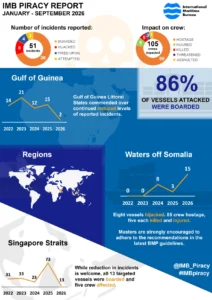
The Gulf of Guinea, once synonymous with the world’s most dangerous waters for seafarers, has recorded a significant milestone. In the first nine months of 2024, only 12 incidents were reported. To place this in perspective, this is the lowest frequency of reports for this region since record-keeping began in 1996.
For nearly three decades, the Gulf of Guinea was plagued by sophisticated piracy syndicates that specialized in kidnapping for ransom and oil theft. The recent decline suggests that the combined efforts of regional coastal states and international naval task forces have succeeded in disrupting the operational capacity of these criminal networks. However, the IMB is quick to temper this optimism. Despite the decline in volume, the severity of the incidents persists. During this period, 11 crew members were kidnapped, and an additional 21 were taken hostage. These figures underscore a grim reality: even if piracy becomes less frequent, the risk of violent confrontation remains a central feature of the maritime trade routes in West Africa.
Somalia and the Gulf of Aden: The Monsoon Effect
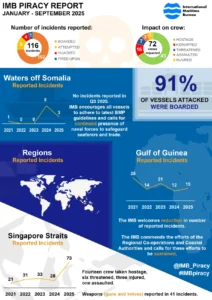
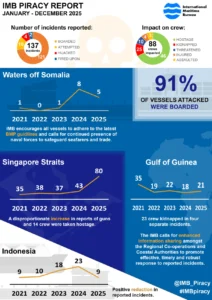
The waters off Somalia and the Gulf of Aden have experienced a resurgence of concern throughout 2024, following years of relative dormancy. Between January and September, authorities logged eight incidents, including three vessel hijackings and two instances where vessels were fired upon.
However, the third quarter (July to September) saw a notable silence. The IMB reports zero incidents during these three months, a development likely attributed to the seasonal prevalence of monsoons. The volatile sea conditions inherent to the monsoon season often inhibit the deployment of small, hijacked dhows or skiffs used by pirates. While the industry welcomes this lull, security analysts warn that this should not be interpreted as a permanent suppression of the threat. The capability of Somali-based piracy syndicates remains intact, and the threat environment is expected to re-emerge as weather conditions stabilize in the coming months.
The Singapore Straits: High Boarding Success Rates
The Singapore Straits—one of the world’s busiest and most critical maritime chokepoints—recorded 23 incidents in the first nine months of 2024. While this represents a decrease from the 33 incidents reported during the same period in 2023, the nature of these attacks remains a critical concern for shipowners.
The data reveals that perpetrators in these waters are highly efficient, successfully boarding vessels in 96% of the recorded cases. Unlike the complex, state-level piracy seen in other parts of the world, these incidents are often classified as "low-level" opportunistic armed robberies. Yet, the high success rate of these boardings suggests that current deterrence measures on many vessels transiting these narrow waters are insufficient to stop intruders who are determined to gain access to the deck.
Supporting Data: Statistical Breakdown
| Region | Incidents (Jan-Sept 2024) | Key Incidents |
|---|---|---|
| Gulf of Guinea | 12 | 11 Kidnapped, 21 Hostage |
| Somalia/Gulf of Aden | 8 | 3 Hijacked, 2 Fired Upon |
| Singapore Straits | 23 | 96% Boarding Success Rate |
The data points to a shift in tactical execution. In the Gulf of Guinea, the focus remains on the extraction of human capital for ransom. In the Singapore Straits, the focus is on rapid, opportunistic theft of ship stores or engine parts. In the waters off Somalia, the threat is existential, involving the potential loss of the entire vessel and its cargo.
Official Responses and Strategic Implications
The IMB’s Stance on Navigational Safety
The International Maritime Bureau has issued a stark warning regarding the "collateral" risks of piracy. Beyond the direct threat to life and cargo, the IMB emphasizes that even low-level incidents in congested waters like the Singapore Straits pose a severe risk to navigation. When pirates board a large vessel, they may force the crew to divert their attention from bridge duties, or in some cases, distract the bridge team during critical navigational maneuvers.
In waters characterized by heavy traffic density and narrow shipping lanes, any disruption to the bridge team’s focus—or the potential for a vessel to become unmanned or partially disabled—could lead to collisions, groundings, or environmental disasters. The IMB posits that these opportunistic crimes are not merely property offenses; they are potential catalysts for catastrophic maritime accidents.
Best Management Practices (BMP) and Proactive Defense
In response to these trends, the IMB continues to advocate for the strict adherence to the latest Best Management Practices (BMP5). These guidelines provide a standardized framework for vessel hardening, including:
- Citadel Construction: Establishing secure, fortified areas within the ship where crew can retreat if the bridge is compromised.
- Watchkeeping Enhancement: Deploying additional lookouts and using thermal imaging or radar to detect small craft approaching at night.
- Physical Deterrents: The use of razor wire, water cannons, and high-intensity lighting to make boarding difficult for small, agile skiffs.
- Reporting Protocols: Immediate notification to regional maritime security centers when suspicious activity is detected.
The IMB stresses that security is not a "set and forget" protocol. As criminal groups evolve their tactics—often using faster boats, night-vision technology, or sophisticated intelligence gathering—the shipping industry must iterate its defensive postures accordingly.
Broader Implications: The Future of Maritime Trade Security
The decline in total incident numbers is undeniably a positive development for global supply chain stability. However, the persistence of violence against crews necessitates a re-evaluation of maritime security policy.
The Human Element
The emotional and psychological toll on seafarers cannot be quantified by incident reports. Being taken hostage or kidnapped causes lasting trauma, impacting crew retention and the mental health of the seafaring workforce. Shipping companies are increasingly under pressure to provide better psychological support for crew members operating in "high-risk areas."
The Regulatory and Diplomatic Landscape
The success in the Gulf of Guinea demonstrates the efficacy of international cooperation. When coastal nations prioritize maritime domain awareness and collaborate with international naval forces, the "operating space" for pirates shrinks. Conversely, the situation in the Singapore Straits highlights a different problem: the difficulty of policing high-traffic, multi-jurisdictional waterways. The lack of a unified patrol authority in these congested lanes often allows perpetrators to evade capture by crossing maritime borders.
Technology and Intelligence
The future of maritime security will likely hinge on the integration of satellite intelligence and AI-driven predictive analytics. By identifying patterns in pirate behavior—such as the monsoon-induced lull in Somalia—shipping companies can optimize their routes and security spending. Furthermore, real-time information sharing between vessels via platforms like the IMB Piracy Reporting Centre (PRC) remains the most effective tool for preventing attacks before they occur.
Conclusion: A Call for Vigilance
As the industry moves into the final quarter of 2024, the IMB’s message is clear: complacency is the enemy of safety. While the downward trend in incidents in the Gulf of Guinea and the Singapore Straits is a testament to the effectiveness of recent security initiatives, the violent reality of the kidnappings and the resurgence of piracy off the coast of Somalia serve as a sobering reminder that the threat is never truly eradicated.
Maritime security is a dynamic, ongoing battle. For vessel operators, the mandate is to remain vigilant, keep the crew informed, and ensure that the Best Management Practices are not just on the books, but fully integrated into the daily operational culture of the ship. The safety of the global supply chain, and more importantly, the lives of those who sustain it, depends on the unwavering commitment to these standards. As global trade continues to expand, the maritime community must remain as resilient as the oceans it traverses, prepared for both the calm of the monsoon and the turbulence of the storm.