Diamonds, symbols of eternal love and enduring value, have captivated humanity for over two millennia. While their dazzling brilliance is universally admired, a less visible, yet equally fascinating, characteristic lies within many of these precious gems: fluorescence. This phenomenon, the emission of light when exposed to ultraviolet (UV) radiation, plays a crucial role in understanding diamond’s true nature, its origin, and its authenticity. For gemmologists and discerning collectors alike, comprehending diamond fluorescence is not merely an academic pursuit but a vital tool in unlocking the secrets held within these extraordinary stones.
Pat Daly FGA DGA, a seasoned expert in gemmology, guides us through the intricate world of diamond fluorescence, demystifying its causes, its impact on appearance, and its critical importance in identifying natural, treated, and synthetic diamonds. This comprehensive exploration delves into the scientific underpinnings of fluorescence, its classification, and the cutting-edge technologies employed to leverage this ethereal glow for authentication.
The Luminescent Heart of a Diamond: Understanding Fluorescence and Its Gemmological Relevance
Diamonds, celebrated for their unparalleled hardness and brilliance, have been cherished for their beauty and symbolic meaning for over 2,000 years. Their fundamental composition, however, remained a mystery until the late 18th century when scientists finally deduced that they are, in essence, pure carbon. The early 20th century marked a significant leap in our understanding of diamond’s intricate structure and chemistry. As the industrial applications of diamond expanded, so too did the scientific imperative to probe its properties, seeking to correlate its physical characteristics with its atomic arrangement and chemical makeup.
At the heart of this scientific endeavor lies the concept of "defects" within the diamond’s crystalline lattice. A theoretically perfect diamond would consist solely of carbon atoms arranged in a flawless three-dimensional structure, with each atom bonded to four neighboring carbon atoms. However, in reality, natural diamonds rarely achieve this ideal. These deviations from perfect structure, known as defects, can manifest as chemical impurities or vacant atomic sites within the crystal.
These defects are not merely structural imperfections; they are the architects of a diamond’s unique personality. They significantly influence its color, transforming a colorless gem into a vibrant canvas of yellows, blues, pinks, and even greens. More crucially for gemmologists, these defects are the key to understanding a diamond’s luminescent responses. This luminescent signature, when examined under specific lighting conditions, becomes an invaluable fingerprint, distinguishing natural diamonds from those that have been artificially treated or synthesized.
The Diamond Spectrum: Classifying Diamonds by Their Impurities
The classification of diamonds into different "types" is primarily based on the presence and distribution of two key impurities: nitrogen and boron. This classification system provides a foundational understanding of why certain diamonds exhibit fluorescence and others do not.
Type I Diamonds: These diamonds are characterized by the presence of significant amounts of nitrogen, typically ranging from hundreds to thousands of parts per million (ppm). The way nitrogen is incorporated into the diamond’s structure dictates its visual and luminescent properties.
-
Nitrogen’s Journey: During the immense pressure and heat of the Earth’s mantle, where diamonds are formed, nitrogen atoms are initially dispersed throughout the carbon lattice. Over millions of years, as these diamonds journey towards the surface, these nitrogen atoms tend to aggregate. They form pairs, and eventually, larger clusters, often surrounding a "vacancy" – a site where a carbon atom is missing.
-
The Impact of Nitrogen Aggregation:
- Single Nitrogen Atoms: When nitrogen atoms exist as isolated entities, they often impart a bright yellow hue to the diamond. However, their contribution to luminescence is generally minimal.
- Nitrogen Pairs: Pairs of nitrogen atoms have a peculiar effect; they tend to "quench" or suppress luminescence. While they don’t significantly impact the diamond’s color, their presence can reduce its fluorescent response.
- Groups of Four Nitrogen Atoms: In contrast, clusters of four nitrogen atoms surrounding a vacancy have no discernible effect on luminescence and do not alter the diamond’s color.
Type II Diamonds: These diamonds contain exceptionally low levels of nitrogen, generally less than 10 ppm. They are further subdivided:
-
Type IIa: These diamonds have very little to no nitrogen. They are typically colorless and rarely exhibit fluorescence under standard gemological examination. However, some naturally colored pink diamonds belonging to this type can display an orange glow under long-wave ultraviolet light. This phenomenon is attributed to a specific defect involving a nitrogen ion associated with a vacancy, a rare occurrence in natural stones but more common in artificially colored or synthetic pink diamonds.
-
Type IIb: A small subset of Type II diamonds contains boron. Boron is responsible for the distinctive blue color of many diamonds and also plays a significant role in their luminescence. While Type IIb diamonds often show little fluorescence in long-wave UV, they can exhibit a range of fluorescence colors – bluish, greenish, and orange to red – when exposed to short-wave ultraviolet light. Phosphorescence, the emission of light after the UV source is removed, is also common in Type IIb diamonds and can persist for a notable duration. The interplay between bluish and greenish fluorescence and red phosphorescence in Type IIb diamonds is so distinctive that it has been proposed as a method for identifying individual stones, particularly those that may have been recut from stolen rough.
The Dance of Light: Fluorescence Colors and Their Origins
The vibrant spectrum of fluorescence observed in diamonds is a direct consequence of the specific types of defects present and their interaction with UV radiation. While blue fluorescence is the most commonly encountered, other colors reveal unique stories about the diamond’s formation and history.
Blue Fluorescence: The Hallmark of Natural Diamonds
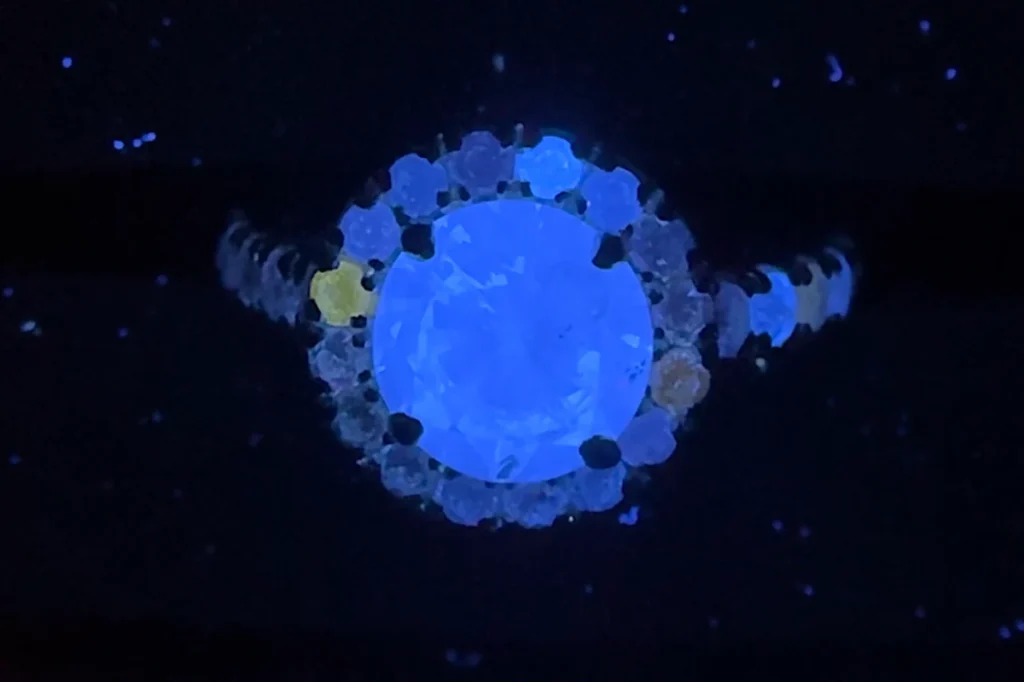
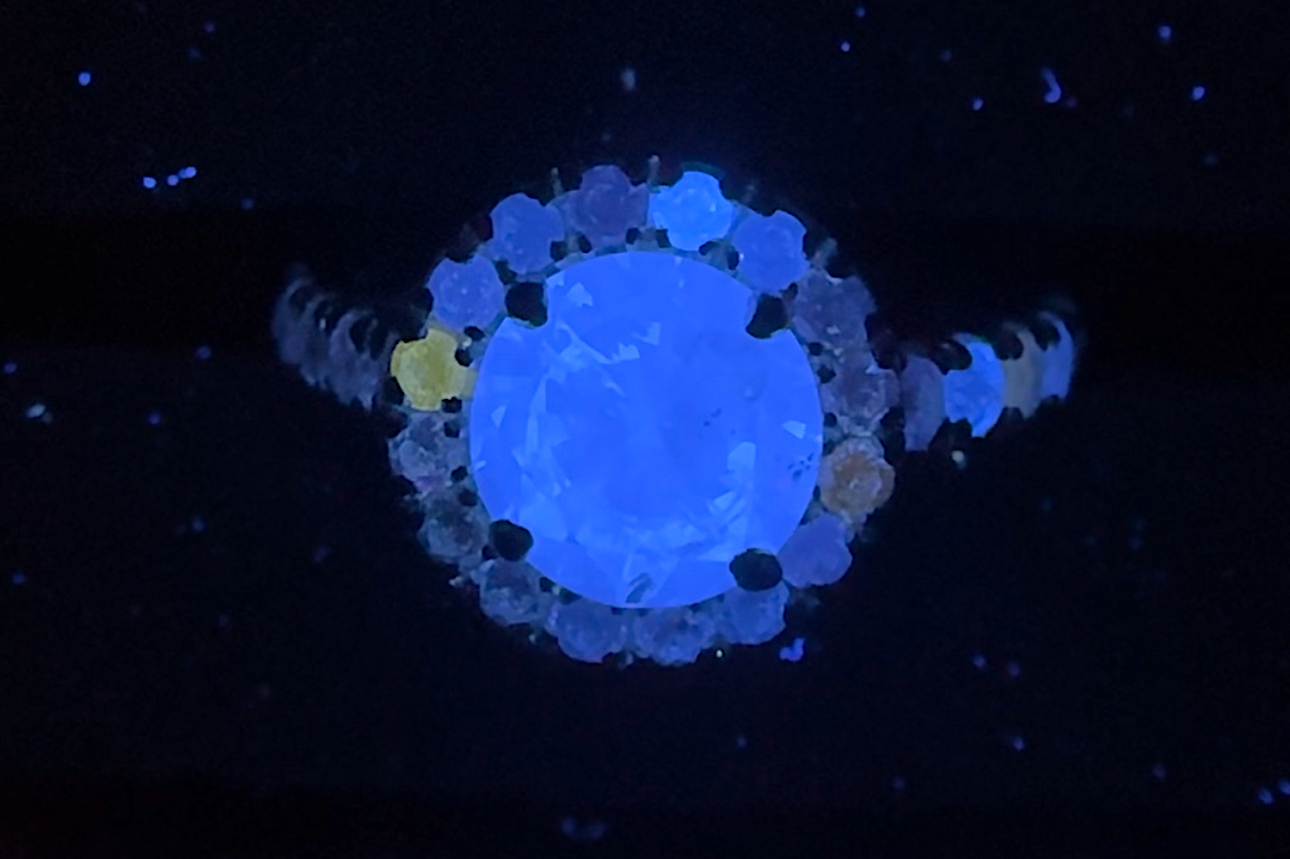
Approximately 98% of natural diamonds contain nitrogen aggregates, most commonly groups of three nitrogen atoms surrounding a vacancy. This specific defect is responsible for a characteristic yellowish color and, crucially, a blue fluorescence under long-wave ultraviolet light. This blue glow is often accompanied by yellow phosphorescence. The intensity of this blue fluorescence is directly related to the abundance of these nitrogen aggregates, balanced against the presence of nitrogen pairs that quench luminescence.
It is estimated that between one-third and all natural diamonds of this type will exhibit fluorescence, with the specific response depending on the UV wavelength used for excitation, the viewing conditions, and the instrument employed. The presence of blue fluorescence, particularly when strong, is considered powerful evidence that a diamond is natural. In some instances, this blue fluorescence can be so pronounced that it is visible even under the UV component of daylight. The strength of fluorescence is often noted on diamond grading reports, though opinions vary on whether it negatively impacts a stone’s appearance; some find it enhances beauty, while others perceive it as detracting from the diamond’s inherent sparkle.
Beyond Blue: A Spectrum of Luminescent Hues
While blue is the most prevalent, other nitrogen-vacancy interactions can lead to a fascinating array of fluorescent colors:
- Green Fluorescence: Two nitrogen ions combined with a vacancy, or four ions with two, can result in a striking green fluorescence.
- Orange Fluorescence: A single nitrogen ion linked with a vacancy can produce an orange fluorescence.
Yellow Fluorescence: A Glimpse of Platelets
Yellow fluorescence is believed to originate from "platelets." These are planar defects within the diamond’s structure, primarily composed of carbon atoms with a small admixture of nitrogen.
Pink Diamonds: Dislocations and Nitrogen’s Embrace
The captivating color of pink diamonds is often attributed to "dislocations." These are faults or distortions within the diamond’s atomic structure, which can interact with nitrogen atoms. Most natural pink diamonds fall under Type I and typically exhibit blue or yellow fluorescence.
The Luminescent Fingerprint of Synthetics and Treated Diamonds
The increasing sophistication of diamond treatments and the rise of synthetic diamond production have made fluorescence analysis an indispensable tool for gemological identification. The luminescent signatures of these stones often differ significantly from those of natural diamonds, providing clear indicators for trained gemologists.
Treated Pink Diamonds: An Orange Glow
Treated pink diamonds, including those synthesized through high-pressure, high-temperature (HPHT) methods, frequently exhibit an orange fluorescence under ultraviolet light. This is a relatively rare response in natural pink diamonds, making it a strong indicator of treatment or synthesis.
HPHT Treated Stones: Bright Yellows and Greens
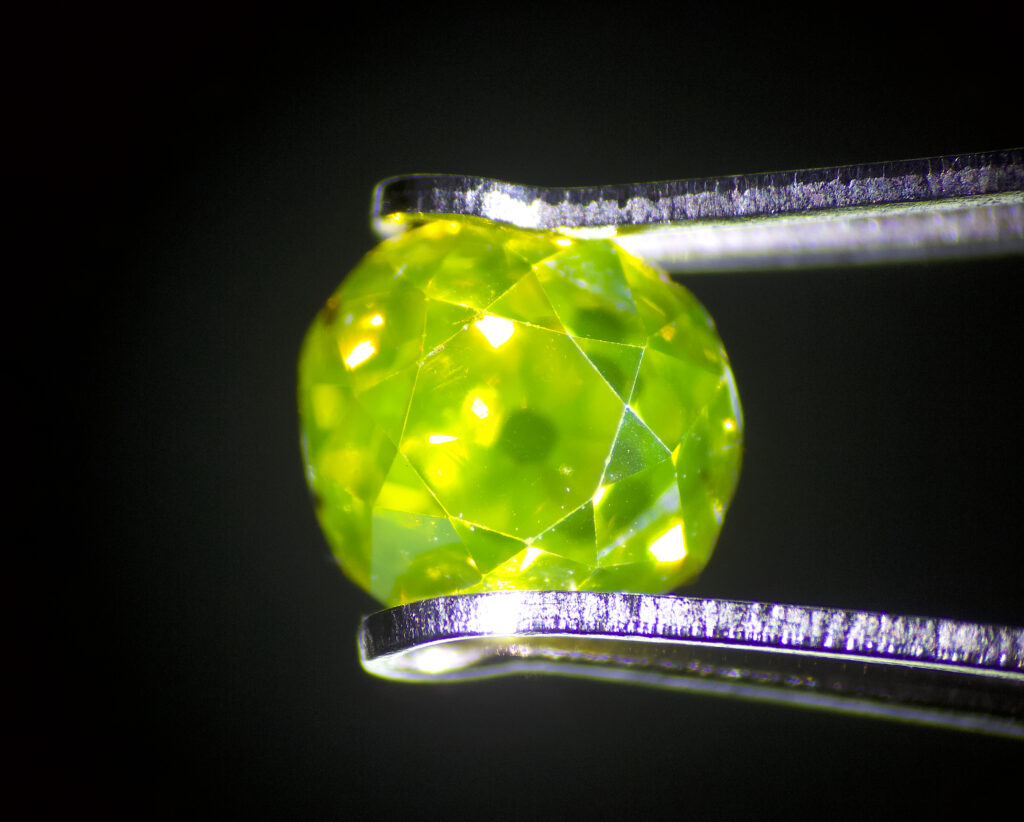
Diamonds subjected to HPHT treatment to enhance their color, particularly those containing nitrogen, often develop vibrant yellow and green body colors and display intense fluorescence in similar hues under UV light.
Synthetic Diamonds: A Varied Luminescent Landscape
The luminescence of synthetic diamonds presents a diverse spectrum:
- Blue Fluorescence: Blue fluorescence under long-wave UV is generally rare in synthetic diamonds.
- Orange to Yellow/Green Glow: Most synthetic diamonds that do fluoresce tend to exhibit an orange to yellow or greenish glow, which is often more pronounced under short-wave UV.
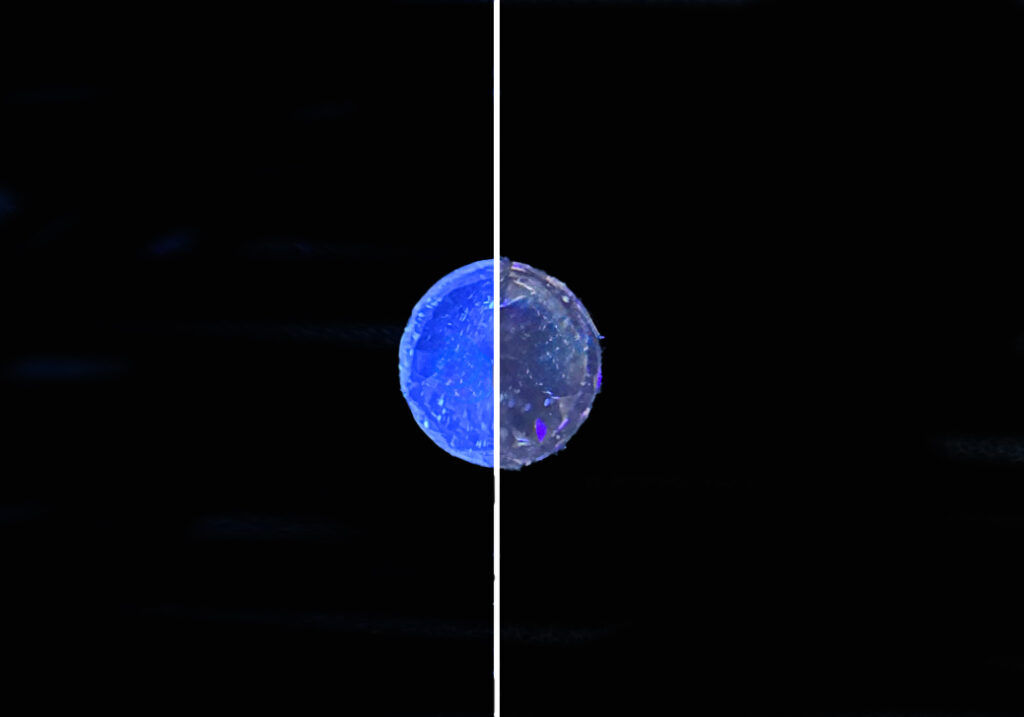
- Long Phosphorescence in Melee Diamonds: Many small melee diamonds produced via HPHT methods contain boron and exhibit a long-lasting phosphorescence, sometimes even stimulated by daylight. This effect can be mitigated by irradiation, but this adds cost and may not always be applied.
The Cutting Edge of Authentication: Advanced Luminescence Detection
The distinct luminescent properties of natural and synthetic diamonds have spurred the development of sophisticated instruments designed to aid the trade in screening and identifying diamonds. These technologies leverage the subtle nuances in fluorescence and phosphorescence to differentiate between the various origins of these precious stones.
-
Diamond View and SYNTHdetect: Pioneered by De Beers, instruments like the Diamond View and SYNTHdetect are at the forefront of this technology. They utilize advanced imaging and spectral analysis to detect the characteristic luminescent signatures of different diamond types.
-
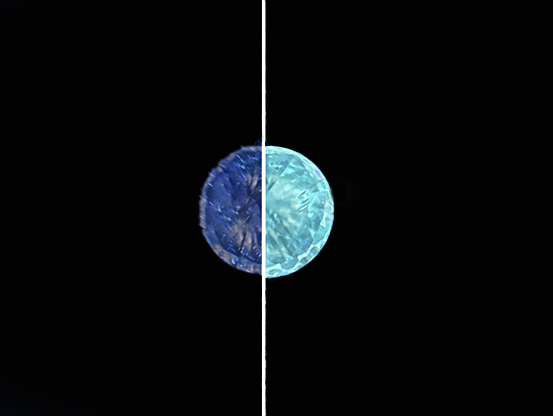
Short-Wave Ultraviolet Analysis: The behavior of diamonds under very short-wave ultraviolet radiation (around 225nm) is particularly revealing. While gemologists typically use lamps emitting around 250nm, the precise short-wave response can differ significantly between natural and synthetic stones. This is because defects accumulate at varying rates on different crystal faces during growth. Natural diamonds almost invariably grow as octahedra, while HPHT synthetics often display prominent cube faces, and CVD-grown synthetics exhibit layers parallel to a pair of cube faces. These growth patterns influence the defect distribution and, consequently, the luminescent response under specific UV wavelengths, allowing for identification even after polishing.
-
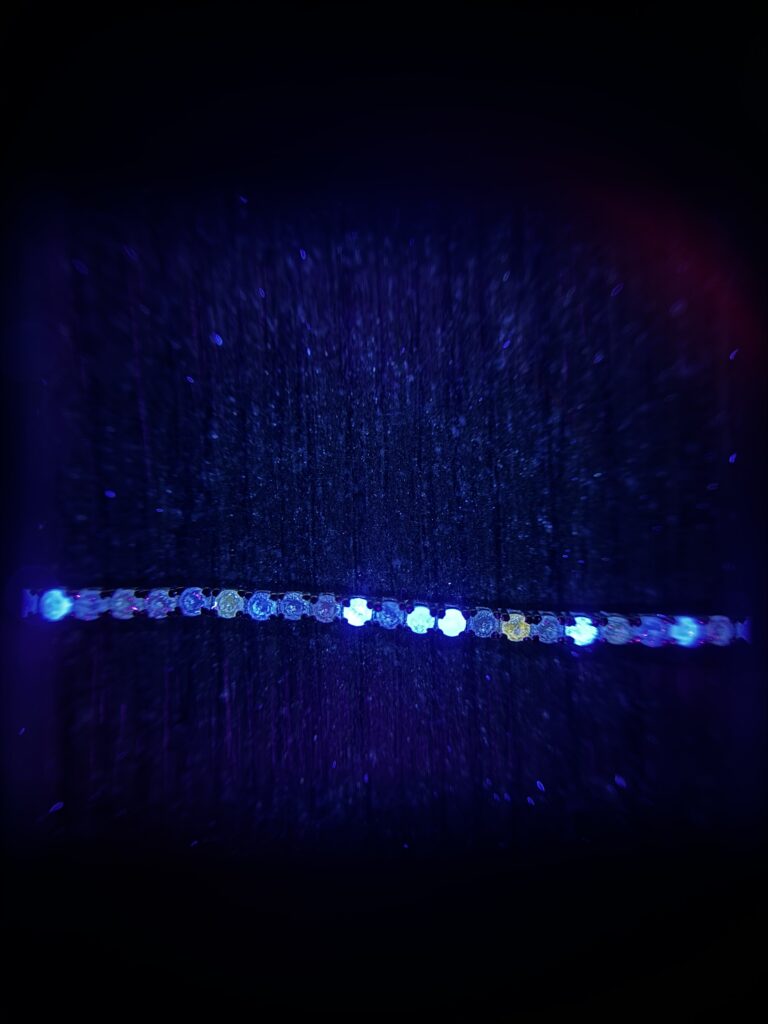
Multi-Stone Testing: Instruments like the SYNTHdetect are designed to test multi-stone jewelry efficiently. By analyzing colors and observing changes in luminescence over short periods, they can effectively separate natural from synthetic diamonds within a piece of jewelry.
Conclusion: The Enduring Allure of Luminescence
Diamond fluorescence, once a curious observation, has evolved into a critical diagnostic tool for gemologists and a fascinating aspect for collectors. It is a testament to the intricate science behind these seemingly simple carbon structures. The ability of diamonds to emit light under UV radiation is not just a beautiful visual effect; it is a complex interplay of atomic defects, chemical impurities, and crystalline structure. This luminescent dance provides invaluable insights into a diamond’s journey from the Earth’s mantle to the jeweler’s bench, helping to authenticate its origin and distinguish it from its man-made counterparts.
As technology advances, our ability to decipher these luminescent clues becomes ever more refined, ensuring greater confidence and transparency in the diamond trade. The study of diamond fluorescence continues to illuminate the path for gemologists, allowing them to uncover the hidden stories and authenticate the enduring allure of these precious stones for generations to come.
For those eager to delve deeper into the captivating world of gemmology and unlock the secrets of these luminous wonders, Gem-A offers introductory online courses like GemIntro and a comprehensive range of accredited educational programs.