By Philippe Legrain
August 27, 2026
As the global geopolitical landscape fractures under the weight of renewed American isolationism, the transatlantic relationship has reached a point of existential inflection. US President Donald Trump’s latest trade offensive against Canada—a nation long considered the United States’ most reliable partner—serves as a clarion call for the European Union. For too long, European leaders have attempted to navigate the volatile currents of "America First" policy by keeping their heads down and hoping for the storm to pass. This strategy of quiet accommodation is no longer merely naive; it is dangerous.
The European Union, much like Canada, occupies the precarious position of a "middle power." Our future prosperity, security, and strategic autonomy depend not on the whims of a capricious hegemon, but on the cultivation of deep, institutionalized solidarity among economic peers. The era of unilateral dependency is over.
I. Main Facts: The New Trade War and the Shift in Alliances
The current crisis was precipitated by a sudden imposition of punitive tariffs by the Trump administration on Canadian steel, aluminum, and telecommunications technology, ostensibly framed under "national security" provisions. This escalation is not a localized skirmish; it is a fundamental shift in how the United States engages with its closest allies.
For the EU, the lesson is stark: the protectionist wall being built around the American economy does not differentiate between rivals and partners. When the White House views international trade as a zero-sum game, every middle power becomes a target. The Canadian government, led by Prime Minister Mark Carney, has moved beyond traditional diplomacy, actively seeking to build a "Coalition of the Reasonable." This grouping aims to stabilize the rules-based international order that has underpinned global prosperity since 1945.
II. Chronology: From Davos to the Arctic Crisis
To understand the current urgency, one must look at the diplomatic timeline of 2026:
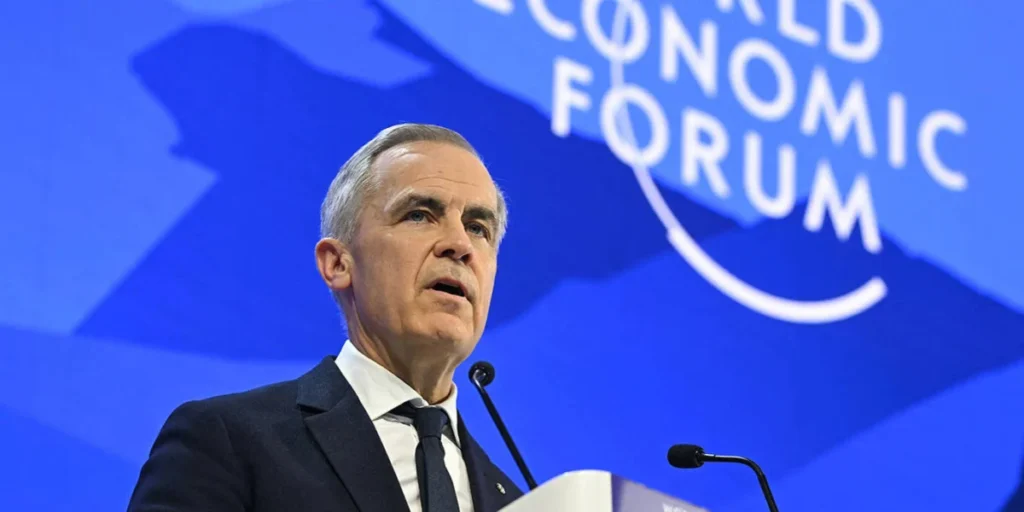
- January 2026: At the World Economic Forum in Davos, Prime Minister Mark Carney delivered a landmark address. He argued that the "era of the singular superpower" had created a vacuum that could only be filled by a concert of middle powers—nations with enough economic weight to resist predatory behavior but not enough to threaten the sovereignty of others.
- March 2026: Tensions flared when the US Department of Commerce announced a "Digital Sovereignty Tax" on Canadian software exports, signaling a pivot toward technology protectionism.
- May 2026: The crisis reached a fever pitch when President Trump made public comments suggesting that the United States had a "strategic interest" in annexing Greenland to control Arctic mineral rights.
- June 2026: Prime Minister Carney, in a move that stunned the Washington establishment, issued a joint statement with European Commission leadership, vowing to defend the territorial integrity of Danish Greenland. This was the first time a Canadian leader had directly challenged the American executive on a security matter of such magnitude.
- August 2026: As of this week, the US has signaled it may escalate its trade sanctions if Canada continues to pursue independent Arctic development agreements with the EU.
III. Supporting Data: The Economic Toll of Isolation
The economic rationale for a unified middle-power response is supported by sobering data. According to the International Monetary Fund’s mid-year report, the "fragmentation premium"—the cost of operating in a world of fractured supply chains—has already shaved 1.8% off the combined GDP of the EU and Canada.
- Trade Dependency: Canada exports nearly 75% of its goods to the United States. However, the EU represents the world’s largest single market. By aligning, Canada and the EU create an economic bloc that represents over 35% of global GDP, providing a credible counterweight to US market access.
- Technological Resilience: In the telecommunications sector, the US ban on Canadian-integrated AI systems has cost the sector an estimated $42 billion in potential valuation. European firms, however, have stepped in to fill the void, with cross-continental investment in R&D rising by 14% since May.
- Energy Security: As the US restricts energy exports to "non-compliant" nations, the EU-Canada energy corridor has become the primary source of stability for European winter heating stocks, proving that strategic cooperation is a matter of physical survival, not just political ideology.
IV. Official Responses: A Tale of Two Strategies
The response from Brussels has been characterized by a divide between the "Atlanticists," who remain committed to the traditional US-led security architecture, and the "Strategic Autonomists," who align with Carney’s vision.
"We cannot base our security on the shifting moods of the Oval Office," stated a senior European trade commissioner in a recent briefing. "Prime Minister Carney’s willingness to stand up for the sovereignty of Arctic territories is a template for how we must act when our own interests are threatened."
Conversely, the White House has characterized these developments as a "betrayal of the North American partnership." In a televised address earlier this month, President Trump claimed that "Canada is being misled by European elites who want to weaken the American economy through unnecessary regulations and bureaucratic entanglements."
The silence from other world powers—most notably China and India—has been telling. By remaining neutral, they have allowed the US and its traditional allies to consume their own diplomatic capital, further weakening the Western bloc.
V. Implications: A New Global Order?
The long-term implications of this rift are profound. If the European Union continues to follow a reactive, fragmented path, it risks being marginalized as a secondary player in a world dominated by American unilateralism and Chinese state capitalism.
1. The Death of the Transatlantic Consensus
The "special relationship" is effectively dead. In its place, we are seeing the birth of a transactional, interest-based alliance system. The EU must decide if it is a partner to the United States or a protectorate.
2. The Arctic as the New Strategic Frontier
The focus on Greenland is not merely about territory; it is about the future of global logistics. As climate change renders the Arctic more accessible, the middle powers must establish a legal framework that prevents a "gold rush" mentality. Canada’s leadership here has provided the EU with the perfect opportunity to assert itself as a neutral, rule-of-law-based arbiter in the North.
3. Economic Diversification
The most immediate takeaway for European businesses is the need for "de-risking." Relying on US-dominated financial rails and supply chains is now a liability. We must accelerate the integration of European and Canadian financial markets to create a robust, independent ecosystem that can withstand future US sanctions.
4. The Moral Imperative
Beyond the balance sheets, there is a moral imperative. Prime Minister Carney’s stand at Davos was not just about trade; it was about the preservation of democratic norms. When a superpower abandons the rule of law to pursue predatory national interests, the responsibility for maintaining the international order falls to those who have the most to lose from its collapse.
Conclusion: The Choice Before Us
Europe is at a crossroads. We can continue to cling to the ghost of the 20th-century transatlantic alliance, hoping that the next US election will restore the status quo, or we can embrace the reality of the 2026 geopolitical climate.
The path forward is clear: it involves a formalized "Middle Power Security and Economic Pact." By deepening our ties with Canada—and potentially expanding this circle to include nations like Japan, Australia, and South Korea—the European Union can ensure that it remains a protagonist in the 21st century rather than a bystander.
Prime Minister Carney has shown us the way. He has proven that when a middle power speaks with courage and conviction, it can alter the trajectory of global events. It is time for Europe to stop looking toward Washington for validation and start looking toward its peers for the future. The survival of the liberal international order depends on it.
As the autumn approaches and the political climate in Washington grows more heated, the question for every European leader remains: when the pressure comes to your door, will you stand with your partners, or will you wait for your turn to be sacrificed? The answer will define our continent for the next generation.