

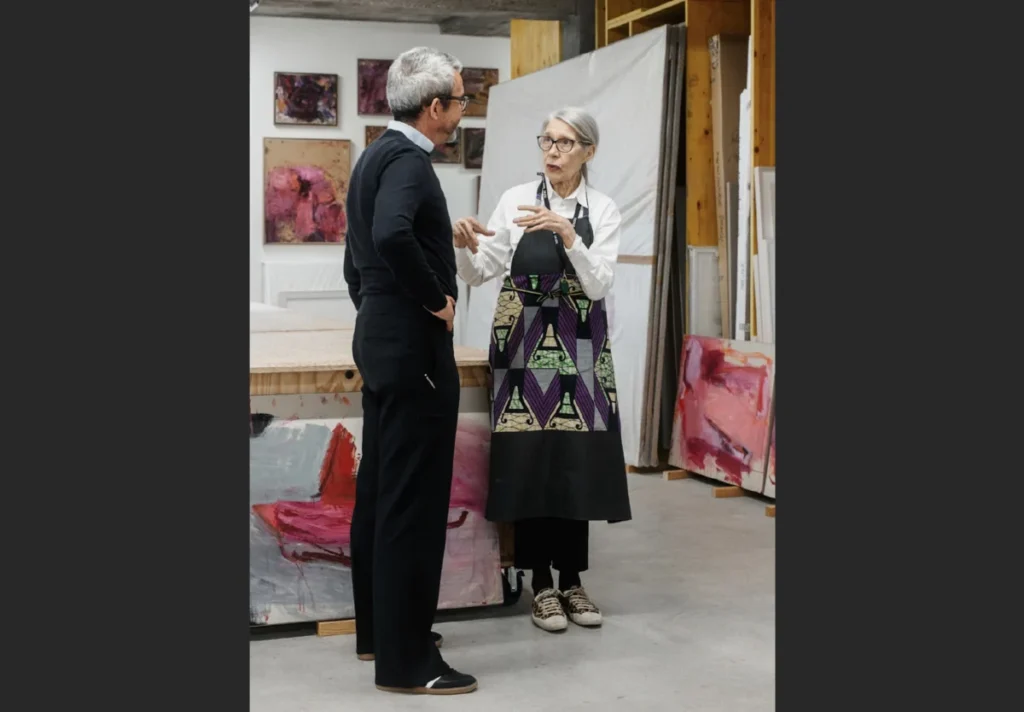
“Painting, for me, is about tension,” the Austrian artist Martha Jungwirth once reflected, articulating a philosophy that has defined her six-decade career. For Jungwirth, the canvas—or more specifically, the paper—is not merely a passive receptacle for pigment. It is a partner in a physical, often combative dance. She describes paper as a “sensual” material, noting that whether it is “smooth or rough, its tactile quality often resembles skin.”
This intimate, somatic relationship between artist and surface has now transcended the gallery walls, finding a new, kinetic life on the runway. In a landmark collaboration for its Spring 2026 collection, the Swiss fashion house AKRIS has transformed Jungwirth’s abstract expressions into wearable art, bridging the gap between the static stroke of a brush and the fluid motion of the human form.
Main Facts: A Convergence of Kinetic Energy
The AKRIS Spring 2026 collection serves as a literal manifestation of Jungwirth’s artistic ethos. Known for her spontaneous smears, explosive color palettes, and gestural streams of paint, Jungwirth has long been celebrated for creating works that feel like bodies in motion. By translating these two-dimensional outbursts into a textile landscape, AKRIS creative director Albert Kriemler has crafted a collection that functions as a "seismographic diary"—a term Jungwirth herself uses to describe her work.
The collection is characterized by its high-energy flourishes. Trailing ribbons, frayed threads, and dangling straps mimic the unruly, energetic drips of Jungwirth’s brush. A standout gown, adorned with metallic fringe, creates a literal forest of movement, trembling and shimmering with every step taken by the wearer. The color palette—a symphony of daring pinks, bruised reds, and ethereal violets—punctuates a foundation of sandy, neutral tones, mirroring the raw, organic aesthetic of Jungwirth’s celebrated series.
Chronology: Six Decades of Artistic Evolution
To understand the weight of this collaboration, one must look at the trajectory of Martha Jungwirth’s career, which spans more than 60 years.
- 1960s–1970s: Jungwirth emerges as a pivotal figure in the Austrian art scene. Unlike many of her contemporaries, she eschews the rigid structures of minimalism, opting instead for a visceral, autobiographical style. Her work begins to focus on the "seismographic" recording of her environment.
- 2016: Jungwirth produces her influential "Istanbul" series. The daubs of pink and violet seen in the AKRIS Spring 2026 collection draw directly from the color memories of this period, where she channeled the heat and chaos of the city into paper-based abstractions.
- 2021: The creation of Bukephalos, a monumental work that captures the raw, animalistic power of movement. This piece later anchors her significant 2024 Guggenheim Bilbao retrospective.
- 2026: The unveiling of the AKRIS Spring 2026 collection. The "Bukephalos" influence is unmistakable on the runway, as the aggressive, sweeping lines of the painting are translated into the silhouettes of the garments.
This chronology illustrates a career built on the refusal to stand still. Jungwirth’s work has consistently evolved, moving from early figurative sketches to the explosive, non-representational abstractions that dominate her current output.
Supporting Data: The Anatomy of the Collection
The technical execution of the AKRIS collection reveals a meticulous devotion to Jungwirth’s original intent. While the inspiration is rooted in abstract expressionism, the construction is grounded in the history of haute couture.
The Materiality of the Brushstroke
Kriemler’s design team utilized custom printing and weaving techniques to replicate the "frayed" quality of Jungwirth’s paint application. By utilizing silk, heavy linen, and metallic thread, they recreate the "skin-like" texture Jungwirth favors. The metallic fringe mentioned earlier is not merely decorative; it is a structural representation of the "trailing" ink marks that often escape the borders of her paper.
Historical Synthesis
Interestingly, the collection is not exclusively a tribute to Jungwirth. In a subtle nod to the house’s own legacy, Kriemler integrated delicate embroidery inspired by a design created by his grandmother in the 1950s—a piece titled Alice. This intersection—where a contemporary avant-garde artist meets mid-century family heritage—suggests that the collection is as much about the preservation of memory as it is about the innovation of form.
Official Responses: The Philosophy of the Act
In a joint statement regarding the collaboration, Albert Kriemler articulated his fascination with the artist’s process: “Seeing Martha’s colors for the first time, I was struck by their sheer audacity. Her paintings never give themselves away at once. You have to keep looking.”
Kriemler characterizes the collection as an investigation into Gefühlsfarben—a German term Jungwirth uses that translates roughly to "feeling-colors." These are colors that are not chosen for their aesthetic harmony, but for their ability to record an internal emotional state.
“This collection looks at getting dressed as an intuitive act,” Kriemler added. “Not only how we want to appear, but what we carry within: instinct, habit, desire, memory, fantasy.”
For Jungwirth, the collaboration serves as a validation of the "tension" she has pursued for decades. If the canvas is a place where the body leaves a trace, then the clothing becomes the ultimate extension of that trace—a way for the wearer to embody the artist’s own internal seismograph.
Implications: The Intersection of Fine Art and Fashion
The AKRIS-Jungwirth collaboration signals a shift in how the fashion industry approaches the "artist collaboration" model. Rather than simply screen-printing an image onto a garment, AKRIS has attempted to internalize the artist’s physical process.
The "Walking Oeuvre"
The implication of this collection is that fashion can function as a medium for archival preservation. By "wearing" the Istanbul series or the energy of Bukephalos, the consumer is not just purchasing a luxury item; they are participating in the continuity of the artist’s work. This elevates the garment from a seasonal trend to a kinetic performance.
The Intuitive Act
Kriemler’s focus on "getting dressed as an intuitive act" suggests a move away from the hyper-curated, performative nature of modern social media fashion. Instead, he proposes a return to the visceral. If fashion is an intuitive act, it mirrors the way Jungwirth approaches a blank page—with instinct, speed, and a lack of fear regarding the outcome.
Future Prospects
This collection likely sets a new benchmark for luxury houses seeking to engage with the fine art world. It suggests that the most successful collaborations are those that identify a shared "language"—in this case, the language of tension, movement, and emotional recording—rather than those that rely on superficial visual mimicry.
As Jungwirth continues to influence the contemporary art landscape, her move into the sartorial space serves as a reminder that artistic expression is not bound by the frame of a gallery. Whether on paper or silk, the "seismographic diary" continues to write itself, mapping the human condition through color, chaos, and the undeniable tension of existence. The AKRIS Spring 2026 collection is more than a wardrobe; it is an invitation to inhabit the brushstrokes of one of the most vital painters of our time, turning the daily ritual of dressing into a profound, tactile encounter with the essence of art.



