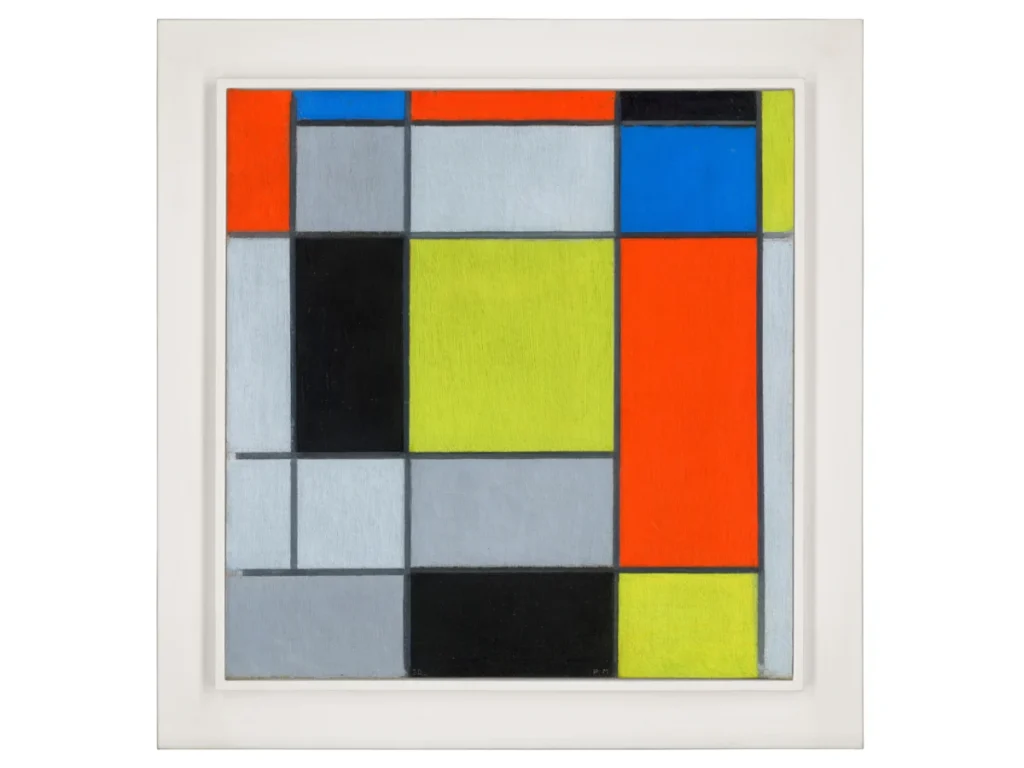
The global art market is bracing for a landmark moment this autumn as Christie’s announces the centerpiece of its upcoming 20th/21st Century Evening Sale in London. On October 14, during the height of the prestigious Frieze Week, Piet Mondrian’s Composition III (1920) will make its auction debut. With a pre-sale estimate of £20 million to £30 million ($27 million to $41 million), the work represents not only a significant financial event but a rare opportunity for collectors to acquire a foundational pillar of modern abstraction.
This appearance marks the first time in history that Composition III has been offered at public auction, having remained in private hands for decades. Its arrival on the block is expected to ignite intense competition among institutional and private buyers, further solidifying Mondrian’s status as a "blue-chip" titan of the 20th century.
Main Facts: A Breakthrough in Neoplasticism
Composition III is more than just a painting; it is a historical document of a radical aesthetic revolution. Executed in 1920, the work dates from the precise moment when Piet Mondrian fully realized his theory of "Neoplasticism." After years of evolving from Dutch landscape painting through Cubism, Mondrian arrived at a language of pure abstraction, defined by a strict grid of black horizontal and vertical lines, punctuated by primary colors and non-colors (white, gray, and black).
The 1920 Turning Point
The year 1920 is widely regarded by art historians as the "breakthrough year" for Mondrian. Having returned to Paris after World War I, the artist began to refine his vision of universal harmony. Composition III showcases the early maturity of this style. Unlike his later, more minimalist works, the 1920 compositions often feature a delicate balance of smaller rectangular fields and a nuanced use of texture that reveals the artist’s hand—a quality that makes these early abstract works particularly coveted by connoisseurs.
Auction Particulars
The sale will be held at Christie’s headquarters in London, strategically timed to coincide with Frieze Week. This period draws the world’s most influential collectors, advisors, and museum directors to the British capital. The estimate of £20 million to £30 million reflects both the rarity of the work and the current high demand for top-tier modernist masterpieces.
Chronology: From the Studio to the Global Stage
To understand the weight of this sale, one must trace the journey of Composition III from its creation in a modest Parisian studio to its status as a multi-million-dollar asset.
1920: The Birth of a New Idiom
Mondrian painted Composition III in Paris, during a period of intense intellectual rigor. He had recently published Le Néo-plasticisme, a manifesto outlining his belief that art should reflect the underlying mathematical and spiritual structure of the universe rather than the chaotic appearance of the natural world.
1952–1973: The Bartos Era
The provenance of the work adds a significant layer of prestige. For over two decades, the painting was a crown jewel in the collection of Armand P. Bartos and his wife, Celeste. Armand Bartos was a renowned American architect, famous for his work on the Shrine of the Book in Jerusalem. As a collector of modernism, Bartos had an expert eye for spatial harmony, making his ownership of a Mondrian—the ultimate "architectural" painter—entirely fitting. During their ownership, the work was part of a collection that helped define the American mid-century appreciation for European modernism.
1973–Present: Private Hands
Following its departure from the Bartos collection in 1973, the painting entered a private collection where it has remained for over half a century. Its re-emergence in 2024 represents a "generational event," as the work has been largely shielded from the public eye and the commercial market for fifty years.
Supporting Data: The Mondrian Market in Context
The valuation of Composition III is supported by a series of high-profile sales over the last fifteen years, showing a consistent upward trajectory for Mondrian’s most significant works.
The YSL Benchmark (2009)
The last time Christie’s handled a significant group of Mondrian works was during the historic "Sale of the Century"—the auction of the Yves Saint Laurent and Pierre Bergé collection in Paris.
- Composition avec bleu, rouge, jaune et noir (1922) sold for $27.9 million, nearly tripling its high estimate of $10 million.
- Composition I (1920), a sibling work to the current offering, fetched $9 million against an estimate of $5 million to $7 million.
These results proved that even in a volatile global economy, Mondrian’s "breakthrough" period (1920–1922) commanded a massive premium.
Record-Breaking Years (2022–2025)
The market reached a new fever pitch in recent years:
- Sotheby’s (2022): Composition No. II (1930) sold for $51 million in New York. This remains the auction record for the artist, demonstrating that the market for his classic "grid" paintings is now firmly in the $50 million+ territory.
- Christie’s (2025): In a more recent landmark sale from the Leonard & Louise Riggio: Collected Works collection, Composition with Large Red Plane, Bluish Gray, Yellow, Black and Blue (1922) sold for $47.6 million.
The £20M–£30M estimate for Composition III is considered by some analysts to be a conservative starting point, given that the 1920 date is increasingly seen as the most historically vital period of his career.
Official Responses: A "Radical Abstract Idiom"
The auction house has expressed profound optimism regarding the sale. Keith Gill, Vice Chairman of 20th/21st Century Art at Christie’s, emphasized the geographical and historical significance of the London location.
“We are delighted to celebrate Mondrian’s extraordinary legacy and present his masterpiece from 1920, Composition III, in London, where another key work from this pivotal year resides, in the collection of the Tate,” Gill stated. He refers to the Tate’s own Composition with Grid 3, which serves as a public counterpart to the work now coming to auction.
Gill further elaborated on the artistic importance of the piece: “Composition III dates from the breakthrough moment in Mondrian’s career, in which he reached a new, radical abstract idiom that profoundly reshaped the language of modern art. Appearing at auction for the first time in its history, it ranks among the most important and rarest of his paintings ever to come to market.”
The sentiment among curators is that Composition III represents the "Holy Grail" of modernism—a work that is instantly recognizable yet incredibly rare in private hands. Most works of this caliber from 1920 are already housed in permanent museum collections, such as the Kunstmuseum Den Haag or MoMA in New York.
Implications: Rarity and the Future of the Art Market
The sale of Composition III carries several broader implications for the art world and the global economy.
1. The "Flight to Quality"
In a cooling global economy, high-net-worth individuals often seek "safe haven" assets. Blue-chip art, particularly works by foundational masters like Mondrian, is seen as a store of value. The fact that this work is "fresh to market" (having never been at auction) significantly increases its desirability. In the art world, "freshness" is a primary driver of price; collectors are willing to pay a premium for a work that has not been "shopped around" or seen in recent trade.
2. The Enduring Influence of De Stijl
The sale highlights the continued relevance of the De Stijl movement. Mondrian’s influence extends far beyond the canvas, impacting 20th-century architecture (the Bauhaus), fashion (Yves Saint Laurent’s 1965 "Mondrian" dress), and contemporary graphic design. As digital art and new media continue to evolve, the "analog" precision and philosophical depth of Mondrian’s grids offer a sense of stability and historical continuity that appeals to modern collectors.
3. London as a Post-Brexit Art Hub
By placing this masterpiece in a London sale during Frieze Week rather than a New York sale, Christie’s is sending a strong signal about London’s resilience as a global art capital. Despite the competition from New York and the rising markets in Hong Kong and Paris, London remains a critical nexus for European and Middle Eastern capital.
4. Institutional Competition
While the price tag may be steep, it is likely that several major museums—particularly those in Asia or the Middle East currently looking to build world-class modernist wings—will be eyeing this work. The presence of Composition III in a collection immediately elevates a museum’s modernist credentials to a global level.
Conclusion
As October 14 approaches, the eyes of the art world will be on Christie’s King Street saleroom. Piet Mondrian’s Composition III is more than a painting; it is a manifestation of the human search for order and beauty in the wake of global upheaval. Whether it sets a new record or finds a home in a prestigious public institution, its sale marks a definitive chapter in the story of 20th-century art. In the silent, vibrating lines of Mondrian’s grid, the market will find a reflection of its own quest for permanence and value.