VANCOUVER, BC – Lion One Metals Limited (TSXV: LIO) (OTCQX: LOMLF) has delivered a landmark development in the evolution of its flagship Tuvatu Alkaline Gold Project in Fiji. The company recently announced a series of exceptional high-grade gold intercepts, including the highest-grade assay result in the mine’s history, marking a significant milestone in its ongoing underground infill and grade control drilling program.
These findings are set to transform the company’s near-term production profile, providing clear evidence of the immense geological potential residing beneath the current mine workings.
1. Main Facts: A Historic Discovery in Fiji
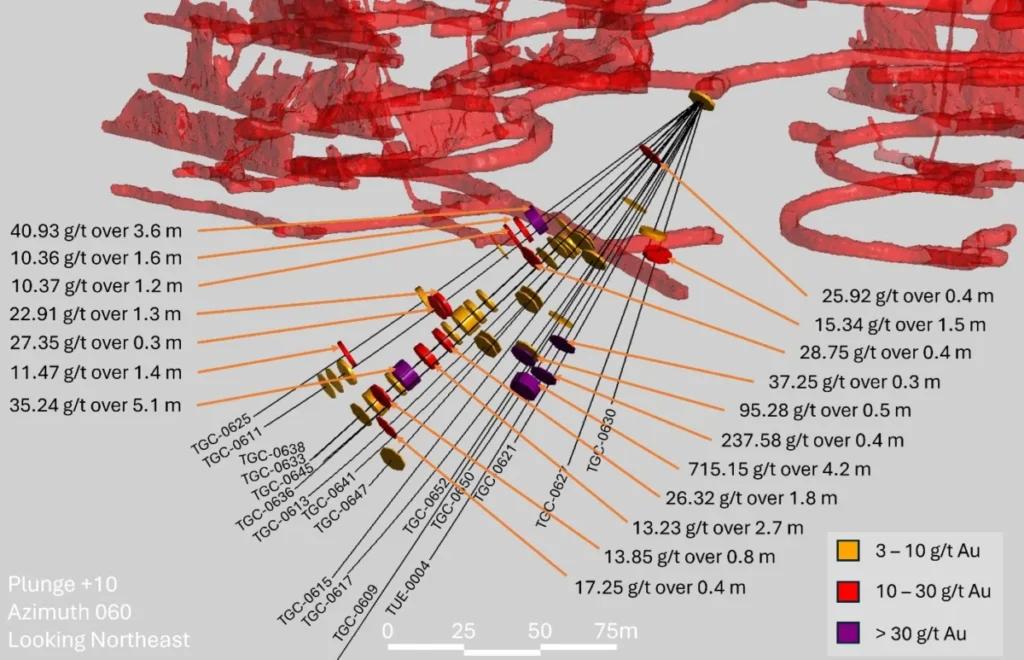
The latest drill campaign, comprising 3,337.30 meters of underground drilling, was specifically focused on the southern and down-dip extensions of the Ura and Murau lode systems within Zone 2 of the Tuvatu deposit. Operating from a single underground drill station on the 1103 level, the company’s exploration team successfully intersected high-grade mineralization in 14 out of 18 drill holes.
The headline result—a staggering 4.2 meters at 715.15 g/t gold—stands as the highest-grade intercept over width ever recorded at Tuvatu. Within this interval, individual assays reached as high as 6,571.20 g/t over 0.45 meters. This discovery is particularly significant because it occurs in an area of limited prior drilling, suggesting that the resource base at Tuvatu is significantly under-defined and ripe for expansion.
The proximity of these results to current underground infrastructure—ranging between 15 and 75 meters—is a tactical victory for the company. Management expects these zones to be fully integrated into the official mine plan within the next 12 months, effectively extending the life and grade profile of the current operations.
2. Chronology: The Evolution of Tuvatu
The Tuvatu project has been a long-term vision for Lion One, transitioning from a conceptual exploration target to a mechanized, active production site.

- 2023: The company initiated commercial production, marking a pivotal shift in its corporate lifecycle. The commencement of operations allowed for more granular, high-density underground drilling, which is now yielding the current results.
- 2025: Initial mining of the Ura and Murau lodes began. During this period, the company demonstrated the viability of the "shrinkage stope" mining method, successfully extracting 5,704 tonnes at 10.6 g/t gold from the Ura lode.
- Late 2025 – Early 2026: The current drill program was launched to test the extensions of these lodes below the 1061 level, which had been previously constrained by lack of data.
- Present Day: The results from the current program have confirmed that the mineralization remains open at depth and along strike, providing a clear pathway for sustained resource growth throughout 2026 and beyond.
3. Supporting Data: The Geology of Alkaline Gold Systems
The geological success at Tuvatu is not accidental; it is a testament to the specific mineralogical characteristics of the Navilawa Caldera. The high-grade intercepts are directly associated with "roscoelite"—a vanadium-bearing mica that acts as a telltale indicator for gold-rich alkaline systems.
The "Flatmake" Phenomenon
The Murau lode system is characterized by shallow-dipping veins known locally as "flatmakes." These structures are remarkably similar to those found in world-class deposits such as the Vatukoula gold mine in Fiji and the legendary Porgera gold mine in Papua New Guinea.
At Porgera, the discovery of Zone VII—which yielded 5.1 million ounces of gold at an average grade of 27 g/t—was predicated on the identification of similar quartz-roscoelite-pyrite veins. The fact that Tuvatu is displaying identical geological markers provides management with a high degree of confidence that they are dealing with a large-scale, high-grade system capable of producing multi-million-ounce results over time.
Quality Control and Assay Rigor
To ensure the integrity of these results, Lion One maintains an industry-leading quality assurance and quality control (QAQC) protocol. The company operates its own IANZ ISO/IEC 17025:2017 accredited geochemical assay laboratory on-site.
All samples are subjected to rigorous fire assay procedures. For samples returning grades above 10.00 g/t, the company utilizes gravimetric finish methods to ensure the highest level of precision. Furthermore, 5% of all samples are sent to independent labs in Australia to confirm results, ensuring the data remains beyond reproach for investors and regulatory bodies.
4. Official Responses: Leadership Perspectives
Ian Berzins, President and CEO of Lion One, emphasized the transformative nature of these results during his recent address to stakeholders.

"We are extremely pleased with the new results from our Zone 2 drilling," said Berzins. "The interval of 715.15 g/t gold over 4.2 meters is the highest grade over width in the history of Tuvatu. It is not just about the numbers; it is about the location. These results are situated in close proximity to our existing underground workings, which minimizes the logistical cost of bringing this ore into our mine plan. The Ura and Murau systems are proving to be a robust, developing target, and these intercepts are a testament to the untapped potential of the entire Tuvatu system."
The company’s focus remains clear: utilize these data points to refine the mine model, optimize extraction sequences, and continue drilling to define the limits of the ore body, which remains wide open at depth.
5. Implications: Why This Matters for the Market
The implications for Lion One Metals are multifaceted, affecting everything from operational efficiency to long-term valuation.
Operational Strategy
By identifying high-grade material within 50 meters of existing development, Lion One can fast-track the development of new levels in Zone 2. This creates a "low-hanging fruit" scenario where the company can increase its production grade without the need for massive capital expenditure on new declines or deep-level infrastructure.
Resource Expansion
The current resource estimate for Tuvatu is likely to be positively impacted by these findings. As these zones were previously "outside the current resource," their successful delineation provides a clear, actionable path toward increasing the total NI 43-101 compliant resource. This, in turn, strengthens the company’s position as a long-life, high-margin producer.
Economic and Investor Sentiment
For investors, the consistency of high-grade intercepts (e.g., 325.75 g/t, 237.58 g/t, and 162.75 g/t) serves to de-risk the project. In the gold mining sector, "grade is king." By repeatedly hitting grades that significantly exceed the industry average, Lion One is distinguishing itself from its peers. The confirmation that the system shares geological DNA with the multi-million-ounce Porgera deposit provides a compelling narrative for long-term growth.

Future Outlook
As the drill program continues, the market will be looking for further evidence that the Ura and Murau systems continue to persist at greater depths. With a dedicated fleet of diamond drill rigs and an on-site lab facilitating rapid turnaround times, Lion One is well-positioned to maintain a steady news flow of exploration success throughout the remainder of the year.
The Tuvatu Alkaline Gold Project is no longer just an emerging prospect; it is an active, evolving mine that continues to surprise even the most optimistic analysts with the depth and richness of its gold mineralization. For a company that has already proven its ability to produce, these latest results provide the necessary fuel to move into a new, more profitable phase of operations.
Disclaimer: This article is for informational purposes only and does not constitute financial advice. Investors are encouraged to consult with professional advisors and review the official technical reports filed by Lion One Metals Limited on SEDAR+ before making any investment decisions.