Introduction: A Strategic Sentinel Reemerges
For centuries, the eastern frontier of the Nile Delta has served as a silent guardian of Egyptian sovereignty, a landscape of shifting sands and strategic waterways that once linked the Mediterranean to the Red Sea. Recent excavations at Tel Abu Saify, located near the eastern bank of the Suez Canal in Qantara East, have provided a dramatic breakthrough in our understanding of this ancient borderland. On August 15, Egypt’s Ministry of Tourism and Antiquities announced that new findings at the site offer compelling evidence linking the sprawling archaeological complex to "Masen," a long-lost city referenced in historical texts but never definitively located.
The site, characterized by its complex stratification of military, religious, and administrative architecture, has long been a subject of intense academic scrutiny. However, the discovery of a monumental sandstone lintel inscribed with the name of King Ramses II has shifted the narrative from one of general historical interest to a specific search for a "missing" urban center. This report details the recent discoveries, the historical context of the site, and the broader implications for Egyptian archaeology.
Chronology of Discovery: From Military Fortress to Lost City
Tel Abu Saify is not a newcomer to the annals of Egyptian archaeology. The site was first identified and excavated decades ago, yielding evidence of a sophisticated military outpost that guarded the "Ways of Horus," the ancient military road connecting Egypt to the Levant.
The Early Excavations
Initial investigations at the site revealed a network of ancient dockyards, mud-brick enclosures, and a temple complex, suggesting that Tel Abu Saify was not merely a fort, but a thriving logistical hub. Scholars have long argued that the location—positioned at a critical intersection of water and land routes—was essential for the pharaohs to control trade and military movements.
Recent Breakthroughs
In the past two years, the pace of discovery at Tel Abu Saify has accelerated. Last year, the mission uncovered a sprawling complex consisting of housing units for soldiers, industrial kilns for ceramic production, and a robust defensive trench system. Perhaps most striking was the discovery of a wide, limestone-paved road that was once lined with trees—a testament to the aesthetic and engineering prowess of the New Kingdom.
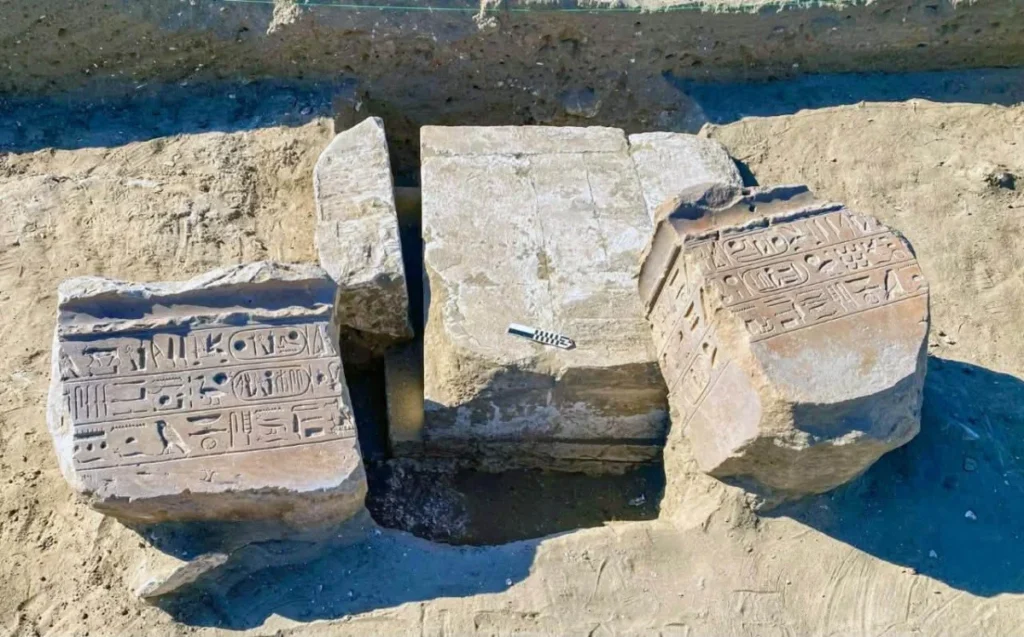
The most recent phase of excavations, led by Hisham Hussein, has moved beyond the military infrastructure to focus on the religious and administrative core of the site. It is here that the team uncovered the broken sandstone lintel, which has provided the crucial linguistic link to the elusive city of Masen.
Supporting Data: Decoding the Lintel
The centerpiece of the recent announcement is a large sandstone lintel, split into two pieces, featuring intricate hieroglyphic inscriptions on three distinct sides. The inscriptions date back to the 13th century BCE, the reign of Ramses II, one of the most prolific builders in Egyptian history.
The "Lord of Masen"
The text inscribed on the lintel is of significant interest to epigraphers. It details restoration work performed on a statue of the falcon-headed god, Horus. Crucially, the inscription refers to this deity as the "Lord of Masen." This reference provides the most tangible evidence to date that the city of Masen—a site previously mentioned in ancient papyri and temple records—is located beneath or immediately adjacent to the Tel Abu Saify complex.
Supporting Architectural Finds
Beyond the lintel, the archaeological team uncovered:
- Paved Roadways: Two additional stone-paved roads, indicating a complex urban grid rather than a temporary encampment.
- Temple Expansions: New rooms attached to the existing temple structure, suggesting that the site underwent multiple phases of religious investment.
- Statuary Fragments: The discovery of basalt and jasper fragments suggests the presence of high-status votive offerings, further reinforcing the theory that the site served as a major regional center, not just a garrison.
Official Responses and Expert Analysis
The significance of the find has been underscored by high-ranking officials within Egypt’s archaeological administration. Mohamed Abdel Badie, head of the Egyptian Antiquities Sector at the Supreme Council of Antiquities, characterized the findings as a watershed moment for the study of the Eastern Delta.
"These discoveries provide further evidence of the site’s changing functions and its strategic importance," Abdel Badie noted. He emphasized that the findings reflect a site that evolved from a military bastion to a center of administration and worship, adapting to the shifting geopolitical climate of the New Kingdom.
However, the scientific community remains cautious. Hisham El-Leithy, secretary-general of the Supreme Council of Antiquities, highlighted the need for rigorous verification. While the mention of "Masen" is highly suggestive, El-Leithy told Ahram that "further excavation and research is needed in order to definitively confirm the connection." The task ahead involves correlating the archaeological layers with the specific chronological references in the inscriptions to ensure that the site was, in fact, known as Masen during the peak of its occupation.
Implications: The Lost City of the Eastern Frontier
The potential confirmation of Tel Abu Saify as the city of Masen has profound implications for our understanding of the Egyptian frontier during the New Kingdom.
Reimagining the Eastern Gateway
For years, the eastern edge of the Suez Canal was viewed primarily as a defensive barrier. If Masen was indeed a bustling urban center, it suggests that the "frontier" was, in reality, a integrated, cosmopolitan, and highly organized zone of interaction between Egypt and its neighbors. The presence of tree-lined roads and elaborate temples indicates a level of urban planning that suggests a permanent, tax-paying, and culturally active population.
The Role of Ramses II
The dedication of the lintel to Ramses II serves as a reminder of the pharaoh’s ambition. Ramses II was known for his extensive building programs, and the evidence at Tel Abu Saify suggests that he prioritized the development of this specific site. This could indicate that Masen was a key staging ground for his military campaigns into Canaan and Syria, or perhaps a religious site of immense symbolic importance that legitimized his rule over the border regions.
Future Research Directions
The path forward for the archaeological mission involves a multi-disciplinary approach. Future work will likely include:
- Geophysical Surveys: Using ground-penetrating radar to map the extent of the buried urban structures without disturbing the delicate remains.
- Epigraphic Analysis: A comprehensive study of the surrounding debris to see if other inscriptions corroborate the mention of Masen.
- Environmental Studies: Analyzing the soil and remains from the tree-lined road to understand the ancient climate and the efforts taken to cultivate green spaces in a desert-border environment.
Conclusion: A Window into the Past
The excavations at Tel Abu Saify offer a rare glimpse into a chapter of history that has long remained obscured by the desert sands. By potentially identifying the lost city of Masen, researchers are doing more than just putting a name to a site; they are reconstructing the life, logistics, and faith of an ancient borderland that defined the prosperity of the Egyptian Empire.
As the team continues to peel back the layers of history, the world awaits the final confirmation. If the connection to Masen is solidified, Tel Abu Saify will likely become one of the most important archaeological sites in Egypt, serving as a beacon for researchers investigating the complex interplay between the Nile’s civilization and the wider ancient world. For now, the broken lintel remains a silent but powerful testament to a pharaoh’s devotion and a city that, for a moment in time, stood as the sentinel of the East.