In an era where more than 80% of global trade is transported by sea, the safety of maritime shipping lanes remains a cornerstone of the world economy. Yet, beneath the calm surface of international waters, a persistent and dangerous threat endures: maritime piracy and armed robbery. Since 1991, the International Maritime Bureau (IMB) Piracy Reporting Centre (PRC) has stood as the maritime industry’s primary bulwark against these criminal elements, serving as a 24-hour nerve center that coordinates intelligence, alerts vessels, and demands accountability from state authorities.
The Sentinel at Sea: Core Functions of the IMB PRC
The IMB Piracy Reporting Centre operates as a unique, independent non-governmental organization that transcends national borders to provide a single, consistent point of contact for ships in distress. When a vessel finds itself in the crosshairs of maritime criminals—whether in the congested chokepoints of Southeast Asia, the volatile Gulf of Guinea, or the unpredictable waters off the Horn of Africa—the PRC is the first line of defense.
The Centre’s mandate is threefold: surveillance, communication, and advocacy. By maintaining a constant watch, the PRC facilitates rapid reactions to distress calls. Upon receiving a report of an incident, the team initiates a sophisticated coordination protocol, alerting nearby naval response agencies, disseminating warning broadcasts via maritime channels, and sending targeted email alerts to vessels transiting through high-risk areas. This proactive stance has saved countless lives and prevented the loss of billions of dollars in cargo.
Beyond immediate incident management, the IMB PRC acts as the global repository for maritime security data. The trends, patterns, and methodologies of pirates are meticulously logged, analyzed, and disseminated, allowing the shipping industry to adapt its security posture in real-time.
A Historical Perspective: Three Decades of Vigilance
The inception of the IMB PRC in 1991 was a direct response to a surge in maritime crime that threatened the integrity of global shipping routes. To understand the current landscape, one must look at the evolution of piracy over the last 34 years.
The 1990s: The Rise of the Reporting Framework
In the early 1990s, the maritime community lacked a centralized mechanism to track incidents. Data was fragmented, and pirates operated with near-total impunity. The establishment of the PRC provided the industry with its first coherent "map" of global piracy, allowing for the identification of hotspots that had previously gone unnoticed.
The 2000s: The Somali Crisis
The turn of the millennium brought a terrifying evolution in piracy: the rise of the Somali pirates. These groups moved from opportunistic petty theft to high-seas hijacking, utilizing motherships and heavy weaponry. During this period, the PRC became a critical hub for the international navies involved in Operation Atalanta and other task forces, proving that the Centre’s data was not just for academic study, but for tactical naval intervention.
The 2010s to Present: Diversification and Technology
As piracy was suppressed in the Indian Ocean, it shifted to the Gulf of Guinea and the Singapore Straits. Modern piracy has become more sophisticated, involving cyber-espionage and rapid-boarding techniques. Today, the IMB PRC utilizes satellite tracking and advanced analytics to monitor these evolving threats, ensuring that shipmasters have the situational awareness needed to navigate the world’s most dangerous waters.
Supporting Data: The 2025 Landscape
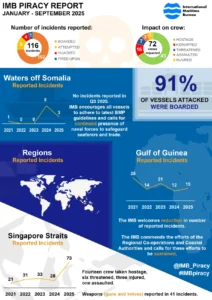
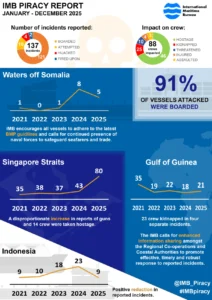
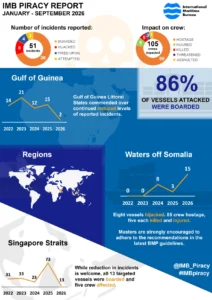
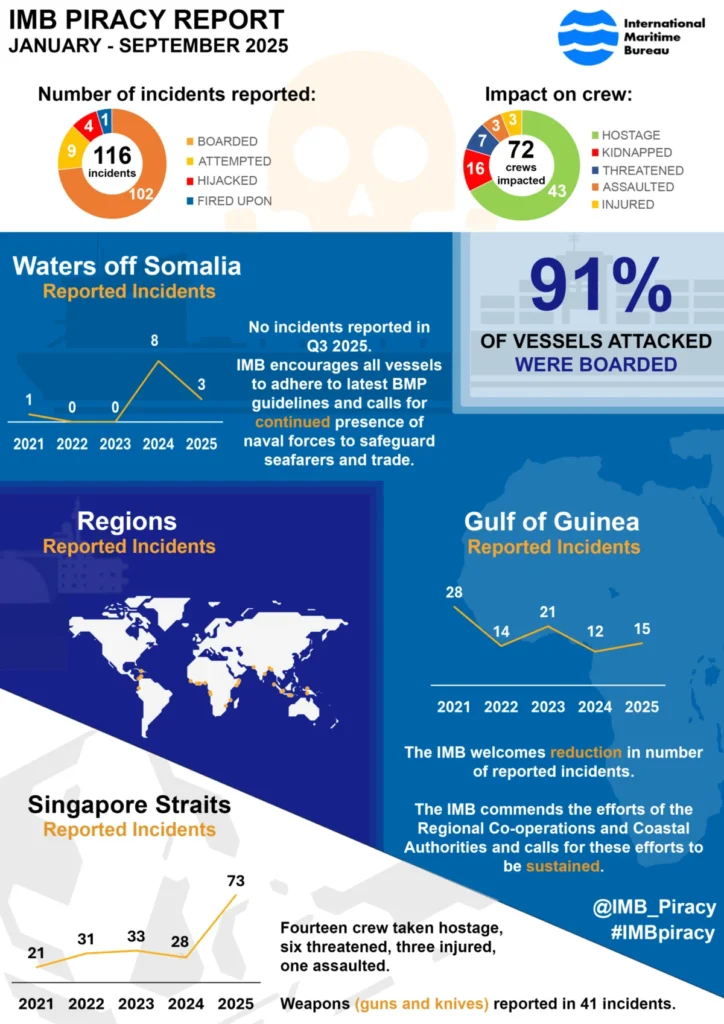
The latest data from the IMB’s January to September 2025 report serves as a somber reminder that the threat remains active. The report, which is essential reading for ship owners, insurers, and maritime security professionals, highlights a critical reality: reporting is not just a formality; it is a fundamental pillar of maritime safety.
The 2025 report identifies key shifts in the modus operandi of maritime criminals. While large-scale hijackings for ransom have decreased in certain regions, there has been a resurgence in "low-level" armed robberies—often involving knives and small-caliber weapons—in the Singapore Straits and the Indonesian archipelago. These incidents, while often dismissed as minor, pose a significant risk to crew safety and can escalate into violent confrontations.
The data reveals that incidents are most likely to occur while vessels are at anchor or underway during hours of darkness. The IMB PRC’s analysis confirms that ships that follow the "Best Management Practices" (BMP)—such as maintaining a sharp radar watch, using citadel procedures, and hardening the vessel’s perimeter—are significantly less likely to suffer a successful boarding.
The Mandate for Transparency: Why Reporting Matters
One of the most pressing challenges facing the IMB PRC is the issue of under-reporting. For various reasons—fear of increased insurance premiums, concerns about commercial delays, or a lack of faith in local law enforcement—some masters or shipping companies choose not to report minor incidents.
The IMB strongly advises against this practice. Reporting an incident to the PRC is the vital first step in ensuring that international authorities allocate resources to the areas where they are most needed. If an area is not "on the map" due to a lack of reported data, naval assets will be deployed elsewhere, leaving those waters vulnerable to further attacks. Reporting is not an admission of failure; it is a contribution to the safety of the entire maritime community.
Official Responses and Strategic Advocacy
Michael Howlett, Director of the ICC International Maritime Bureau, has long been a vocal advocate for more robust international cooperation. In his official communications, Howlett emphasizes that while the PRC can coordinate and alert, it cannot act as a police force. The heavy lifting must be done by coastal states and international maritime task forces.
"The safety of our crews and the security of global supply chains depend on the willingness of nations to take responsibility for their territorial waters," says Howlett. "The IMB PRC provides the intelligence, but the response must be a collective effort from the global community."
The IMB’s advocacy efforts are directed toward:
- Strengthening Regional Governance: Urging coastal states to increase patrols in known hotspots.
- Standardizing Incident Reporting: Ensuring that the transition from a distress call to a naval response is as seamless as possible.
- Crew Welfare: Focusing on the psychological and physical impacts of piracy on seafarers, pushing for better support systems for those who have experienced trauma at sea.
Implications for Global Trade and Future Maritime Security
The implications of maritime piracy go far beyond the individual vessel. When shipping lanes become unsafe, insurance premiums spike, causing the cost of goods to rise globally. Furthermore, when vessels are forced to reroute to avoid dangerous areas, the added fuel consumption contributes to environmental degradation and creates logistical bottlenecks that ripple through global supply chains.
Looking toward the future, the integration of Artificial Intelligence (AI) into the IMB PRC’s operations is the next frontier. By using predictive modeling, the Centre hopes to forecast where pirates are likely to strike before they even set sail. This proactive approach, combined with the continued commitment of shipmasters to report incidents, promises a future where the high seas are once again a safe corridor for the lifeblood of the global economy.
Conclusion: A Shared Responsibility
The IMB Piracy Reporting Centre is more than just an office; it is a testament to what can be achieved when the maritime industry unites against a common threat. The figures provided in the January to September 2025 report are not merely statistics; they represent lives, livelihoods, and the essential flow of global commerce.
As we look toward the remainder of the decade, the message from the IMB is clear: vigilance is the only sustainable strategy. Shipmasters, owners, and operators must continue to utilize the PRC as their primary resource for information and support. By maintaining open lines of communication and demanding accountability from regional authorities, the global maritime community can ensure that the shadows of piracy do not overshadow the promise of international trade.
For further inquiries, detailed analysis, or to report an incident, please contact the IMB Piracy Reporting Centre:
- Director: Michael Howlett
- Organization: ICC International Maritime Bureau
- Telephone: +44 207 423 6960
- Email: [email protected]
- Documentation: Download the Jan-Sept 2025 Piracy and Armed Robbery Report