By Editorial Staff
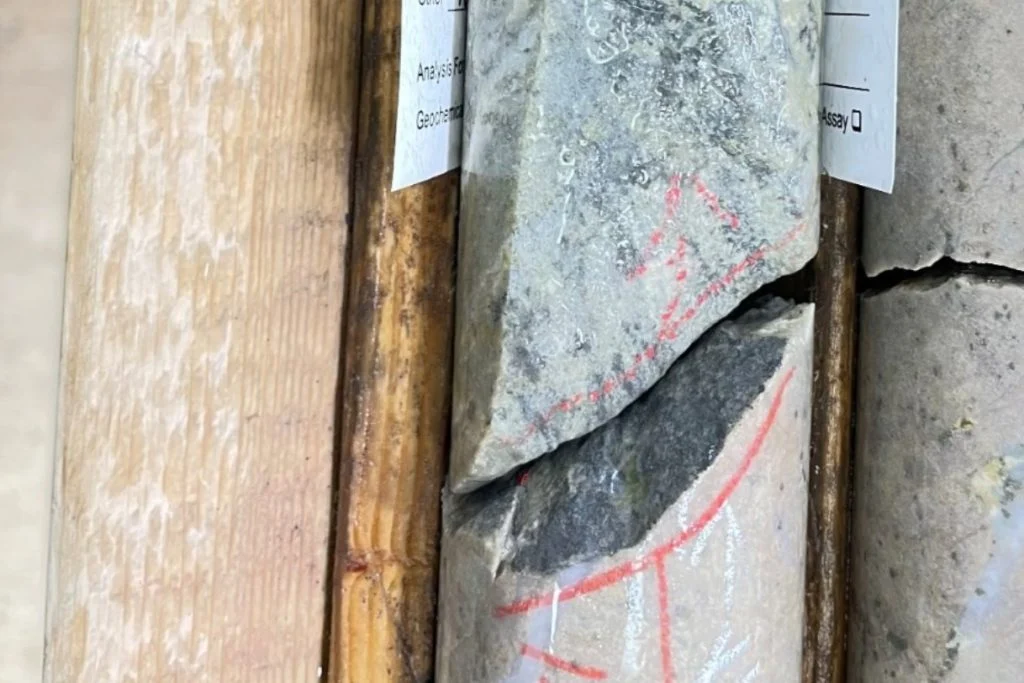
Antimony Resources Corp. [ATMY-CSE, ATMYF-OTCQB, K8J0-FSE] has reached a significant milestone at its flagship Bald Hill Antimony Property in southern New Brunswick. The company recently announced the discovery of visible gold within the Central Zone of the project, a finding that potentially enhances the economic profile of an already high-grade antimony deposit.
The identification occurred in drill hole BHC-26-13 at a depth of 165.85 metres. Initial analysis using portable X-ray fluorescence (pXRF) technology returned a reading of 285 g/t gold, providing empirical support for the geological potential of the area. This discovery marks a pivotal moment for the company as it seeks to delineate the full resource potential of its holdings amid a global supply crunch for critical minerals.
The Significance of the Bald Hill Discovery
The Bald Hill project has long been recognized as a premier, high-grade antimony deposit. Previous drilling campaigns have successfully outlined a robust mineralized system in the Main Zone, extending over 600 metres in length and reaching depths of at least 350 metres. The mineralization remains open in all directions, suggesting that the current footprint of the deposit may only represent a fraction of the total geological potential.
While Bald Hill is primarily categorized as an antimony asset, the presence of associated gold is a development that market analysts are watching closely. The association between antimony-bearing stibnite mineralization and precious metals is well-documented in geological literature, and the confirmation of visible gold in the core provides tangible evidence of a multi-commodity potential that could significantly improve the project’s internal rate of return (IRR).
Chronology of Development at Bald Hill
The road to the current discovery has been one of systematic exploration and validation.
- Early Development: Bald Hill established its reputation as a high-grade antimony site through historical data and preliminary drilling, which identified it as potentially the highest-grade antimony deposit in North America.
- NI 43-101 Validation: The company commissioned an NI 43-101-compliant Technical Report, which estimated the quantity and grades of the drilled area at approximately 2.7 million tonnes, with grades ranging between 3.0% and 4.0% antimony. While the company maintains that more work is required to confirm these figures definitively, the estimate serves as a foundational baseline for current operations.
- July 2026 Exploration Phase: A press release dated July 27, 2026, detailed the ongoing geological descriptions of the Central Zone. During this period, field crews noted the presence of stibnite—the primary host mineral for antimony—in several drill holes. These holes were prioritized for assaying to better understand the distribution of minerals across the zone.
- The Breakthrough: The discovery of visible gold in hole BHC-26-13 in late 2026 represents the latest, and perhaps most impactful, update in this exploration chronology. The pXRF analysis, while preliminary, has successfully catalyzed interest from investors and stakeholders alike.
Supporting Data and Geological Context
Antimony is a silvery-white metalloid that has historically operated in the shadows of more "glamorous" battery metals like lithium or copper. However, recent geopolitical shifts have propelled it into the spotlight.
The geological context of the Bald Hill deposit is defined by its stibnite mineralization. Stibnite (Sb₂S₃) is the most significant ore of antimony. At Bald Hill, the high-grade nature of this ore is bolstered by the structural integrity of the surrounding rock, which allows for mineable widths and consistent grade distribution.
From a data perspective, the company’s reliance on pXRF technology offers a rapid, if initial, assessment of the core. While laboratory-based fire assays remain the gold standard for final certification, the 285 g/t pXRF reading acts as a strong indicator of localized high-grade zones. The industry expectation is that the company will now proceed with full-scale fire assays for the Central Zone core samples to reconcile these pXRF findings with official laboratory data.
Official Responses and Strategic Outlook
James Atkinson, CEO of Antimony Resources, expressed optimism regarding the recent findings. "This is a very exciting discovery," Atkinson stated. "While we have suspected the presence of gold associated with the antimony-bearing stibnite mineralization at Bald Hill, we have received assays indicating the presence of gold; this was the first instance of observing gold in the drill core."
Atkinson emphasized the broader implications for the company’s exploration strategy. "While we understand that Bald Hill is dominantly an antimony deposit, the association of antimony and gold is well known worldwide. This discovery validates our geological models and encourages us to expand our focus as we continue to drill."
The market reaction to the announcement has been measured but watchful. Antimony Resources shares remained unchanged at 56 cents following the news, with the stock maintaining a 52-week trading range between $0.20 and $1.65. This volatility reflects the speculative nature of junior mining exploration, yet the company’s focus on a critical, high-demand mineral provides a level of thematic support that is absent in other junior exploration plays.
Global Implications: The Strategic Importance of Antimony
The urgency surrounding Antimony Resources’ activities is rooted in global supply chain security. Antimony has been officially designated a "critical mineral" by the U.S. Department of the Interior. This designation is not merely a bureaucratic classification; it is a recognition of the material’s indispensable role in modern national security and industrial infrastructure.
The Chinese Monopoly
The global market for antimony has been dominated by China since the mid-1800s. According to the U.S. Geological Survey (USGS), in 2022, China accounted for approximately 54.5% of total mined antimony production. The Xikuangshan Mine in Hunan Province remains the largest producing mine globally. Russia (18.2%) and Tajikistan (15.5%) round out the top producers.
This heavy concentration of production in a limited number of jurisdictions has created a vulnerability that has recently manifested in supply chain shocks. When China imposed export restrictions on antimony products, it sent a clear signal to Western nations: the reliance on foreign, non-aligned supply chains is no longer a viable long-term strategy for defense and technological manufacturing.
Industrial and Military Applications
Antimony’s utility is diverse and essential:
- Flame Retardants: Antimony trioxide (Sb₂O₃) is the most common form of the element used in industry. When combined with halogens like chlorine or bromine, it serves as an effective flame retardant in plastics, textiles, and electronics.
- Military Technology: It is a key component in armor-piercing ammunition, tracer rounds, and precision optics. The military demand for high-grade antimony is inelastic, making domestic sources like Bald Hill strategically vital for North American defense contractors.
- Energy Storage: The element is widely used in the manufacturing of lead-acid batteries, a sector that continues to evolve alongside the rise of renewable energy storage systems.
- Precision Optics: Its application in infrared sensors is essential for night-vision equipment and surveillance technology, further cementing its status as a critical mineral for defense applications.
Investment Considerations and Due Diligence
As with any junior exploration company, investors should approach Antimony Resources with a clear understanding of the inherent risks. While the Bald Hill property shows immense potential, the company explicitly notes that it has not yet completed enough work to definitively confirm the resource estimates outlined in its technical reports.
Mining is a capital-intensive, high-risk endeavor. The transition from a promising drill intercept to a viable, producing mine involves years of permitting, environmental assessment, engineering studies, and significant financial expenditure. The current 52-week price fluctuation of the company’s shares—ranging from $0.20 to $1.65—highlights the sensitivity of the market to exploration results and broader macro-economic sentiment regarding commodity prices.
Potential investors should conduct thorough due diligence, including:
- Technical Review: Analyzing the upcoming laboratory assay results to verify the pXRF readings reported in the Central Zone.
- Regulatory Environment: Monitoring any updates regarding environmental permits and land-use agreements in New Brunswick, which are essential for the advancement of the Bald Hill project.
- Market Dynamics: Keeping a close eye on the global antimony price, which is heavily influenced by Chinese export policies and the ongoing demand for flame retardants and defense-related materials.
Conclusion
The discovery of visible gold at Bald Hill provides a much-needed catalyst for Antimony Resources Corp. as it navigates the competitive landscape of critical mineral exploration. By potentially adding a precious metal component to its high-grade antimony deposit, the company has broadened its value proposition to investors.
However, the real test lies ahead. As the company continues to drill, the industry will be looking for the conversion of these promising initial sightings into sustained, verifiable mineral resources. Given the global, and particularly North American, thirst for secure, domestic sources of antimony, Antimony Resources is positioned in a highly strategic niche. Whether it can capitalize on this position will depend on its ability to execute its exploration program with technical rigor and transparency in the coming quarters.
Disclaimer: Resource World Magazine Inc. has prepared this editorial for general information purposes only and should not be considered a solicitation to buy or sell securities in the companies discussed herein. The information provided has been derived from sources believed to be reliable but cannot be guaranteed. This editorial does not take into account the readers’ investment criteria, investment expertise, financial condition, or financial goals of individual recipients and other concerns such as jurisdictional and/or legal restrictions that may exist for certain persons. Recipients should rely on their own due diligence and seek their own professional advice before investing.