

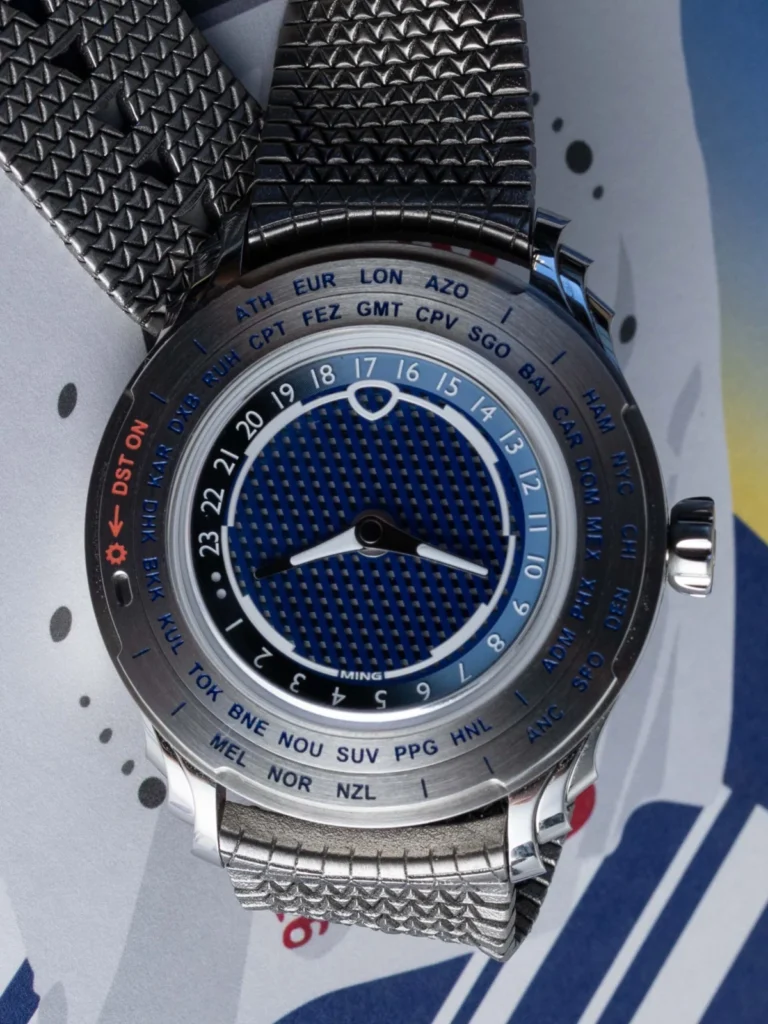
In the landscape of modern independent horology, few brands have managed to cultivate a design language as distinct—or as fiercely debated—as MING. Founded by Ming Thein, the brand has built its reputation on the concept of "evolutionary refinement," taking established watchmaking archetypes and stripping them down to their core functions before rebuilding them with a modern, architectural lens. The latest release, the MING 57.05 Comet, represents the brand’s most ambitious foray into the worldtimer complication, offering a patent-pending solution to one of the industry’s most persistent headaches: the management of Daylight Savings Time (DST).
Main Facts: A Modern Take on Global Timekeeping
The MING 57.05 Comet is, at its heart, a sophisticated reinterpretation of the classic worldtimer. Traditionally, a worldtimer is a specialized GMT-style instrument that replaces the standard 24-hour hand with a peripheral rotating disc. This disc, when synchronized with a fixed ring of global city names, allows the wearer to track time across 24 time zones simultaneously.

However, the worldtimer has long been hampered by two fundamental flaws: the inability to account for the arbitrary nature of Daylight Savings Time and the logistical impossibility of representing "half-hour" or "quarter-hour" time zones (such as those found in India or parts of Australia) on a standard disc.
The 57.05 Comet addresses the former with a clever, patent-pending dual-scale rotating bezel. By featuring two distinct scales—one for cities currently observing DST and one for those that do not—the watch removes the guesswork for the global traveler. The user simply needs to know whether their target destination is currently in a "summer" or "standard" time phase, and the bezel provides the accurate adjustment.

The Chronology: From Concept to Comet
The development of the 57.05 Comet was not a sudden pivot but rather a continuation of the 57-series design evolution. The name "Comet" is a deliberate homage to the de Havilland Comet, the world’s first commercial jet airliner. This naming convention underscores the brand’s fascination with mid-century aviation, high-speed travel, and the "Jet Age" era of luxury.
- Design Phase: The brand sought to retain the iconic Art Deco-inspired stepped lugs and the prominent, sculpted bezel that has become synonymous with the MING aesthetic.
- Engineering Milestone: The integration of the dual-scale bezel required extensive prototyping to ensure the mechanical interface remained intuitive for the wearer while maintaining the clean, minimalist lines the brand demands.
- Final Assembly: By utilizing a modified Swiss-made Sellita SW330 automatic movement, MING ensured that the core timekeeping mechanism was reliable, easily serviced, and capable of a 50-hour power reserve.
Supporting Data: Technical Specifications
The architecture of the 57.05 Comet is a study in precise proportions. The case, rendered in stainless steel, measures 40mm in diameter with a thickness of 10.3mm. Its lug-to-lug distance of 47.8mm provides a balanced wrist presence, ensuring that it remains wearable for a wide variety of wrist sizes while maintaining its architectural, "stepped" visual identity.

Key Specifications:
- Movement: Modified Swiss Made Sellita SW330 automatic movement.
- Frequency: 4Hz (28,800 vibrations per hour).
- Power Reserve: 50 hours.
- Water Resistance: 100 meters (suitable for daily wear and light swimming).
- Crystal: Box-style sapphire crystal on both the front and exhibition case back.
- Lume: Three-color Super-LumiNova application, strategically placed to enhance legibility between the dial and the bezel.
- Strap: Produced by Jean Rousseau in Paris, featuring premium blue goat skin leather and a refined micro-adjustment buckle system.
The watch also features a mesmerizing aesthetic trick: a perforated middle section on the 24-hour disc that sits above the base dial. As the disc rotates, the interaction between the grooves, light, and shifting purple-and-blue hues creates a dynamic, ever-changing visual texture that arguably compensates for the absence of a running seconds hand.
Official Perspectives: The Philosophy of "Less is More"
In discussing the 57.05 Comet, the MING team has been vocal about the difficulty of maintaining a "clean" dial when dealing with the high information density required of a worldtimer. "Many worldtimer watches suffer from visual clutter," notes a company spokesperson. "The dial often becomes a victim of the complications surrounding it. Our goal was to push the technical data to the perimeter, keeping the central focal point sparse and elegant."

This design choice—the removal of the seconds hand and the shifting of markers to the outer ring—is a testament to the brand’s commitment to visual balance. The 57.05 is not merely a tool for reading the time in Tokyo, London, or New York; it is a piece of kinetic art. The inclusion of the "Polymesh" 3D-printed titanium bracelet as an optional upgrade (priced at 1,500 CHF) further highlights the brand’s obsession with material innovation. This "titanium chain mail," as described by collectors, offers a textile-like comfort that contrasts sharply with the rigidity of traditional steel links.
Implications for the Future of Independent Horology
The MING 57.05 Comet is not a limited edition in the traditional sense, though the brand’s "batch production" model ensures that availability will remain constrained. This release has several broader implications for the industry:

- The Renaissance of the Complication: By making the worldtimer "user-friendly," MING is proving that high-end mechanical complications do not have to be cumbersome or outdated. The patent-pending bezel solution may well inspire other independent houses to rethink how they handle DST.
- Aesthetic Democratization: The brand continues to bridge the gap between "niche independent" and "accessible luxury." At a price point of 6,950 CHF, the 57.05 positions itself in a competitive tier where value is defined not by the brand name, but by the level of finish, proprietary engineering, and design uniqueness.
- The "Jet Age" Aesthetic: The success of the 57.05 suggests that collectors are moving away from the "tool watch" craze of the 2010s and toward a more refined, sophisticated aesthetic that favors thinness, light play, and historical nods to mid-century aviation.
Conclusion
The MING 57.05 Comet is a triumph of balance. It manages to integrate a complex, useful, and historically significant complication into a package that feels inherently modern. By choosing to solve the DST problem with a mechanical interface rather than a digital or quartz-based one, MING has reinforced its status as a brand that respects the traditions of watchmaking while refusing to be bound by them.
Whether you are a seasoned collector looking for a new way to track the world or a design enthusiast drawn to the interplay of light and geometry, the 57.05 Comet offers a compelling argument for the future of the worldtimer. As the brand continues to explore new colorways and potential iterations of this platform, it is clear that the MING 57.05 is more than just a watch—it is a signal that the brand is just beginning to reach its cruising altitude.