The intersection of temporal decay and architectural permanence is set to take center stage this month as Philippe Parreno’s seminal work, Iceman in Reality Park (1995–2023), makes its highly anticipated New York debut. Hosted by the Esther Schipper gallery at the Independent 20th Century art fair, the installation marks a significant moment for both the artist and the gallery. Set within the brutalist confines of the iconic Breuer Building—the former home of the Whitney Museum of American Art—the work challenges traditional notions of sculpture, permanence, and the gallery-goer’s experience.
Main Facts: A Sculptural Event in the Heart of Manhattan
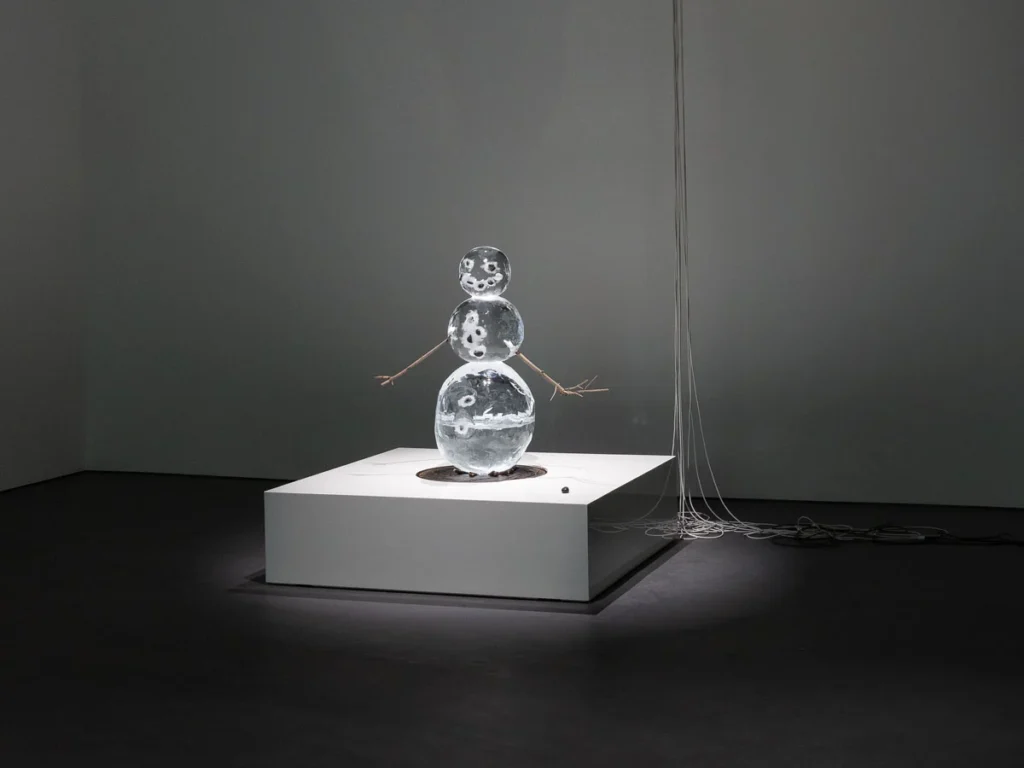
Philippe Parreno, a leading figure in the "Relational Aesthetics" movement, originally conceived Iceman in Reality Park in the mid-1990s. The work consists of a figurative ice sculpture that is destined to melt, leaving behind only the memories of its form and, in some iterations, the physical debris embedded within its frozen core.
For its New York premiere, the piece will be presented by Esther Schipper, a gallery with deep roots in Berlin, Paris, and Seoul, which has recently intensified its presence in the United States. This presentation also marks Esther Schipper’s debut at an Independent fair, signaling a strategic expansion into the New York market.
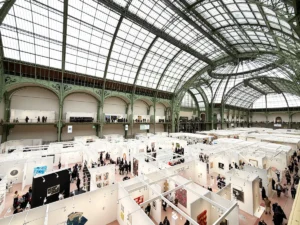
The installation is not merely a static object but a daily performance. Each morning of the fair, a fresh ice sculpture will be delivered and installed on a specially designed plinth. Throughout the day, visitors will witness the gradual dissolution of the figure—a process Parreno describes as a "metronome" of natural time. The work will occupy a prime location on the fourth floor of the Breuer Building, situated within one of the largest booths at the fair, shared in an L-shaped configuration with the Marian Goodman Gallery.
Chronology: The Evolution of a Disappearing Act
To understand the significance of Iceman in Reality Park in 2024, one must look back at its nearly thirty-year history. The work has evolved through several iterations, each reflecting the specific environment and cultural moment of its display.
1995: The Tokyo Debut
The work was first realized for a group exhibition titled "Ripple Across the Water," curated by the late Belgian visionary Jan Hoet. Staged in the Aoyama neighborhood of Tokyo, the exhibition utilized outdoor public and private spaces. Parreno’s sculpture was installed in a private park owned by the Kirin Brewery Company. In this original context, the sculpture was replaced daily just before the brewery workers took their lunch breaks, serving as a temporal marker for the local community. The summer heat of Tokyo ensured a rapid and dramatic transformation, emphasizing the work’s relationship with the environment.
2020: The Berlin "Manifestation"
Twenty-five years after its debut, Parreno revisited the concept for his solo exhibition, "Manifestation," at Esther Schipper’s Berlin space. This version introduced a more structured mode of display: a plinth designed to collect the melting runoff. Unlike the Tokyo version, which was replaced daily, the Berlin iteration was replaced every few days. This allowed the work to reach a state of near-total disappearance, where only the "internal" elements—stones and branches—remained on the plinth, acting as a skeletal record of the vanished ice.

2024: The Seoul Iteration
Earlier this year, the Leeum Museum of Art in Seoul showcased a new variation. This version saw Parreno experimenting with the composition of the ice itself, mixing it with soil to create a more textured, earthy aesthetic. This version was smaller in scale, standing approximately 3.15 feet tall, and utilized a plinth with a metal grate, further refining the industrial aesthetic of the work’s support system.
2024: The New York Premiere
The upcoming presentation at Independent 20th Century returns to a daily replacement cycle. It will feature "white or clear" ice, mirroring the scale of the Seoul version but focusing on the stark purity of the melting process within the controlled, light-filled environment of the Breuer Building.
Supporting Data: Logistics, Scale, and Contextual Design
The logistical undertaking of maintaining a melting sculpture in a high-traffic art fair is considerable. Unlike traditional bronze or marble works, Iceman in Reality Park requires a complex supply chain and environmental management.
- Scale and Material: The New York iteration will stand at roughly 38 inches (3.15 feet) including the plinth. The material is high-clarity ice, sculpted into a form reminiscent of a snowman or a simplified human figure.
- Replacement Cycle: A fresh sculpture will be delivered to the Breuer Building every 24 hours for the duration of the fair.
- The Plinth as Art: According to the gallery’s description, the work exists even when the ice is gone. "The empty plinth is also a manifestation of the work," the gallery notes, emphasizing that the absence of the object is as conceptually vital as its presence.
- The Breuer Setting: The fourth floor of the Breuer Building is noted for its massive, trapezoidal windows. The sculpture will be positioned to catch the natural light, which will both illuminate the ice and accelerate its melting, directly tying the artwork’s lifespan to the movement of the sun.
- The Booth Configuration: Moving away from the standard "white cube" box, Esther Schipper and Marian Goodman Gallery will utilize two 50-foot walls in an L-shape. This open-plan design is intended to facilitate movement and allow the Iceman to serve as a central "anchor" for the surrounding conceptual works.
Official Responses: Curatorial and Gallery Perspectives
The decision to bring a melting ice sculpture to an indoor art fair was met with both excitement and logistical inquiry.
Elizabeth Dee, Founder of Independent:
Dee recalled her initial reaction to the proposal: "How are we going to do it? What are the considerations and the context of supporting a work that’s melting?" Despite the technical hurdles, Dee emphasized that the fair "embraced it." She noted that the work’s placement is intentional: "We positioned this project in the center of the fair… which has the biggest Breuer window and is the most dynamic of all the spaces." For Dee, the work offers a rare opportunity for fair-goers to witness "what it means for something to decay over that period of four days."
Leah Turner, Senior Director at Esther Schipper (New York):
Turner highlighted the flexibility and conceptual depth of the series. "The beautiful idea with the ‘Iceman’ series is that it can be reproduced as many or as few times as desired," she told ARTnews. Turner explained that the presentation is a way to showcase the gallery’s historical core—the conceptual artists of the 1990s who redefined the relationship between the viewer and the object. "This core of conceptual artists is what the gallery built itself on… we thought it would be a great way to showcase the gallery in New York."
Philippe Parreno (Artist Statement):
In a 2020 interview with Frieze, Parreno elaborated on the philosophical intent behind the work. "I wanted to create a work that conveys time without involving any technology—like a metronome," he said. He noted that in the current era, there is a renewed relevance in seeing something "melting" in person, perhaps as a commentary on the fleeting nature of digital experiences or the broader environmental anxieties of the 21st century.

Implications: Relational Aesthetics and the Market for the Ephemeral
The presentation of Iceman in Reality Park at Independent 20th Century carries several broader implications for the art world and the New York market.
1. The Institutionalization of the 1990s
By featuring Parreno alongside Liam Gillick, Pierre Huyghe, Dominique Gonzalez-Foerster, and Angela Bulloch, Esther Schipper is providing a retrospective look at the "Relational Aesthetics" movement. This movement, famously defined by curator Nicolas Bourriaud, posited that art is a set of practices which take as their theoretical and practical point of departure the whole of human relations and their social context. Seeing these works in the "20th Century" section of the fair suggests that the experimental, often difficult-to-sell conceptualism of the 90s has now entered the historical canon.
2. The Experience Economy in Art Fairs
As art fairs become increasingly crowded and commercial, "event-based" works like the Iceman provide a reason for visitors to return. Because the work looks different at 10:00 AM than it does at 4:00 PM, it encourages a "slow looking" that is often absent in the frantic environment of a fair. This reflects a broader trend where galleries use experiential installations to build brand identity and engage collectors on a deeper level than a simple wall-hanging could achieve.
3. The Breuer Building’s Final Act
The use of the Breuer Building is particularly poignant. As the building transitions between tenants (from the Whitney to the Met to the Frick and now to its future as a Sotheby’s-owned space), Parreno’s work—which is about the passage of time and the remnants of history—mirrors the building’s own shifting identity. The "decay" of the ice sculpture within the "permanent" brutalist stone of Marcel Breuer’s architecture creates a powerful dialogue about what lasts and what vanishes.
4. Market Strategy for European Galleries
Esther Schipper’s decision to beef up its US presence via a high-concept booth at Independent signals a sophisticated approach to the American market. Rather than simply showing "market-friendly" paintings, the gallery is leading with its intellectual pedigree. This "outreach," as Turner calls it, establishes the gallery not just as a seller of objects, but as a steward of a specific, influential art-historical narrative.
As the Iceman prepares to melt in the New York sun, it serves as a reminder that even in the high-stakes world of international art commerce, there is still room for the poetic, the temporary, and the beautifully disappearing.