By Gabriela Ramos
August 18, 2026
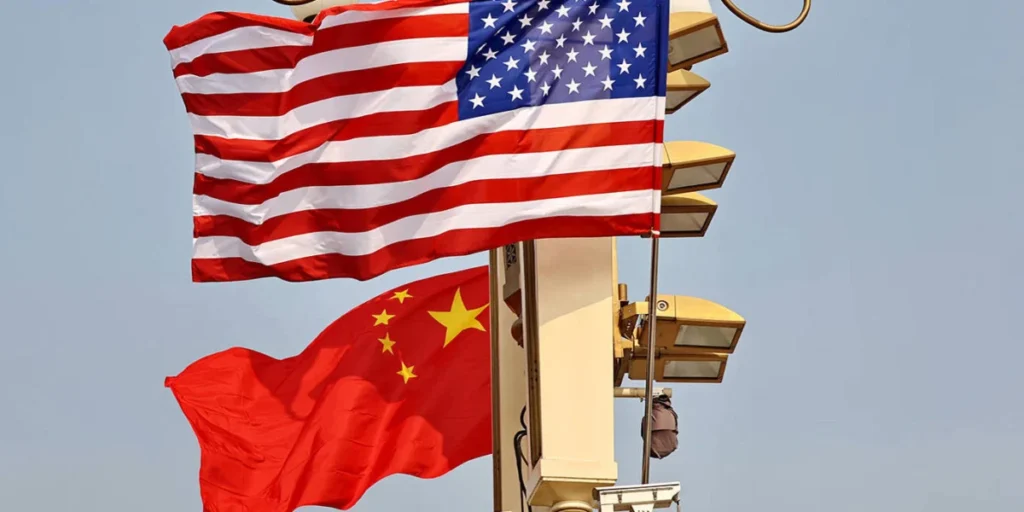
The global race for artificial intelligence supremacy has transitioned from a purely technological contest into a defining geopolitical struggle. As the United States pivots toward an "America First" strategy—prioritizing domestic industrial competitiveness over the fragile multilateral frameworks of the past—the international landscape for AI governance is fracturing. This vacuum of global leadership has provided an opening for China to reshape the norms of digital development, yet Beijing’s approach remains tethered to its own strategic ambitions rather than a pursuit of universal safety or neutrality.
The emergence of the World Artificial Intelligence Cooperation Organization (WAICO), announced last month, serves as a stark signal that the era of a unified global AI standard is rapidly receding. As the world splits into competing technological orbits, the question is no longer whether we can maintain a singular governance framework, but whether we can avoid a catastrophic decoupling of the global digital infrastructure.
The Main Facts: The Emergence of WAICO
In July 2026, China officially launched the World Artificial Intelligence Cooperation Organization (WAICO), a multilateral platform comprising 38 member nations. The organization’s stated mission is to bridge the "AI divide"—the gap between technologically advanced nations and the Global South—by facilitating the sharing of infrastructure, fostering local innovation, and accelerating the deployment of AI in developing economies.
While the rhetoric surrounding WAICO emphasizes "cooperation" and "developmental equity," the initiative functions as a strategic counterweight to Western-led AI forums. By offering technical assistance and governance models to countries that feel marginalized by the exclusionary policies of the G7 and the OECD, China is effectively exporting its own vision of AI governance. This vision emphasizes state-led development, data sovereignty, and a flexible approach to human rights oversight, contrasting sharply with the rights-centric, risk-averse frameworks championed by the European Union and the current U.S. administration.
Chronology: From Cooperation to Competition
To understand the current fragmentation, one must trace the rapid deterioration of multilateral consensus over the last thirty months.
- January 2024: The "Bletchley Declaration" marked the high-water mark of international consensus, with 28 countries—including the U.S. and China—pledging to manage the risks of "frontier" AI models.
- November 2024: The U.S. election outcome triggered a decisive shift in Washington’s policy. The new administration abandoned the "responsible AI" multilateralism of the previous term, viewing it as an obstacle to rapid domestic scaling.
- March 2025: Washington intensified export controls on advanced semiconductors, effectively cutting off major Chinese AI labs from the highest-tier processing power.
- January 2026: The collapse of the UN-led AI Advisory Body negotiations signaled a terminal failure in finding common ground on safety standards.
- July 2026: Beijing announces the formation of WAICO, formalizing a new, alternative governance bloc focused on the Global South.
Supporting Data: The Widening AI Gap
The necessity for a global framework has never been higher, yet the data suggests we are moving in the opposite direction.
Current analysis indicates that over 80% of global AI research and development remains concentrated within the United States, China, and the European Union. However, the deployment of AI-driven solutions is highly unequal. According to the latest figures from the World Bank and independent digital observatories, developing nations are facing a "computational famine."
In the last year alone:
- Hardware disparity: The cost of training a state-of-the-art Large Language Model (LLM) has increased by 40% due to supply chain bottlenecks, effectively pricing out smaller nations.
- Governance polarization: 142 countries have yet to adopt any formal national AI policy, leaving them as "governance takers" in a world divided between U.S.-led and China-led technological spheres.
- The WAICO demographic: Of the 38 members of WAICO, 32 represent economies where AI infrastructure is still in its infancy, suggesting that China’s strategy is to secure a dominant market share in the next generation of digital growth markets.
Official Responses and Diplomatic Friction
The launch of WAICO has met with a tepid and skeptical response from the West. A spokesperson for the U.S. Department of Commerce described the initiative as "a transparent attempt to build a closed-loop digital ecosystem that serves the strategic interests of a single state."
Conversely, the Chinese Ministry of Foreign Affairs characterized WAICO as "the only viable path for the Global South to avoid the digital colonialism practiced by Western tech monopolies."
The European Union, currently caught in the middle, has expressed concern regarding the lack of transparency in WAICO’s standard-setting processes. Brussels continues to push for the "Brussels Effect"—the idea that the EU’s strict regulatory standards will become the global default. However, with the U.S. prioritizing market dominance and China providing "no-strings-attached" infrastructure, the EU’s influence is increasingly confined to its own borders.
Implications: A Fragmented Future
The fragmentation of AI governance is not merely a diplomatic annoyance; it carries profound, long-term implications for the stability of the global order.
1. The Death of Universal Standards
As the world bifurcates, the hope for a global "Geneva Convention for AI" is fading. We are likely to see two distinct standards for AI safety, ethics, and data privacy. For multinational corporations, this will necessitate the creation of "regionalized AI models"—different versions of software designed to comply with the legal requirements of either the Washington-led or Beijing-led bloc. This increases costs, limits innovation, and creates massive security vulnerabilities at the interfaces between these two systems.
2. The Weaponization of Infrastructure
By providing infrastructure to developing nations, China is gaining significant "data leverage." As these countries adopt Chinese-led AI systems, their data flows will likely be integrated into Chinese-managed cloud architectures. This creates a dependency that extends beyond technology into the realms of trade, security, and geopolitics, effectively creating a modern-day "Digital Silk Road."
3. Safety and Existential Risk
Perhaps the most dangerous implication is the dilution of safety standards. If the race to achieve AGI (Artificial General Intelligence) is treated as a zero-sum game, the incentive to cut corners on safety protocols will be irresistible. If one bloc believes the other is ignoring safety to reach a breakthrough faster, they will inevitably follow suit. The competition for speed over safety is the single greatest threat to humanity in the 21st century.
4. The Erosion of Multilateral Institutions
The creation of WAICO is a symptom of the declining efficacy of the United Nations. When major powers prefer to create their own "clubs" rather than work through universal institutions, they signal the end of the post-WWII multilateral order. The inability of the UN to mediate the AI race suggests that we are entering a new era of "Great Power Governance," where norms are dictated by whoever holds the most processing power.
Conclusion: Reclaiming the Middle Ground
The emergence of WAICO is a warning. It is the physical manifestation of a world that has lost its collective sense of direction. While the United States and China are currently locked in a battle for technological hegemony, they are both ignoring the reality that AI governance cannot be solved by one or even two nations.
True innovation requires the free flow of ideas, shared safety standards, and a commitment to ensuring that AI serves the collective good of humanity rather than the narrow interests of a single state. The current trajectory—a world divided into competing digital silos—serves only to increase the probability of catastrophic failure.
To bridge this divide, the international community must move past the rhetoric of the new "Cold War" and re-engage in a dialogue that prioritizes human safety over national competitiveness. We need a neutral, independent mechanism for monitoring AI development—one that is immune to the political ambitions of Washington or Beijing. Without it, we are not just building machines; we are building the architecture of our own division. The time to act is before the fracture becomes permanent.