

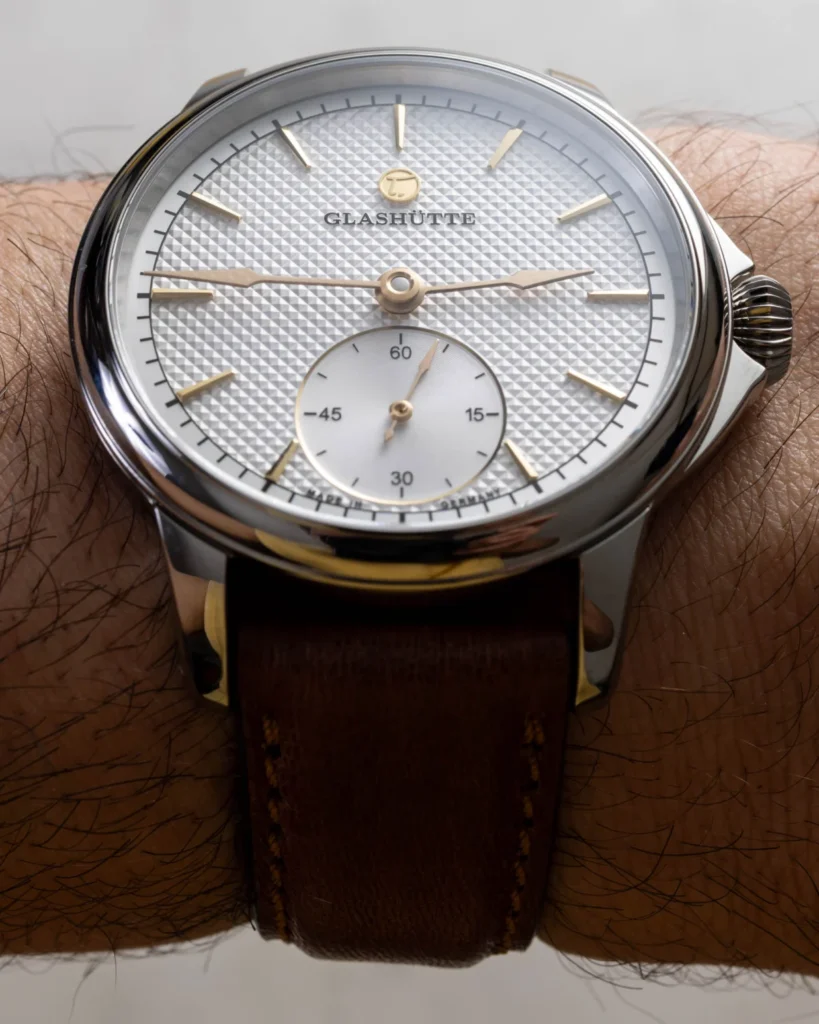
In the hallowed halls of Glashütte, Germany—a town synonymous with the pinnacle of horological artistry—Tutima has long held a distinct position. Known historically for its robust aviation chronographs and utilitarian military instruments, the brand has spent the last decade undergoing a deliberate, high-stakes transformation. The latest fruit of this strategic repositioning is the Tutima Patria 6612, a timepiece that masterfully bridges the gap between traditional German classicism and modern, wearable luxury.
The Patria 6612, specifically the reference 6612-09, is not merely a watch; it is a declaration of intent. By moving away from the heavy, oversized proportions of its predecessors and embracing grade 5 titanium, Tutima has crafted a watch that feels as much at home on a weekend outing as it does in a boardroom.

Main Facts: The Anatomy of the 6612
The Tutima Patria 6612-09 is a study in refined proportions. Housed in a 41mm-wide grade 5 titanium case, it manages to provide a commanding presence without the excessive weight that once plagued the collection’s gold predecessors. With a thickness of approximately 12mm and a lug-to-lug distance of 48mm, the geometry is expertly calculated for ergonomics.
The aesthetic profile is defined by a striking contrast: a silver-white, machine-engraved textured dial serves as the backdrop for 18k yellow gold indices and hands. This pairing provides exceptional legibility, a hallmark of German watchmaking that often gets lost in the pursuit of pure "dress watch" minimalism. The watch is powered by the in-house Caliber 617, a manually wound movement that pays homage to the Glashütte tradition of three-quarter plate construction. Priced at €8,600, the 6612 represents a significant value proposition for those seeking an authentic, high-end, in-house caliber from the Saxony region.

A Chronology of Transformation
To understand the significance of the 6612, one must look at the path Tutima has traversed since the turn of the century.
The Era of Utility (Pre-2011)
For much of its post-reunification history, Tutima was synonymous with tool watches. Collectors knew the brand for its Flieger chronographs and the rugged M2 series. These were instruments of purpose, designed for pilots and military personnel, characterized by affordability and technical reliability.

The "Hommage" Shift (2011–2013)
The turning point arrived in 2011 with the unveiling of the Tutima Hommage Minute Repeater. It was a shock to the industry. By creating a watch with a six-figure price tag, Tutima was not looking to capture the mass market, but to signal a fundamental change in capability. It was a "proof of concept" that the brand could play in the same sandbox as A. Lange & Söhne. In 2013, this ambition materialized into the original Patria collection—a line of 43mm gold dress watches. While technically impressive, they struggled to find a foothold with collectors who found the sizing and price-to-concept ratio difficult to reconcile.
The Wilderness and the Renaissance (2019–2025)
Following a brief experiment with a steel 43mm Patria, the brand entered a period of re-evaluation. The management team recognized that the market demanded wearability and distinct character. The 2025 release of the 6612 family marked the true "coming of age" for the modern Tutima. By reducing the size, switching to titanium, and introducing sophisticated guilloché-style textures to the dials, the brand finally found its "Goldilocks" zone.

Supporting Data: Engineering and Aesthetics
The technical specifications of the Patria 6612 reveal a brand that has listened closely to the grievances of its enthusiast base.
The Case and Dial
The shift to grade 5 titanium is not merely a weight-saving measure; it is a stylistic choice that gives the watch a modern, "sporty-classic" edge. The polished finish on the titanium provides a premium feel that often exceeds the expectations of the material. The dial, featuring a complex machine-engraved pattern, offers a visual depth that standard flat dials lack. The decision to return to the historic "T" logo with the "Glashütte" inscription provides a sense of continuity and brand heritage that was missing in earlier iterations.

The Caliber 617 Movement
At the heart of the 6612 lies the manual-wind Caliber 617. Unlike the skeletonized versions that sacrifice traditional aesthetics for modern showiness, the 617 adheres to the classic German philosophy of the three-quarter plate.
- Power Reserve: 65 hours.
- Frequency: 3Hz (21,600 bph).
- Balance: Breguet-style, traditionally weighted with gold screws.
- Decoration: Real gold chatons and traditional Glashütte ribbing.
While some critics might point to the lack of blued screws as a missed opportunity, the design choice is intentional. By avoiding the "Lange-lite" aesthetic, Tutima has carved out a unique visual language for its movements—gold-toned, robust, and unmistakably engineered for longevity.

Official Perspectives and Market Positioning
Tutima’s current strategy is one of "accessible excellence." The brand has positioned the Patria 6612 as a watch for the daily wearer—a professional who appreciates the provenance of Glashütte but finds the delicate, hyper-fragile nature of some luxury dress watches impractical.
Industry analysts have noted that by offering seven different variations of the 6612, Tutima is attempting to segment the market effectively. The 6612-09, with its mahogany brown sheepskin strap and yellow gold accents, is clearly aimed at the traditionalist, while other models cater to those preferring lacquer dials or monochromatic aesthetics. The brand’s willingness to experiment with material—specifically the marriage of titanium and high-horology finish—positions them in a category that is currently under-served: the "everyday haute-horlogerie" watch.

Implications for the Glashütte Market
The success of the Patria 6612 has broader implications for the German watch industry. It proves that a storied brand can successfully pivot from "tool-only" to "luxury-classic" without losing its soul.
Why This Matters for Collectors
For the collector, the 6612 represents an opportunity to own a piece of German heritage that is not stagnant. It is a watch that reflects the evolution of the brand itself. The shift from the 43mm gold models to the 41mm titanium models is a tacit admission that the brand is finally prioritizing the wearer’s experience over the manufacturer’s desire to show off.

Future Outlook
As Tutima continues to refine the 6612 line, the next logical step—as noted by enthusiasts—would be the integration of a power reserve indicator. A simple, elegant complication that would complement the existing manual-wind architecture. However, even in its current, "simple" state, the watch stands as a testament to what a determined team can achieve when they stop chasing the shadows of their neighbors and start leaning into their own unique identity.
In conclusion, the Tutima Patria 6612-09 is a triumph of design and engineering. It is a watch that invites you to look closer, to appreciate the interplay of titanium and gold, and to acknowledge that in the quiet town of Glashütte, a giant is finding its stride once again. Whether worn with a suit or a casual sweater, it performs its primary function—telling time—with a level of beauty and precision that few others can match at the €8,600 price point. It is not just a watch; it is a signal that Tutima has arrived at its new home.