For millions of years, the Pacific Northwest has been defined by the relentless, grinding dance of tectonic plates. Off the coast of Vancouver Island, the Juan de Fuca and Explorer plates have been steadily forced beneath the North American continent, a process known as subduction. This geological engine is responsible for the dramatic volcanic peaks of the Cascades, the vast mountain ranges of the West, and the ever-present threat of seismic activity.
However, beneath the surface of the Pacific, researchers have captured an unprecedented, high-definition glimpse of a monumental geological transition: the Cascadia subduction zone is beginning to break apart. A study recently published in the journal Science Advances offers the first clear evidence of a major tectonic system in the active process of "dying," challenging long-held assumptions about how the Earth’s crust eventually reaches its end.
The Life and Death of a Subduction Zone
Subduction is one of the fundamental processes that dictates the morphology of our planet. As oceanic plates sink into the Earth’s mantle, they recycle crustal material, power volcanic chains, and drive the movement of continents. These systems are the tectonic equivalent of a runaway freight train—once they gain momentum, they are notoriously difficult to stop.
"Getting a subduction zone started is like trying to push a train uphill—it takes a huge effort," explains Brandon Shuck, a geologist at Louisiana State University and the lead author of the study. "But once it’s moving, it’s like the train is racing downhill, impossible to stop. Ending it requires something dramatic—basically, a train wreck."
Yet, these systems cannot exist forever. If they did, the planet’s geological history would be an endless cycle of ocean closure and continental collision. To maintain the equilibrium of the Earth’s surface, subduction zones must eventually cease, but until now, the mechanisms behind this termination remained largely theoretical. The discovery off the coast of the Pacific Northwest suggests that the "train wreck" is not a singular, cataclysmic event, but rather a slow, protracted dismantling of the plate structure.
Chronology of Discovery: The CASIE21 Experiment
The path to this discovery began in 2021 with the National Science Foundation-funded Cascadia Seismic Imaging Experiment (CASIE21). During this mission, researchers deployed a specialized vessel to conduct deep-sea seismic reflection imaging.
The process is analogous to medical ultrasound technology. By sending powerful sound waves into the ocean floor and measuring the time and frequency with which these echoes returned, the team was able to create a high-resolution map of the subterranean landscape. A 15-kilometer-long streamer equipped with sensitive listening instruments captured the reflected signals, allowing the team to peer through miles of sediment and rock.
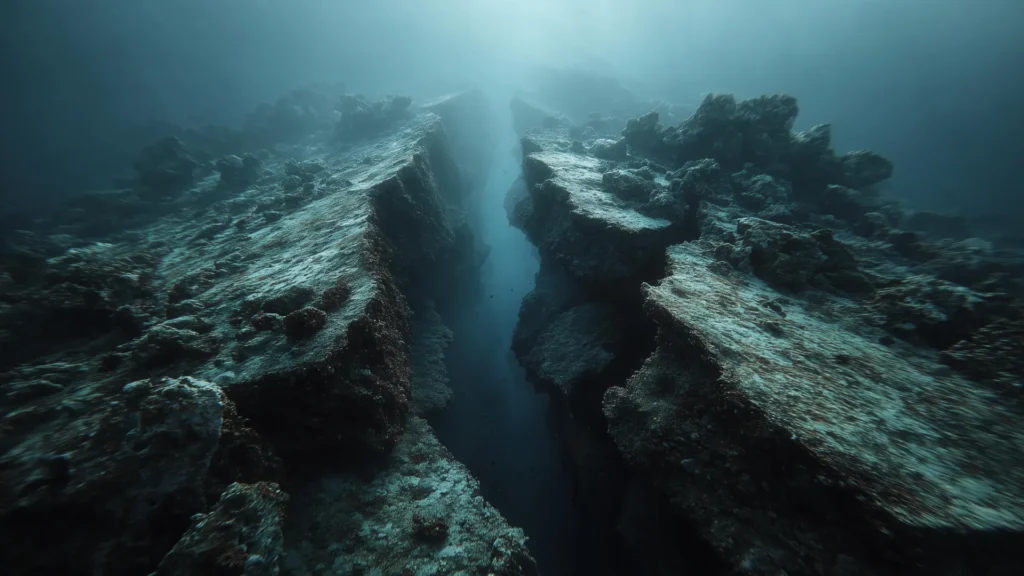
What emerged from the data was startling. Instead of a uniform, coherent slab of rock sliding into the mantle, the images revealed a fractured, fragmented landscape. Large faults and jagged shears were found slicing through the sinking plate, with evidence suggesting that the Juan de Fuca plate is not merely bending—it is actively snapping into smaller, independent pieces.
Supporting Data: Visualizing the Tectonic Fracture
The seismic images revealed a complex network of fractures, the most dramatic of which is a 75-kilometer-long tear. In one particular sector, researchers identified an offset where a portion of the oceanic slab has dropped by roughly five kilometers—a massive structural failure that indicates the plate is on the verge of total separation.
"This is the first time we have a clear picture of a subduction zone caught in the act of dying," Shuck noted. "Rather than shutting down all at once, the plate is ripping apart piece by piece, creating smaller microplates and new boundaries. Instead of a big train wreck, it’s like watching a train slowly derail, one car at a time."
The study further correlated these visual findings with seismic activity. By analyzing earthquake records, the team discovered that some sections along the 75-kilometer tear are seismically active, while others have gone strangely quiet.
In geological terms, silence is a sign of detachment. Earthquakes are triggered by friction and the buildup of stress between locked blocks of rock. Where the rocks are no longer locked—because they have completely separated from the main plate—the seismic signal vanishes. The researchers observed that this "quiet" zone is gradually expanding, signaling that the piece-by-piece disassembly of the plate is an ongoing, evolving process.
Implications for Earth’s Crust and Microplate Formation
The "piecewise" termination of the Cascadia system suggests that subduction zones do not fail in a single event, but through a series of episodic fractures. This process is heavily influenced by "transform boundaries"—fault lines where sections of the crust slide horizontally past one another. These boundaries act as geological scissors, carving out fragments of the plate as it descends.
Once a section is fully severed, it forms a "microplate." These are independent, rigid segments of the Earth’s shell that behave differently than the massive plates that spawned them. As more of these fragments detach, the downward pull—the "slab pull"—that drives subduction is diminished. Shuck likens this to removing cars from a runaway train; eventually, the system loses the mass required to keep it in motion.
This discovery provides a long-awaited solution to an ancient geological puzzle. For decades, geologists have struggled to explain the presence of abandoned plate fragments and anomalous volcanic rocks in the geological record. The remnants of the Farallon plate, found off the coast of Baja California, have long hinted at a chaotic end to a subduction zone. The Cascadia observations provide a contemporary template for how such fragments are created, confirming that these ancient systems likely unraveled in the same fragmented fashion.
Tectonic Tearing and Volcanic Consequences
The death of a subduction zone has profound implications for the mantle beneath it. When a plate tears, it creates a "slab window"—a gap in the descending rock. This aperture allows superheated material from the Earth’s mantle to rise toward the surface.
This influx of heat can radically alter magma production in the overriding crust. Over millions of years, this can lead to irregular, shifting patterns of volcanic activity. By linking the modern observation of tearing plates to the chronological sequence of volcanic rocks, scientists now have a new tool to interpret the history of vanished plate boundaries across the globe.
Assessing the Seismic Hazard: A Question of Time
While the discovery of a "dying" subduction zone is a landmark in geophysics, it raises immediate questions for the residents of the Pacific Northwest. Could these structural tears influence the behavior of future earthquakes?
A rupture, the rapid displacement along a fault that generates an earthquake, depends on the continuity and integrity of the crustal material. If the plate is segmented by these large tears, a future rupture might be stopped, diverted, or altered by the presence of these gaps.
However, the researchers provide a critical caveat: this discovery does not change the short-term earthquake risk for the region. The process of tectonic disintegration is operating on a geological timescale, occurring over millions of years rather than decades or centuries.
"The region is still capable of producing extremely large earthquakes and tsunamis," the authors state. "The breakup observed beneath the ocean is a slow-motion process."
Nevertheless, the inclusion of these newly identified structures in seismic hazard models represents a significant leap forward in precision. By better understanding the internal "cracks" in the Cascadia system, scientists can improve the accuracy of computer simulations that predict the potential scale and impact of future seismic events.
For the geological community, the Cascadia subduction zone has become a unique, real-time laboratory. As we watch the system slowly dismantle itself, we are gaining a clearer understanding of the life cycle of the very ground beneath our feet, proving that even the most enduring features of our planet are subject to the slow, steady progress of change.