
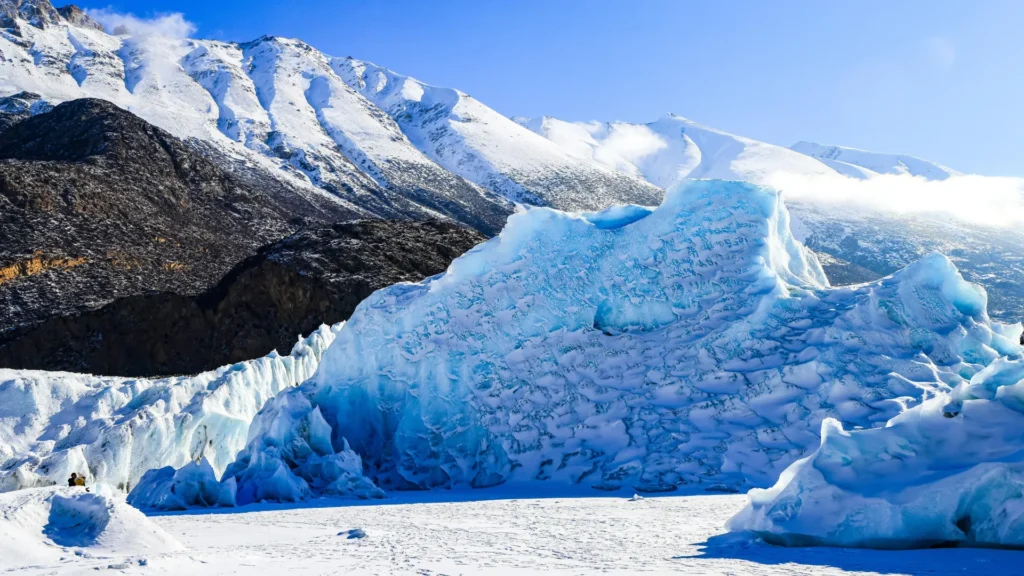
Deep within the frigid, high-altitude expanse of northwestern Tibet lies the Guliya Plateau, a region characterized by its stark, wind-swept beauty and unforgiving climate. It is here that an international team of scientists has unearthed a climatic "holy grail": a pristine, frozen record of Earth’s history that potentially stretches back more than 128,000 years. This discovery, recently detailed in the journal Science Advances, provides an unprecedented look at how mountain glaciers—often referred to as the "Third Pole"—have weathered the tumultuous transitions of our planet’s ancient climate.
The Discovery: A Century-Spanning Achievement
The significance of the Guliya ice cores cannot be overstated. By successfully dating these samples, researchers have extended the known glacial record for the region by over 100,000 years. These cores now stand as the oldest ever recovered from this specific part of the Tibetan plateau.
The achievement is the culmination of decades of rigorous scientific inquiry. The researchers analyzed ice cores extracted from the Guliya Plateau during two separate expeditions: one in 1992 and another in 2015. Despite the 23-year gap between the drilling operations, the samples yielded strikingly similar patterns of oxygen isotopes. In the field of paleoclimatology, these isotopes act as a chemical "fingerprint" of the atmosphere at the time the snow fell. The fact that two separate teams, separated by over two decades, found consistent isotopic signatures confirms that the ice has preserved a reliable, reproducible, and incredibly stable record of climate history.
"Reproducibility of the records within a given ice cap is extremely important," explains Lonnie Thompson, the study’s lead author and a distinguished professor of earth sciences at The Ohio State University’s Byrd Polar Research Center. "If you get an identical record a quarter of a century later, it tells you a lot about the behavior of the ice over time and confirms the integrity of the data we are interpreting."
Chronology: The Quest for an Accurate Timeline
Dating ice that has remained frozen for tens of thousands of years is a Herculean task. As ice accumulates over millennia, the layers become compressed, and traditional dating methods often fail as the physical evidence of annual layers thins or disappears. To overcome this, the international research team utilized advanced geochronological techniques, focusing on radioactive isotopes of beryllium and chlorine.
Identifying the Magnetic Signature
These radioactive forms of elements decay at predictable, constant rates, functioning like a "geological clock." The team specifically looked for evidence of the "Leschamp Geomagnetic Excursion," a significant, temporary reversal of Earth’s magnetic field that occurred approximately 41,000 years ago. This event caused a spike in cosmogenic isotopes that settled into the ice, leaving a chemical "timestamp" that allowed researchers to anchor their timeline with remarkable precision.
Cross-Referencing with Cave Deposits
To further validate their findings, the team cross-referenced the ice core data with oxygen isotope records recovered from nearby Tibetan cave deposits (speleothems). Because cave formations are also sensitive to changes in precipitation and temperature, the alignment of the ice core data with these cave records provides a robust "triple-check" of the timeline. The combined evidence suggests that the Guliya ice cap contains data that extends significantly beyond the 128,000-year mark, offering a window into the Eemian interglacial period—a time when Earth was arguably warmer than it is today.
Supporting Data: The Science of Ice Cores
Ice cores are arguably the most valuable archives of Earth’s past climate. As snow accumulates on a glacier, it traps air bubbles, dust, pollen, and volcanic ash. Over time, the weight of subsequent snowfalls compresses these layers into ice, effectively creating a vertical timeline of the atmosphere.
However, the utility of these cores is entirely dependent on the accuracy of the chronology. For years, the Guliya record was subject to debate. Earlier interpretations suggested that the record only reached back to the middle of the Holocene—the current geological epoch that began approximately 12,000 years ago. This interpretation was problematic, as it suggested that the Tibetan glaciers had melted away completely during the transition from the last ice age, only to reform later.
The new data shatters this hypothesis. By proving the ice is at least 128,000 years old, researchers have confirmed that these massive mountain glaciers survived the climatic extremes that followed the last ice age. This proves that high-altitude ice sheets are significantly more resilient than previously estimated, providing critical data for climate modelers who attempt to predict how today’s glaciers will react to current global warming trends.
Official Perspectives and Expert Analysis
The implications of this study are being felt across the global scientific community. Lonnie Thompson, whose career has been defined by his work in the world’s most remote glacial environments, views this as a vital piece of the global climate puzzle.
"It’s a really critical finding, because outside of the polar regions, this is the only ice core we have from the mountaintops that goes back that far," Thompson noted. "Other famous records, such as those from Huascarán in the Andes, only go back about 30,000 years. The fact that Guliya captures more than 100,000 years makes it a uniquely valuable asset for understanding global climate connectivity."
The research team, which includes an array of experts from the U.S., Switzerland, and China, emphasizes that the findings represent a "consistent story." The consistency across the isotope records and the radioactive decay markers suggests that the methodology is sound and that the interpretation of the climate history is robust. As Thompson puts it, "If you get the science right, the results are consistent. It is our understanding of what the ice is trying to tell us that has to catch up."
Implications for the Future of Climate Science
The discovery at Guliya is not merely an exercise in historical reconstruction; it has profound implications for how we understand the future of the planet.
Understanding Glacial Persistence
By establishing that these ice masses survived the end of the last glacial period, scientists can better understand the thresholds of glacial melting. This knowledge is essential for assessing the water security of the millions of people who live downstream from the Tibetan plateau, as these glaciers serve as the "water towers" for much of Asia.
Refining Climate Models
The revised timeline provides a new, more accurate dataset that can be integrated into global climate models. If scientists can understand exactly when major periods of glaciation began and ended in the past, they can better calibrate their predictions for how ice will retreat in a warming world.
Future Explorations
The research team has already begun planning further analyses of the Guliya cores. With a reliable timeline established, previously ambiguous layers can now be re-examined to look for signals of ancient volcanic activity, changes in solar intensity, and shifts in atmospheric circulation patterns. Researchers believe that there is still a wealth of untapped information within these samples that could reveal how Earth’s climate system responds to rapid warming events.
Conclusion
The Guliya ice cap is more than just a frozen relic of the past; it is a silent witness to the history of our planet. By unlocking the secrets trapped within this ancient ice, scientists have gained a clearer understanding of the Earth’s natural climate cycles. This research serves as a stark reminder of the importance of longitudinal studies in climate science—proving that, sometimes, the answers to our future lie hidden in the deepest, most inaccessible corners of our past.
Supported by the U.S. National Science Foundation and involving a global coalition of researchers from institutions such as ETH Zurich, the Chinese Academy of Sciences, and The Ohio State University, this study stands as a testament to the power of international collaboration in solving the mysteries of our changing world. As the scientific community continues to digest these findings, one thing remains clear: the ice has a story to tell, and for the first time, we have the map to read it.