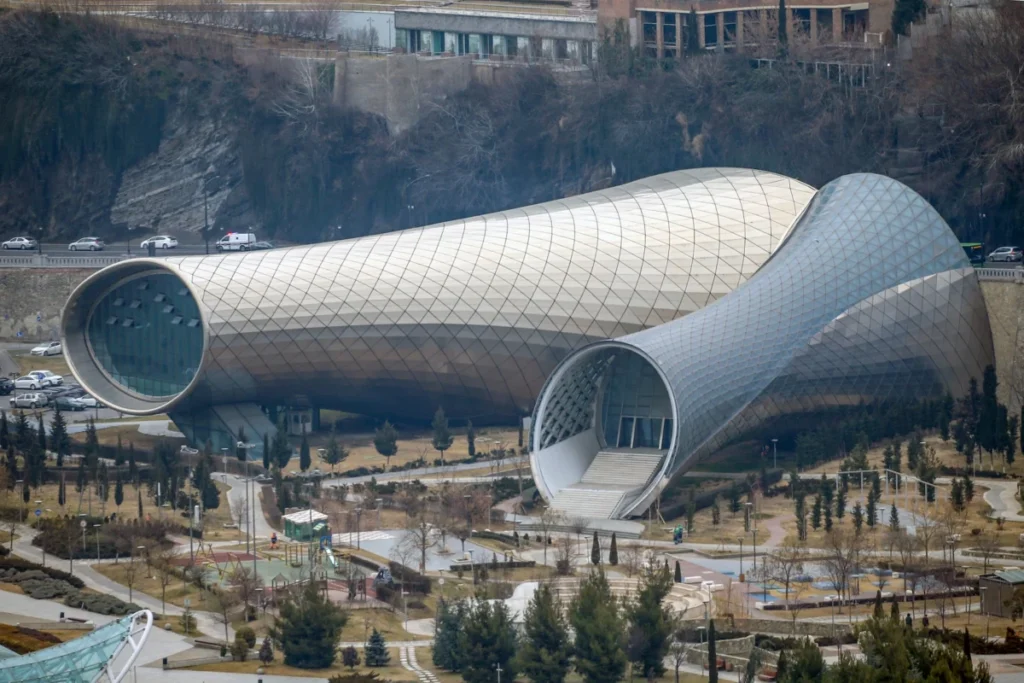
In the heart of Tbilisi, Georgia, the skeletal remains of a once-ambitious architectural vision are being systematically dismantled. The Rike Park Music Theatre and Exhibition Hall, a striking, serpentine structure affectionately—and often derisively—known as the "Rike Tubes," is currently being reduced to rubble. Despite fervent appeals from its original designers and a segment of the local architectural community, the demolition, which commenced in late July following municipal approval in June, is moving forward at a steady pace. It is a process expected to conclude by December, marking the final chapter for a building that has stood as a polarizing monument to Georgia’s post-Rose Revolution aspirations.
The destruction, first brought to international attention by Reuters and further documented in a poignant photo-essay by Civil Georgia, is not occurring in isolation. It is part of a broader, unsettling trend in the Georgian capital that has seen the disappearance of landmark sites, including the Brutalist former flour mill known as "Silo." As the cranes tear through the steel and glass, the city finds itself grappling with a recurring question: what is the price of progress, and who has the right to rewrite a city’s skyline?
A Chronology of Controversy: From Vision to Void
The history of the Rike Tubes is inextricably linked to the political transformation of Georgia following the 2003 Rose Revolution.
- 2004–2012: Under the administration of then-President Mikhail Saakashvili, Georgia embarked on an aggressive campaign of modernization and Westernization. Architecture was weaponized as a tool of soft power, with the state commissioning daring, "starchitect"-led projects to signal a break from the Soviet past.
- The Commission: The Rike Park project was awarded to the renowned Italian firm Fuksas Studio, led by the husband-and-wife duo Massimiliano and Doriana Fuksas. The design—two elongated, tubular structures clad in glass and stainless steel—was intended to serve as a futuristic music theater and exhibition space, framing the Kura River and the historic backdrop of Old Tbilisi.
- 2012: As the project neared completion, a seismic political shift occurred. The Georgian Dream party ousted the United National Movement (UNM) in parliamentary elections. With the change in government came a cessation of support for many of the previous administration’s "vanity projects."
- The Stagnation: The complex, which reportedly consumed approximately 75 million lari ($29 million USD) in public funding, never officially opened its doors. It remained a vacant, eerie landmark—a "ghost building" that stood as a silent witness to the political gridlock that followed the transition of power.
- The Sale: In the years that followed, the 108,000-square-foot site was privatized. Ownership eventually transitioned to Rike Dom, a subsidiary of the developer Maqro Property.
- June 2026: The Tbilisi city government granted formal approval for the site’s redevelopment, effectively greenlighting the demolition.
- July 2026: Demolition crews arrived at the site.
- December 2026 (Projected): Completion of the demolition process, leaving the site cleared for new development.
Supporting Data: The Economics of Abandonment
The Rike Tubes were never merely a building; they were a significant investment of public capital in an era of high-stakes nation-building. The reported $29 million USD expenditure represents a substantial sum in the context of the Georgian economy, particularly for a structure that served no public function for over a decade.
Critics of the project have long pointed to the massive maintenance costs associated with keeping the climate-controlled, glass-heavy structure viable, even while empty. For the current municipal government, the demolition is framed as a pragmatic resolution to a financial and logistical burden. However, urban planners argue that the "sunk cost" of the building is being compounded by the environmental and historical cost of its destruction.
The demolition of the Rike Tubes, along with the destruction of the historic Silo mill, highlights a lack of heritage protection frameworks in Tbilisi. Data from urban monitoring groups suggests that the city is losing its architectural diversity at an alarming rate, replacing layers of historical and modern complexity with monolithic, often anonymous, commercial developments.
Official Responses and the Architecture of Discontent
The decision to raze the site has sparked a firestorm of debate, pitting the private property rights of the developer against the collective memory of the public.
The Architects’ Plea
Massimiliano and Doriana Fuksas have been vocal in their opposition to the destruction of their work. In communications with city officials, the studio offered to collaborate on a repurposing strategy, suggesting that the interior spaces could be adapted for cultural or community use rather than being relegated to the scrap heap. "Architecture is a dialogue," a representative for the firm noted. "By destroying this building, the city is not just removing a structure; it is silencing a chapter of its own history."
The City’s Stance
Tbilisi’s municipal authorities have maintained a largely defensive posture, emphasizing the private nature of the land ownership. By privatizing the site, the government effectively relinquished its ability to dictate the building’s preservation. The official narrative from the city suggests that the site was an "eyesore" and an "impediment" to the development of the Rike Park area. They argue that the developer, Maqro Property, has the legal right to utilize the land as it sees fit—which, according to preliminary reports, involves the construction of a new hotel.
Implications: A City in Identity Crisis
The razing of the Rike Tubes carries profound implications for Tbilisi’s urban future.
The Loss of Architectural Pluralism
Tbilisi is a city of layers—Persian, Ottoman, Russian Imperial, Soviet, and post-Soviet. The Rike Tubes, while controversial, represented a specific moment in time: the attempt to graft high-tech, Western-oriented modernity onto an ancient urban fabric. By erasing this layer, the city risks becoming a homogenized space where only "safe" or commercially viable architecture is permitted to exist.
The Precedent of Privatization
The Rike case serves as a warning about the limits of public influence over private property. When historic or significant buildings are sold into private hands without protective covenants, the public loses the ability to safeguard its heritage. The looming question remains: if the Rike Tubes can be demolished without a significant public debate or a search for alternatives, what prevents the future destruction of other, perhaps more beloved, landmarks?
The "Hotelization" of Public Space
The shift toward luxury hotel developments—a trend visible across many post-Soviet capitals—threatens to displace the public from the city center. If the Rike site becomes a private, high-end hotel, the public space that once promised to be a cultural hub will be gated off, restricted to those with the means to stay within its walls. This represents a privatization of the city’s heart, replacing civic potential with consumer exclusivity.
Conclusion: Looking Toward the Future
As the end of the year approaches, the skyline of Tbilisi will change. The glass curves that once reflected the sunset over the Kura River will be gone, replaced by the uncertainty of a construction site.
The tragedy of the Rike Tubes is not necessarily that they were a perfect building—architecture is always subject to critique and reassessment—but that they were a lost opportunity. The failure to adapt, to repurpose, and to find a middle ground between the political baggage of the past and the commercial demands of the future is a failure of urban governance.
Tbilisi stands at a crossroads. As it moves further away from the fervor of the early 2000s, it must decide what it values. Is it a city that preserves its complexity, or one that clears the slate whenever a new administration takes the stage? The demolition of the Rike Tubes is a definitive answer, and for many in the architectural community, it is a haunting reminder that once a monument is destroyed, the history it held is often buried with the rubble.
As the final beams are removed, the citizens of Tbilisi are left to wonder: when the dust settles, will the city be more beautiful, or simply more hollow? The answer, unfortunately, is unlikely to be found in the blueprint of the hotel that will eventually rise in the Tubes’ place.