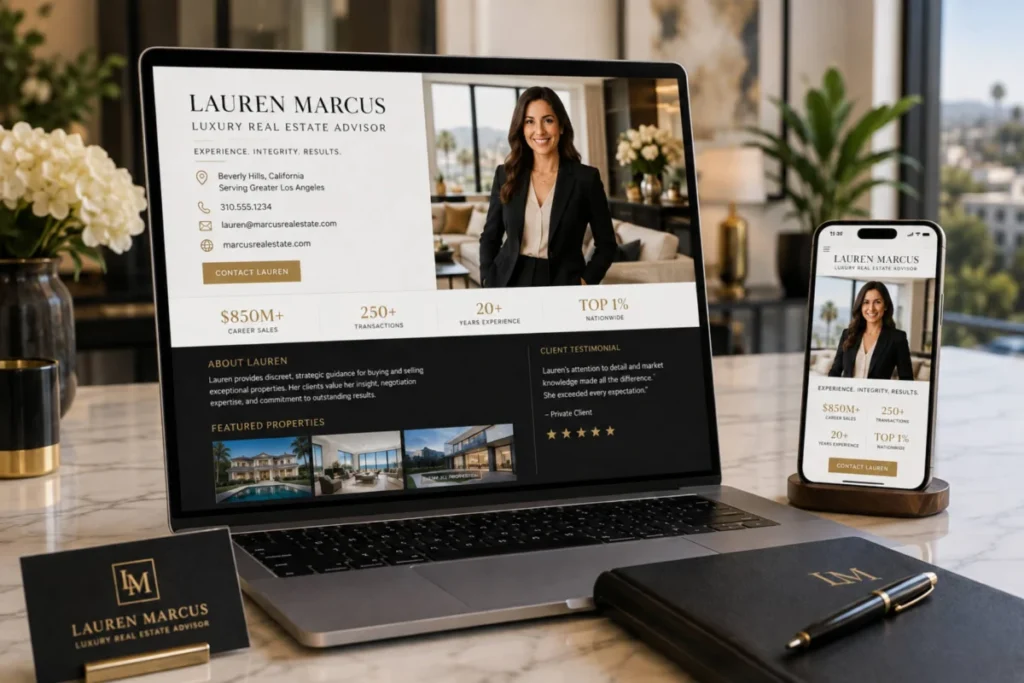
In the high-stakes world of luxury real estate, presentation is not merely an aesthetic preference—it is the foundation of the business. From the meticulous staging of a sprawling estate to the professional cadence of a private showing, every touchpoint is a carefully curated signal of competence. Yet, even the most seasoned brokers often suffer from a "digital identity crisis." While their property listings may be featured in glossy magazines and their brokerage websites may offer robust search tools, the individual agent’s professional identity remains fragmented across a digital landscape of social media feeds, archived bios, and third-party review platforms.
When a potential client asks the fundamental question—“Who is this agent, and why should I trust them with my most significant asset?”—the answer is rarely found in one unified location. Bridging this gap requires a pivot from the expansive, resource-heavy real estate website to a focused, high-impact professional profile.
The Evolution of the First Impression: Beyond the Homepage
In luxury circles, relationships are rarely forged through a cold search engine query. They begin with a whisper of recommendation: a text from a trusted financial advisor, a referral from a previous client, or a quick exchange at a high-profile industry event. When a prospective seller receives a name, their first instinct is to "vet" the individual.
The traditional brokerage website, while valuable for long-form market data and property search, often fails this specific test. It is too broad, too cluttered, and too focused on the company rather than the individual. The modern luxury agent needs a professional profile that functions as a digital handshake—concise, credible, and immediately accessible.
The Chronology of an Introduction
- The Referral: A client, colleague, or partner provides the agent’s contact information.
- The Digital Audit: The prospect searches for the agent’s name to confirm their reputation.
- The "Trust Gap": The prospect encounters disparate links, social media profiles, and outdated bios, requiring them to manually synthesize an identity.
- The Decision Point: The prospect chooses to either reach out or move on to a competitor who appears more established and cohesive.
By centralizing their story into a single, polished professional profile, agents can eliminate the "digital scavenger hunt," ensuring that the first impression is controlled, consistent, and compelling.
Website vs. Profile: Defining the Purpose
It is essential to distinguish between a digital "resource center" and a "professional introduction." A comprehensive real estate website is akin to a retail storefront—it is designed for browsing, market research, and long-term engagement. It is a place where a visitor stays for twenty minutes to analyze neighborhood trends.
A professional profile, by contrast, is a business card for the digital age. It is designed for speed and impact. Its sole objective is to move a prospect from curiosity to connection. Platforms such as CardCloser have emerged to address this specific need, providing a dedicated space where an agent can curate their most persuasive proof points without the distraction of peripheral content.
The Pillars of a High-Trust Professional Profile
To move a visitor from recognition to trust, a profile must be more than a static biography. It must function as a curated exhibit of the agent’s professional life.
1. Establishing a Clear Identity
A visitor should never have to guess what an agent does. The profile must immediately clarify:
- The Specialization: Does the agent focus on waterfront properties, urban penthouses, or investment portfolios?
- The Geographic Scope: Where is the agent’s primary sphere of influence?
- The Affiliation: While the agent is an individual, their relationship with their brokerage must be clear and professional.
2. The Power of Visual Consistency
In luxury markets, imagery is the language of the brand. A professional portrait is the centerpiece of the profile; it must be current, high-resolution, and reflective of the agent’s personal brand. If an agent’s LinkedIn photo is five years old, but their Instagram is trendy and their website is corporate-stiff, the lack of consistency creates "subtle friction"—a psychological barrier that undermines trust. Every visual touchpoint must align in typography, color palette, and tone.
3. The Narrative: Moving Beyond the Résumé
A biography should not be a chronological list of job titles. It should be a narrative that explains the agent’s "Why." Why are they passionate about the local market? What is their philosophy on negotiation? What is their unique value proposition? A strong, two-paragraph narrative is significantly more memorable than a dry, ten-year history of firm affiliations.
Supporting Data: Proof over Adjectives
One of the most significant pitfalls in luxury real estate marketing is the reliance on subjective adjectives. Every agent claims to be "dedicated," "knowledgeable," and "responsive." These words have become white noise in the industry. Persuasion, however, is built on evidence.
Types of Persuasive Proof:
- Contextualized Results: Instead of just citing a total sales volume, explain the outcome of a specific, high-stakes negotiation.
- Client Advocacy: Curated, specific testimonials that highlight the agent’s problem-solving skills rather than just their "niceness."
- Market Insight: A brief, authoritative take on a current market trend that demonstrates deep, specialized knowledge.
- Representative Work: A selection of property sales that showcases the agent’s breadth—proving they have successfully managed both the high-volume condo market and the singular, estate-level transaction.
Official Responses and Strategic Implications
Industry leaders are increasingly recognizing that the fragmentation of digital presence is a liability. According to recent internal industry analyses, agents who maintain a centralized professional profile report a 30% increase in conversion rates from referral-based leads. This is because the "next step" is clear, low-friction, and professional.
The strategic implication for the luxury sector is clear: the era of the "link-in-bio" directory is ending. Agents are moving toward dedicated, branded digital experiences that aggregate their proof of competence. This shift reduces the "work" required by the client, allowing them to make an informed decision without navigating a maze of disconnected platforms.
Avoiding Common Mistakes: A Checklist for Success
As agents transition to a more unified digital presence, they must avoid the most common traps that lead to a loss of credibility:
- The "Link Directory" Trap: Do not simply create a page of social media icons. A directory is not a profile; it is a way to lose the visitor to other distractions.
- The Stale Content Hazard: An agent with an outdated listing on their profile looks like an agent who has left the business. If you cannot update it, remove it.
- The Over-Correction: Do not try to pack every certification and award into the profile. Less is more. Keep the information focused on the needs of the current prospective client.
- Burying the Lead: If the goal is a meeting, the "Book a Consultation" or "Contact" button must be the most prominent element on the page, regardless of device size.
The Professional Profile Audit Checklist
- Identity: Is it clear who you are, where you work, and who you serve?
- Positioning: Is your unique value proposition articulated in less than 30 seconds?
- Proof: Does your profile offer objective evidence of your expertise?
- Contact: Is there a clear, immediate path for the user to reach you?
- Consistency: Do the visuals and tone match your other professional channels?
Conclusion: The New Standard for Luxury
In a market defined by high-value transactions and intense competition, the professional profile has moved from an optional digital accessory to a core business requirement. It is the agent’s most reliable introduction, acting as a bridge between the initial referral and the formal client relationship.
By curating a space that prioritizes trust, consistency, and clear, actionable proof, luxury agents can distinguish themselves in a crowded marketplace. They are no longer just asking to be found; they are providing the evidence necessary to be chosen. In an industry where trust is the ultimate currency, the professional profile is the ledger upon which that trust is verified. Whether through a dedicated site or a specialized professional platform, the commitment to a unified, high-quality digital identity is no longer just a marketing strategy—it is the hallmark of the modern, successful luxury real estate professional.