Deep beneath the sprawling urban landscape of Southern California, a silent, subterranean countdown is underway. For over a century, the region’s two most formidable tectonic structures—the San Andreas Fault and the San Jacinto Fault—have been locked in a period of relative quiescence. While the surface remains tranquil, a groundbreaking new study reveals that this "quiet" interval has allowed tectonic stress to reach levels unseen in the last millennium. Researchers now warn that the convergence point of these two giants, a geological junction known as Cajon Pass, may act as a volatile "earthquake gate," capable of triggering a catastrophic multi-fault rupture.
The Mechanics of a Seismic Time Bomb
Earthquakes are the Earth’s violent way of balancing its internal energy ledger. They occur when stress, accumulated over decades or centuries as massive tectonic plates grind against one another, is suddenly released along fractures in the crust known as faults. When these plates become "stuck," the pressure mounts, bending the crust like a giant spring. Eventually, the rock reaches its breaking point, and the resulting snap sends seismic waves radiating outward.
In Southern California, the San Andreas and San Jacinto fault systems act as the primary conduits for this tectonic motion. They are the region’s geological backbone, and their interaction at the Cajon Pass—located just northeast of the densely populated Los Angeles basin—has long been a subject of intense scientific scrutiny. Since the magnitude 7.9 Fort Tejon earthquake in 1857, the southern segments of these faults have been suspiciously silent. This "seismic gap" has led geophysicists to conclude that the region is not merely resting, but rather loading a significant amount of potential energy.
A Millennium of Data: The Physics of the Past
To peer into the future of Southern California’s seismic risk, a team of international researchers led by Dr. Liliane Burkhard of the University of Bern’s Division of Space Research and Planetary Sciences (WP) embarked on an ambitious project. The team, which included experts from the University of Hawaiʻi at Mānoa, the U.S. Geological Survey (USGS) Earthquake Science Center, and the Scripps Institution of Oceanography, sought to reconstruct 1,000 years of seismic activity to calibrate a new, four-dimensional earthquake cycle model.
Reconstructing the Timeline
The model’s precision relies on a robust foundation of geological evidence. By synthesizing radiocarbon dating, tree ring records that capture ground disturbances, and historical accounts of surface ruptures, the researchers built a comprehensive timeline of the region’s earthquake history.
"The model tracks how each earthquake changes stress on neighboring fault segments, how stress accumulates during the quiet intervals between events, and how the deeper layers of the crust slowly relax following large ruptures," explains Dr. Burkhard. By simulating this thousand-year history, the team was able to translate historical events into a modern-day stress map. The results, published in the Journal of Geophysical Research: Solid Earth, are sobering: tectonic stress in the region has reached, and in some localized segments, surpassed, any levels observed over the past 1,000 years.
The Concept of the "Earthquake Gate"
Perhaps the most significant contribution of the study is the introduction of the "earthquake gate" concept. Geologists have long debated why some earthquakes remain confined to a single fault line while others jump from one fault to another, creating "cascading" events that release significantly more energy.
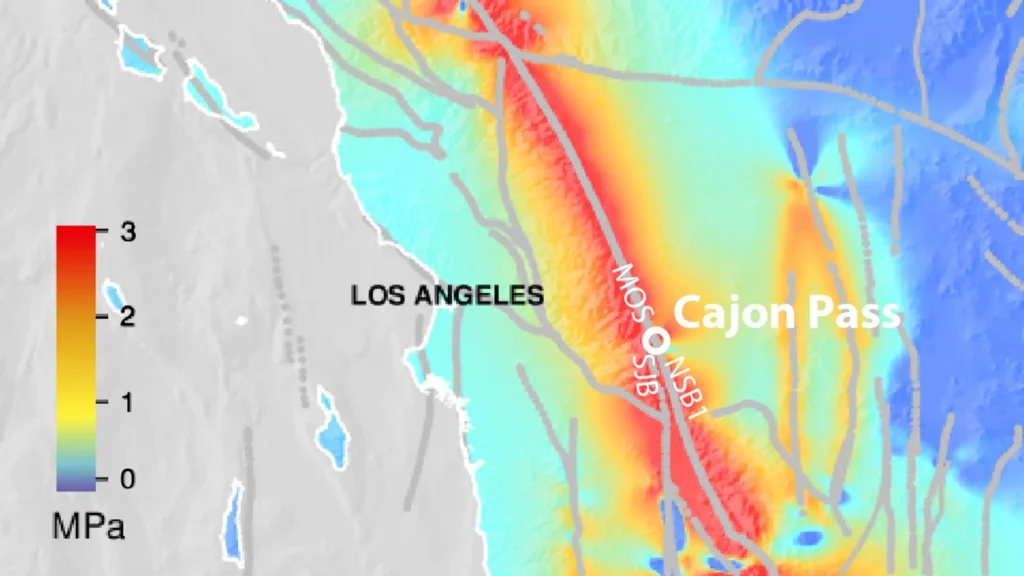
Cajon Pass serves as this critical juncture. It is a geologically complex area where the San Andreas and San Jacinto systems come into close proximity. The study suggests that the gate’s function is not binary; it does not simply block or facilitate a rupture. Instead, it responds dynamically to the prevailing stress conditions.
Historical Precedents and Modern Configurations
The study highlights two starkly different historical outcomes to illustrate the gate’s behavior:
- The 1857 Fort Tejon Event: A massive rupture that, despite its intensity, stopped at the gate, leaving the San Jacinto fault largely unaffected.
- The 1812 Wrightwood Event: A multi-fault rupture that successfully bridged the gap, propagating through both systems in a single, sustained seismic event.
The researchers determined that the "gate" opens or closes based on the symmetry of stress. When stress levels on both faults are disparate, a rupture is more likely to be checked at the junction. However, when stress levels on both sides of the junction reach similarly high, critical thresholds, the gate becomes "transparent," allowing a rupture to jump the gap and escalate into a dual-system event.
Data Analysis: The Critical Stress Threshold
The findings present a statistically alarming picture. The model estimates that stress on the San Jacinto-Bernardino section has reached 3.6 MPa (megapascals), a value that stands as an all-time high in the millennium-long simulation. Simultaneously, the Mojave South section of the San Andreas Fault sits at 2.8 MPa.
Because both sections are now operating under high, comparable stress, the current configuration mirrors the conditions that historically preceded multi-fault ruptures. "It is not just that the stresses are reaching historic highs," Dr. Burkhard notes, "but also that the relative stress conditions between the two fault systems are approaching the range we associate with major ruptures crossing both faults simultaneously."
Implications for a Modern Metropolis
The prospect of a multi-fault rupture is not merely a scientific curiosity—it is a major public safety concern. A "gate-crossing" earthquake would affect a massive geographical footprint, stretching from the Inland Empire and the Coachella Valley through to the heart of the Los Angeles metropolitan area.
Infrastructure at Risk
Cajon Pass is not just a geological junction; it is a vital artery for Southern California’s infrastructure. It hosts major interstate highways, high-capacity rail lines, and critical energy corridors, including natural gas pipelines and electricity transmission lines. A major rupture occurring at this specific site would likely sever these lifelines, paralyzing regional commerce and complicating emergency response efforts.
The cascading nature of a multi-fault event would also produce seismic shaking that lasts significantly longer and affects a wider area than a single-fault earthquake, exponentially increasing the potential for structural failure in older, non-retrofitted buildings and infrastructure.
Scientific Cautions and Future Preparedness
Despite the dire implications of the data, the research team is careful to temper the findings with necessary scientific caveats. "The study is not a prediction of when an earthquake will occur," Dr. Burkhard emphasizes. "What we can say is that the system is critically stressed and that physics-based models like ours give a clearer picture of the range of scenarios we should be prepared for."
A Call for Resilience
The "earthquake gate" framework provides urban planners and emergency management agencies with a new, physics-based lens through which to view hazard assessments. By identifying that the system is in a state prone to large-scale, multi-fault events, officials can better prioritize seismic retrofitting and update disaster response protocols.
The study’s methodology is also highly scalable. While the research was focused on the California landscape, the team believes the framework can be applied to complex fault junctions worldwide, from the Anatolian Fault in Turkey to the various strike-slip systems in New Zealand.
As the scientific community continues to refine these models, the message for the public remains one of informed vigilance. We cannot predict the day or the hour of the next "Big One," but for the first time, we have a clear, data-driven understanding of the structural pressures building beneath our feet. The "earthquake gate" is not a warning of an imminent catastrophe, but a reminder that the landscape of Southern California is a dynamic, evolving environment that demands robust preparation, resilient infrastructure, and a culture of constant readiness.