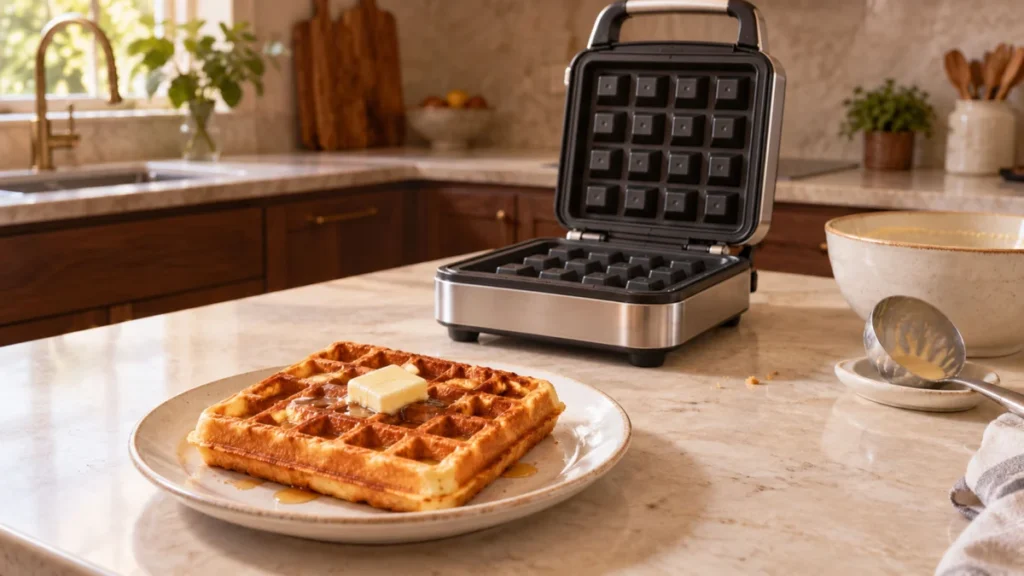
In the modern luxury kitchen, the definition of success has shifted from purely aesthetic appeal to high-functioning utility. Nowhere is this evolution more evident than in the rising trend of the dedicated "baking station." For households that view a Sunday morning waffle ritual as a cornerstone of their lifestyle, the challenge lies in bridging the gap between a showroom-ready kitchen and a workspace that actually supports the messy, rhythmic, and high-heat reality of breakfast production.
A truly successful home baking station earns its square footage by streamlining the journey from raw ingredients to a perfectly textured plate. As design experts increasingly note, a handsome cabinet cannot compensate for a work surface that becomes claustrophobic the moment a waffle iron lid is lifted. To build a station that is both beautiful and functional, homeowners must prioritize the mechanics of the process over the appearance of the cabinetry.
The Chronology of the Morning Routine
Mapping the Workflow
To design a space that works, one must first document the "path of the breakfast." Before consulting with an architect or interior designer, homeowners are encouraged to perform a "rehearsal" of their typical morning. This involves placing every item—the batter bowl, the measuring scales, the whisk, the waffle maker, and the serving plates—on the counter in their natural order of use.
The goal is to identify the "awkward moments." Does the cook have to reach over a hot, open iron to grab a spatula? Does the mixing bowl block the path to the refrigerator? By documenting these friction points, the user provides a designer with a map of their specific habits.
- The Preparation Phase: This is where the batter is mixed. It requires a broad, stable surface where the recipe remains readable and ingredients are within arm’s reach.
- The Active Cooking Phase: The center of gravity shifts to the waffle iron. This requires specific clearances for the lid and a designated "landing zone" for the portioning tool.
- The Handoff Phase: This involves the transfer of the finished product to the dining surface. Crucially, this route must be kept clear of the cooking zone to prevent collisions or burns.
- The Cleanup Phase: Often overlooked, this phase dictates whether a station remains a joy or becomes a chore. It must account for cooling the appliance, wiping down surfaces, and returning ingredients to their proper storage.
Supporting Data: The Science of Texture and Flow
Engineering the Culinary Environment
The success of a breakfast station is intrinsically linked to the science of the food itself. According to resources from UDTECH, the texture of a waffle—whether the goal is a crispy exterior or a light, airy crumb—is dependent on the cook’s ability to follow precise mixing and pouring methods. If the kitchen layout forces the cook to rush or compromise on mixing stability, the final product suffers.
Data suggests that spatial constraints often lead to "improvisational cooking," where the chef resorts to shortcuts to save space. These shortcuts—such as neglecting to preheat the iron properly or failing to measure ingredients accurately—are the primary culprits behind inconsistent textures. A well-designed station removes these barriers by providing:
- Ergonomic Zoning: Separating the "dry" preparation area from the "wet" heat zone.
- Proximity Management: Keeping the portioning utensil (the ladle or scoop) within a dedicated, reachable rest rather than requiring the cook to traverse the kitchen.
- Environmental Control: Ensuring that the heat from the appliance does not interfere with the storage of perishables like milk or eggs.
Official Guidelines: Safety and Technical Specifications
Beyond Aesthetic Design
A common error in high-end kitchen design is the attempt to integrate appliances into cabinetry in ways that contradict manufacturer specifications. Professional kitchen planners emphasize that an appliance’s footprint is not its operational requirement.
Before committing to a built-in look, users must consult the manufacturer’s manual for "operating clearances." Many waffle makers require significant vertical space for the lid to remain open and, crucially, require adequate ventilation to prevent overheating and moisture buildup.
"Storage dimensions and operating requirements answer different questions," note kitchen design consultants. A cabinet might be deep enough to store a closed iron, but that does not mean it is a safe or effective place to operate one. If the manufacturer’s instructions are vague, professional guidance should be sought before any permanent joinery is finalized. This is particularly important for electrical safety, as high-draw appliances often require dedicated circuits to prevent tripping breakers in a busy morning environment.
The Implications of a Purpose-Built Station
Creating a Sustainable Routine
The implications of a well-executed baking station extend far beyond the breakfast table. When the kitchen is organized to support a specific ritual, the household experiences a reduction in daily "cognitive load."
1. Preventing "Cleanup Fatigue"
A major factor in whether a station is used or abandoned is the ease of cleanup. Designers should prioritize materials that resist batter splatter and are heat-resistant. If the counter requires moving three decorative objects to wipe it down, the user will eventually stop using the station. A "wiping-first" approach to design—where surfaces are clear, continuous, and easily accessible—ensures the station remains as clean at 9:00 AM as it was at 7:00 AM.
2. Enhancing Social Dynamics
A well-planned station clarifies the "handoff." By keeping the cooking area distinct from the display area (where plates, fruit, and toppings are kept), the design encourages a natural flow. Guests can serve themselves from a peripheral area without entering the "hot zone" managed by the cook. This separation is essential for safety, particularly in households with children or frequent visitors.
3. Adaptability for the Future
A rigid, single-use station is a liability. The best designs are those that allow the station to "rest" when the waffle iron is stored. By ensuring that the cabinetry and counter space can serve as a coffee bar, a prep space for dinner, or a serving buffet during parties, the design gains longevity. A little unused room or "breathing space" on a counter is not wasted space—it is the hallmark of a flexible kitchen.
Constructing the Brief: A Professional Approach
When moving from the concept phase to the execution phase, the homeowner should present their designer with a formal "brief." This document should move away from abstract concepts like "warm morning light" or "modern farmhouse style" and focus on the following technical requirements:
- The Appliance Identity: Specify the exact model of the waffle iron and provide the dimensions when the lid is fully vertical.
- The Routine Map: Provide the written sequence of the morning, highlighting which tools move, which stay, and where the "hot" vs. "cool" zones are located.
- The Storage Logic: Define where the appliance, its accessories, and its cleaning tools will live. Every item must have a "home" that is logically linked to its use.
- The Safety Mandate: Clearly define the separation between the cook’s area and the guest access area.
Final Thoughts: The Return on Investment
The true value of a home baking station is found in the calm that it brings to the morning. In a world of increasing complexity, the ability to prepare a favorite meal without a struggle is a luxury in its own right.
By grounding the design in the physical reality of the routine—measuring, mixing, cooking, and serving—the homeowner ensures that the station is not merely a display piece, but an active participant in their quality of life. Whether you are a professional chef or a parent trying to facilitate a seamless weekend breakfast, the principles remain the same: simplify the path, protect the texture of the food, and design for the reality of the cleanup. When these elements align, the kitchen ceases to be a room where work is performed and becomes a space where experiences are crafted.