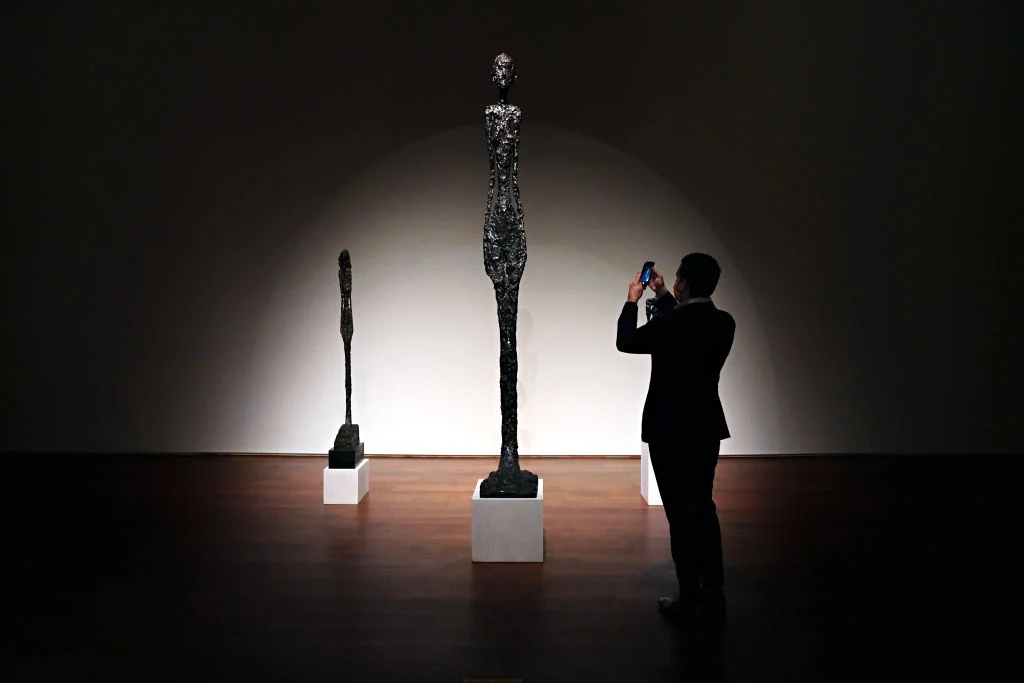
The image of an Alberto Giacometti sculpture is etched into the collective consciousness of the art world: a spindly, elongated figure, its surface scarred and pitted, standing as a lone sentinel against an invisible wind. These "matchstick-thin" forms, characterized by a profound sense of existential dread, have become the most sought-after trophies in the global art market. Born in Borgonovo, Switzerland, in 1901, Giacometti transformed the landscape of 20th-century art, moving from the dreamscapes of Surrealism to a raw, postwar realism that captured the fragility of the human condition.
Today, Giacometti’s work represents the absolute pinnacle of the auction world. He remains one of the few artists—alongside titans like Picasso, Da Vinci, and Modigliani—to see his works cross the elusive $100 million threshold. As major institutions and private billionaires compete for the rare opportunity to own a lifetime-cast bronze, the market for Giacometti has evolved from a niche interest for connoisseurs into a high-stakes arena of global finance and cultural prestige.

Main Facts: The Market Titan of Modernism
Alberto Giacometti’s market dominance is not merely a product of aesthetic appreciation but a result of extreme scarcity and historical significance. While many Modernist sculptors produced large editions of their work, Giacometti’s most iconic "tall" figures were produced in very limited numbers, often with subtle variations in their hand-painted patinas.
The "gold standard" for his market was set in 2015 when L’homme au doigt (Pointing Man, 1947) sold for a staggering $141.3 million at Christie’s New York. At the time, it became the most expensive sculpture ever sold at auction, a record it still holds. This sale solidified Giacometti’s status as the world’s most valuable sculptor. His works are prized for their "intensity of reality," a phrase the artist himself used to describe his goal: "The object of art is not to reproduce reality, but to create a reality of the same intensity."

The appeal of Giacometti lies in his ability to translate the philosophical weight of the mid-20th century—specifically the existentialism of Jean-Paul Sartre and the theater of Samuel Beckett—into three-dimensional bronze. For collectors, a Giacometti is not just a statue; it is a monument to the resilience and isolation of the human spirit.
Chronology: The Evolution of a Visionary
To understand why a Giacometti bronze commands the price of a private jet or a skyscraper, one must look at the painstaking evolution of his style.

1920s–1930s: The Surrealist Experiments
After moving to Paris in 1922 to study under Antoine Bourdelle, Giacometti initially gravitated toward the Surrealist movement. His works from this era, such as The Palace at 4 a.m. and Woman with Her Throat Cut, were psychological and often violent. However, his insistence on working from life—a practice the Surrealists found too "traditional"—led to his expulsion from André Breton’s circle in 1935. This break was pivotal; it forced Giacometti into a decade of intense isolation and experimentation.
1940s: The Great Diminishing
During World War II, Giacometti returned to Switzerland. In a tiny hotel room in Geneva, he began creating sculptures that grew smaller and smaller. Legend has it that he left Switzerland at the end of the war with his entire four years of production contained within six matchboxes. These "micro-sculptures" were the precursor to his tall figures; he was attempting to capture the way a person looks from a distance—a shimmering, thin presence in a vast space.

1947–1960: The Mature Postwar Style
Upon returning to his cramped studio on Rue Hippolyte-Maindron in Paris, Giacometti’s figures began to grow vertically. This period (roughly 1947 to 1951) is considered his "golden age." It was during these years that he conceived his most famous works: L’Homme qui marche (Walking Man), Le Chariot, and Grande femme debout. These figures, though tall, remained incredibly thin, as if the air around them was eroding their mass.
1966–Present: Posthumous Recognition
Giacometti died in 1966 in Chur, Switzerland. In the decades following his death, the market for his work moved from the hands of his contemporaries into the global secondary market. The establishment of the Fondation Giacometti in Paris ensured a rigorous cataloging of his work, which provided the market with the transparency and provenance necessary for nine-figure valuations.

Supporting Data: The Top 10 Auction Results
The meteoric rise of Giacometti’s prices can be traced through a series of landmark auctions. Below is an analysis of the works that have defined his financial legacy.
- L’homme au doigt (1947) – $141.3 Million (2015, Christie’s): This work is considered unique because it was hand-painted by the artist, adding a layer of intimacy that drove the price to a world record.
- L’homme qui marche I (1960) – $104.3 Million (2010, Sotheby’s): When this sold in London, it was the first time a sculpture had ever surpassed the $100 million mark, shocking the art world and resetting the ceiling for Modernist art.
- Chariot (1950) – $101 Million (2014, Sotheby’s): A rare work featuring a goddess-like figure perched atop a chariot with oversized wheels, symbolizing both stillness and momentum.
- Grande femme I (1960) – $90.1 Million (2020, Sotheby’s): As mentioned in the original report, this sale occurred via a "sealed bid" process during the height of the pandemic, proving that demand for Giacometti was recession-proof.
- Grande tête mince (1954) – $53.3 Million (2010, Christie’s): A bust of the artist’s brother, Diego, which demonstrates the "blade-like" profile that Giacometti perfected in the 1950s.
- Buste de Diego (Stele III) (1958) – $50 Million (2013, Sotheby’s): Another depiction of his brother, showcasing the intense, tactile surface of the clay from which the bronze was cast.
- Grande femme debout II (1960) – $27.4 Million (2008, Christie’s): Though low by today’s standards, this sale in 2008 was an early indicator of the massive surge that would follow two years later.
- La Place (1948) – $13–$15 Million (Various Sales): His multi-figure compositions, which depict urban isolation, consistently command high eight-figure sums.
- L’Homme qui chavire (1950) – $19.3 Million (2009, Sotheby’s): A dynamic work showing a man in the moment of falling, capturing human vulnerability.
- Diego en chemise écossaise (Painting, 1954) – $32.6 Million (2013, Christie’s): While known for sculpture, Giacometti’s paintings are equally sought after, featuring the same "vibrating" lines and monochromatic intensity.
Official Responses and Expert Insights
The art market’s obsession with Giacometti is often described by specialists as a "flight to quality." In times of economic uncertainty, ultra-high-net-worth individuals seek "blue-chip" assets that act as a store of value.

Simon Shaw, Vice Chairman of Sotheby’s, has frequently noted that Giacometti’s work resonates across cultures. "Whether you are in New York, London, Hong Kong, or Zurich, the image of the ‘Walking Man’ is a universal symbol of human striving," Shaw commented during a recent press preview. "It is the ultimate trophy because it is instantly recognizable and carries immense intellectual weight."
Art historians also point to the technical mastery of the casts. Unlike many contemporary artists who delegate production to foundries, Giacometti was intimately involved in the process. "His thumbprints are literally frozen in the bronze," says Dr. Catherine Grenier, Director of the Fondation Giacometti. "When you stand before a Grande femme, you are standing before the physical residue of his struggle with the material."

Implications: The Future of the Giacometti Market
The continued success of Giacometti at auction has several implications for the broader art market and cultural landscape:
1. The "Giacometti Effect" on Sculpture
Historically, paintings have always commanded higher prices than sculptures. Giacometti single-handedly changed this narrative. His success has paved the way for other 20th-century sculptors—like Louise Bourgeois, Henry Moore, and Jeff Koons—to achieve higher price points, as collectors now view sculpture as a primary, rather than secondary, medium.

2. Scarcity and the "Final Frontier"
As more of Giacometti’s major works enter permanent museum collections (such as the MoMA, the Tate, and the Kunsthaus Zürich), the number of pieces available for private sale dwindles. This scarcity will likely drive prices even higher. We are approaching a reality where a major Giacometti "Tall Figure" appearing at auction will be a once-in-a-generation event.
3. The Enduring Relevance of Existentialism
In an age of digital saturation and AI-generated imagery, the raw, haptic nature of Giacometti’s work feels more relevant than ever. His sculptures remind the viewer of the "void"—the space between people and the inherent isolation of the human experience. As long as these themes remain central to the human condition, his work will remain at the center of the art world.

In conclusion, Alberto Giacometti’s rise from a modest studio in Paris to the apex of the global auction market is a testament to the power of a singular vision. His "spindly cast of figures" continues to captivate not just because of their financial value, but because they hold a mirror to our own fragility. As records continue to shatter, the "Walking Man" moves forward, an eternal symbol of an artist who didn’t just want to copy life, but to create a reality that was just as intense.