The art world is in mourning following the passing of Yayoi Kusama, the avant-garde Japanese icon whose hypnotic polka dots and immersive "Infinity Mirror Rooms" redefined the boundaries of contemporary art. Kusama, a titanic figure whose creative output spanned over seven decades, died on August 14 at a hospital in Tokyo at the age of 97. Her representative, David Zwirner, confirmed the cause of death as multiple organ failure, noting that the artist had remained dedicated to her craft, painting until the final days of her life.
A Legacy of Infinite Imagination
To describe Yayoi Kusama simply as a painter would be a profound understatement. She was a cultural phenomenon, a pioneer of minimalism and pop art, and an architect of the modern experiential art movement. From her early, humble beginnings in Matsumoto, Japan, to her explosive arrival in the New York art scene of the 1950s, Kusama transformed her personal struggles and visions into a universal language of dots, nets, and pumpkins.
Her influence on contemporary culture is immeasurable. Long before the era of social media, Kusama understood the power of the "total environment." Her Infinity Mirror Rooms—which use mirrors and light to create an illusion of endless space—became the ultimate precursors to today’s experiential art installations, capturing the public imagination and becoming a staple of the Instagram era.
Chronology: From Matsumoto to Global Icon
The trajectory of Kusama’s life is a testament to perseverance and singular focus. Born in 1927, she began painting at the age of 10, using the polka dots that would eventually become her signature motif as a way to cope with hallucinations.
The New York Years
In the late 1950s, Kusama moved to New York City, a bold move for a Japanese woman at the time. She quickly inserted herself into the city’s thriving downtown scene, rubbing shoulders with the likes of Donald Judd, Andy Warhol, and Frank Stella. It was here that she developed her "Accumulation" sculptures—soft, stuffed fabric protrusions that covered furniture—and her "Infinity Nets," vast canvases covered in repetitive, obsessive brushstrokes.

The Return to Japan and Resurgence
After years in New York, Kusama returned to Japan in the 1970s, where she voluntarily checked herself into a psychiatric facility in Tokyo. She continued to live and work from this location for the remainder of her life, maintaining a studio nearby. Rather than hindering her, this controlled environment became the cocoon from which her most famous works emerged. By the 1990s, her star had risen significantly, culminating in her representation of Japan at the Venice Biennale in 1993, which cemented her status as a global art-world legend.
The Intersection of Art and Luxury: The Louis Vuitton Partnership
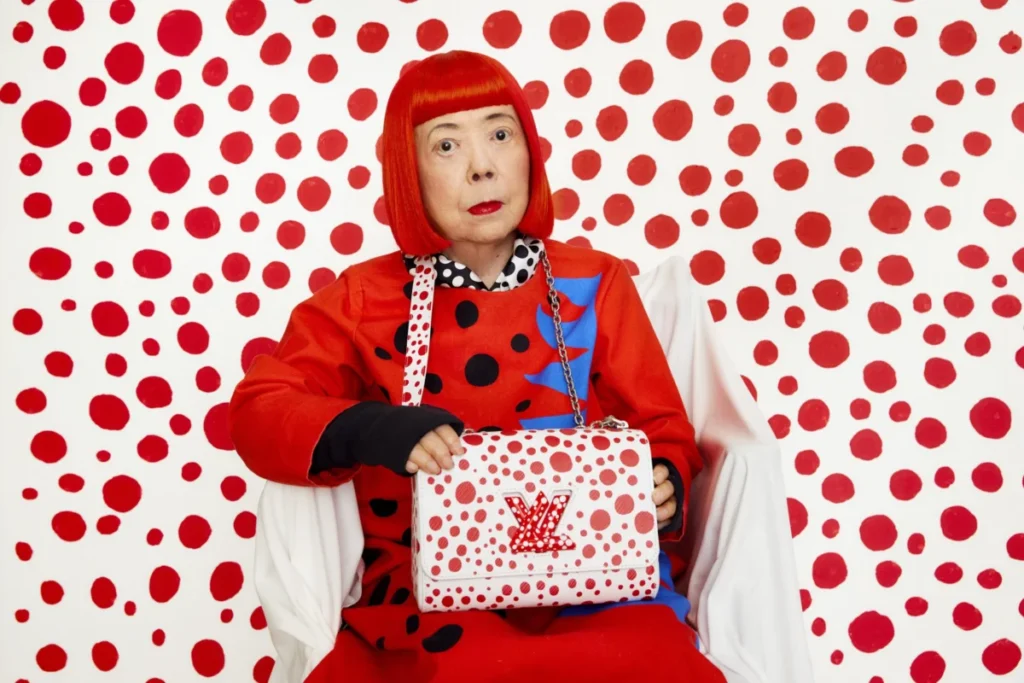
One of the most defining aspects of Kusama’s late-career visibility was her unlikely but triumphant partnership with the French luxury house Louis Vuitton. The collaboration bridged the gap between high art and high fashion, making her distinct aesthetic accessible to a global audience.
The genesis of this relationship dates back to 2006, when then-creative director Marc Jacobs visited Kusama in her Tokyo studio. During that encounter, she presented him with a classic Vuitton Ellipse bag, which she had personally customized with her hand-painted dots. That moment of artistic alchemy sparked a professional union that would span nearly two decades.
In 2012, the world saw the first official Louis Vuitton x Yayoi Kusama collection. It was a massive success, featuring handbags, ready-to-wear pieces, and accessories that utilized her iconic tentacles and polka-dot patterns. However, it was the 2023 follow-up collection that truly demonstrated the depth of the partnership. Conceived entirely during the isolation of the COVID-19 pandemic, the collaboration relied on digital technology and remote communication to bring her vision to the global stage.
Delphine Arnault, reflecting on the project in 2022, noted, "One of the aspects of her work is happiness, and we thought it would be really refreshing after the pandemic to have the worlds of Vuitton and the world of Kusama meet again."

Official Tributes and Reflections
The death of Kusama prompted an outpouring of grief and reverence from the highest echelons of the creative and business worlds. Pietro Beccari, chairman and CEO of Louis Vuitton, issued a formal statement reflecting on her monumental impact.
"She shaped her life and work with extraordinary freedom, imagination, and vision, leaving an indelible mark on the art world over the past decades," Beccari stated. "It is a profound honor for everyone at Louis Vuitton to have collaborated with her. Her boundless creativity and singular vision have always been a tremendous source of inspiration. We extend our deepest condolences to her family, her loved ones, and all those who had the privilege of working alongside her."
David Zwirner, the gallerist who represented Kusama for many years, emphasized the historical weight of her contributions. "Kusama’s art influenced the histories of minimalism, pop art, and performance art; more recently her large-scale installations single-handedly pioneered what is now referred to as experiential art," Zwirner said. "She will go down in history books not just as a Japanese artist, but as one of the definitive figures of the 20th and 21st centuries."
The Philosophy of the Dot
Throughout her life, Kusama remained steadfast in her belief that business and art were not mutually exclusive. In a 2012 interview with WWD, she provided a poignant defense of her commercial collaborations.
"Be it a sculpture or be it clothes, for me it is the same thing. It’s my creation. I don’t see any difference. It is part of my art," she explained. "I will be an artist until the end of my life. If with the power of art, we can touch the hearts of people, it’s a wonderful thing—so why not with the help of business? In that sense, for me, business can also be a sort of art, especially in the fashion world."

Implications for the Art Market
The passing of a titan like Kusama inevitably carries significant weight for the art market. Over the last decade, her works—particularly the pumpkins and the dot-covered canvases—have consistently set records at auction houses globally.
Beyond the financial valuation, her death marks the end of an era for the "mid-century avant-garde." As the last of the legendary artists who bridged the gap between the 1950s New York experimentalists and the modern digital art age, her absence leaves a void in the global creative consciousness. However, her legacy is securely anchored. With major retrospectives housed in museums from the Whitney in New York to the Tate in London and the National Art Center in Tokyo, the "Kusama effect" will continue to be felt for generations.
A Lasting Vision
Perhaps the most lasting image of Kusama is not the artist herself, but the environment she created. Whether it was a room filled with yellow pumpkins, a space reflecting infinite lights, or a luxury handbag adorned with metallic dots, her work served as an invitation to lose oneself in her vision.
Kusama often spoke of "self-obliteration"—the idea that by covering herself and her surroundings in dots, she could disappear into the universe. In her death, she has achieved a form of immortality. She transformed her trauma into beauty, her isolation into connection, and her private visions into a public spectacle that the world will continue to study, wear, and celebrate.
As the art world turns the page, the polka-dot motif—once the hallmark of a young girl’s struggle—remains the permanent signature of a woman who proved that one person’s imagination is powerful enough to dot the entire globe.