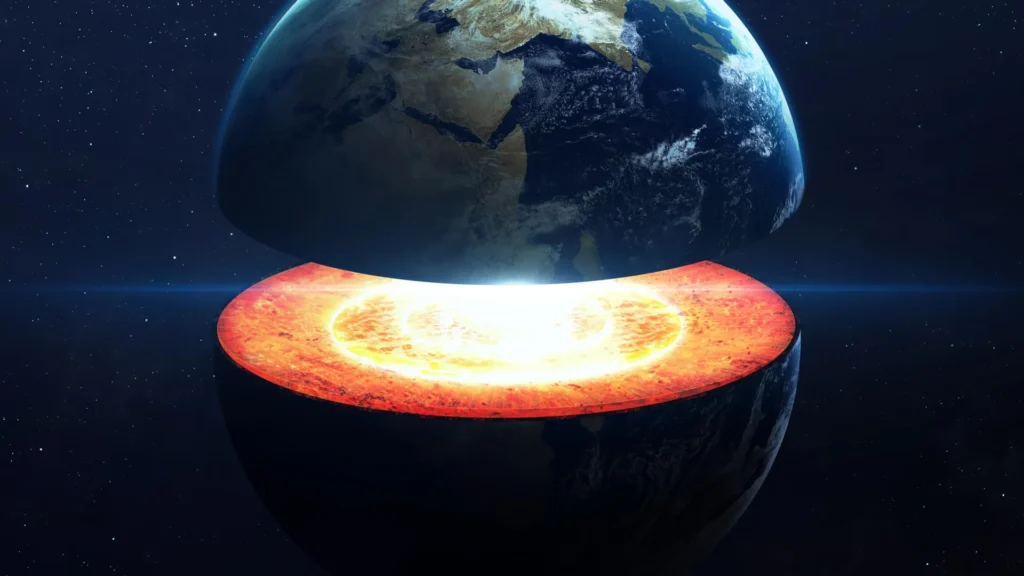
In the high-stakes world of plate tectonics, the "subduction zone"—the region where one of Earth’s massive crustal plates is forced beneath another—is typically viewed as a predictable, albeit violent, machine. For decades, geologists have relied on established thermal models to predict how these plates heat up as they sink into the Earth’s mantle. However, a singular, unassuming rock unearthed in Papua New Guinea has shattered these long-standing assumptions, revealing a complex thermal journey that challenges our understanding of the planet’s internal engine.
Published in the journal Nature Geoscience, an international research team led by the University of Göttingen has unveiled findings that suggest the Earth’s subduction zones are far more enigmatic than previously theorized. By analyzing a specimen of "eclogite"—a dense, metamorphic rock often associated with high-pressure environments—scientists have reconstructed a thermal history that indicates a surprising transition from hot to cool subduction, forcing a re-evaluation of how heat is distributed deep beneath our feet.
The Chronicles of a Deep-Earth Traveler
To understand the magnitude of this discovery, one must look at the timeline of the rock’s journey. Approximately four million years ago, this specific fragment of Earth’s crust began a harrowing descent into the planetary interior. As the tectonic plates shifted, this rock was pulled into the "subduction factory," eventually reaching depths exceeding 90 kilometers (56 miles).
The journey was not a simple, linear increase in temperature. Instead, the rock served as a geological data logger, recording the intense physical stresses of its descent. At a depth of 45 kilometers—roughly halfway to its ultimate destination—the rock was already experiencing temperatures of approximately 700°C (1,292°F). Under conventional geological models, one would expect the temperature to continue rising sharply as the rock delved deeper into the mantle.
However, as the rock descended the final 45 kilometers to its 90-kilometer resting point, the rate of heating slowed significantly. By the time it reached the 90-kilometer mark, it was at 800°C (1,472°F). While the temperature did technically increase, the delta was unexpectedly small, indicating that the rock had passed through a "hot" zone early in its descent, only to be buffered by a "cooler" environment later on. This transition—from a high-heat initiation to a cooler, stable subduction phase—is the smoking gun that has left the geological community searching for answers.
Microscopic Clues: The Science of Eclogite
The ability to reconstruct this journey rests on the shoulders of advanced analytical mineralogy. Eclogite is a metamorphic masterpiece, characterized by its vibrant red garnets and green pyroxene minerals, formed under the immense pressures of the Earth’s deep interior.
Within the Papua New Guinea specimen, researchers identified microscopic crystals of coesite. Coesite is a high-pressure polymorph of silica; it acts as a geological time capsule, forming only when a rock is subjected to extreme pressures that would otherwise crush less resilient materials. Because these crystals were trapped inside other minerals, they were shielded from the chemical changes that often occur as a rock returns to the surface.
By utilizing high-resolution mass spectrometry and electron backscatter diffraction, the team at Göttingen was able to read the "thermal signatures" embedded within the chemical composition of these minerals. This microscopic investigation provided the empirical backbone for the study, confirming that the rock’s history was not merely a theoretical exercise, but a physical reality that contradicts the standard thermal gradient models currently used in geosciences.
Official Responses and Scientific Inquiry
Dr. Jan Schönig, a lead researcher at the University of Göttingen’s Geoscience Center, has been vocal about the implications of the team’s work. "Finding this change from hot to cold subduction was unexpected as this contradicts our current thermal models of subduction zones," Dr. Schönig stated.
The scientific community, while initially skeptical, has lauded the rigor of the study. The research, supported by the German Research Foundation (DFG), represents a paradigm shift. For years, textbooks have taught that subduction zones follow a relatively steady increase in heat as plates descend. The "Schönig finding" suggests that there is a missing variable in the equation.
The researchers have proposed two primary hypotheses to explain the phenomenon. The first centers on "mechanical heating." As two tectonic plates grind against each other, the immense friction and shearing forces at the boundary may generate significant heat at relatively shallow depths. This would explain why the rock was already quite hot at 45 kilometers.
The second hypothesis suggests a temporal component: the subduction zone itself may have been in its infancy. If the tectonic process had not yet stabilized, the surrounding mantle might not have reached the equilibrium required by standard models, resulting in an initially hotter environment that cooled as the subduction zone matured over time. It is highly probable, the researchers note, that both mechanisms acted in tandem to produce the unique thermal signature found in the specimen.
Implications for Global Geological Systems
Why does the temperature of a rock in Papua New Guinea matter to the rest of the world? The implications of this study extend far beyond the laboratory, touching upon the fundamental processes that govern our planet’s stability.
Earthquakes and Volcanism
Subduction zones are the epicenter of the world’s most devastating natural disasters. They are the sites of "megathrust" earthquakes and the primary drivers of volcanic arcs. If our thermal models are inaccurate, our predictions regarding the rheology—the way rocks flow and break—of these subduction zones may be flawed. Understanding the precise temperature profile of a descending plate allows scientists to better predict the likelihood of plate rupture, which is essential for earthquake preparedness and hazard mitigation.
The Global Carbon Cycle
Perhaps the most significant long-term implication concerns the Earth’s climate. Subduction zones act as a planetary recycling center. As plates sink, they carry carbon-rich sediments from the ocean floor deep into the Earth’s mantle. This process, known as the long-term carbon cycle, is a primary thermostat for the planet. By sequestering carbon in the interior and releasing it later through volcanic outgassing, the Earth regulates its atmospheric CO2 levels over millions of years.
If the thermal history of subduction is different than we thought, it implies that the efficiency with which carbon is recycled—or returned to the atmosphere—may also differ. This discovery provides a new framework for climate scientists to examine how Earth has maintained its habitability over billions of years.
A New Roadmap for Tectonics
The discovery of this rock marks the first time that such a clear transition between two different thermal states has been observed in the geological record. It serves as a reminder that Earth’s interior is not a static, uniform environment, but a dynamic and often chaotic system.
As researchers look forward, the focus will shift toward finding similar samples in other subduction zones globally. By creating a library of these "thermal diaries," geologists hope to build a more accurate, three-dimensional map of how heat moves beneath our crust.
Ultimately, the Papua New Guinea rock has done more than just reveal a local geological quirk; it has opened a window into the deep past. It challenges the academic community to move beyond simplified models and embrace the complex, often contradictory, reality of our planet’s interior. In the words of the research team, this study is merely the beginning of a broader investigation into the "thermal memory" of the Earth—a memory that continues to shape our world, one tectonic shift at a time.