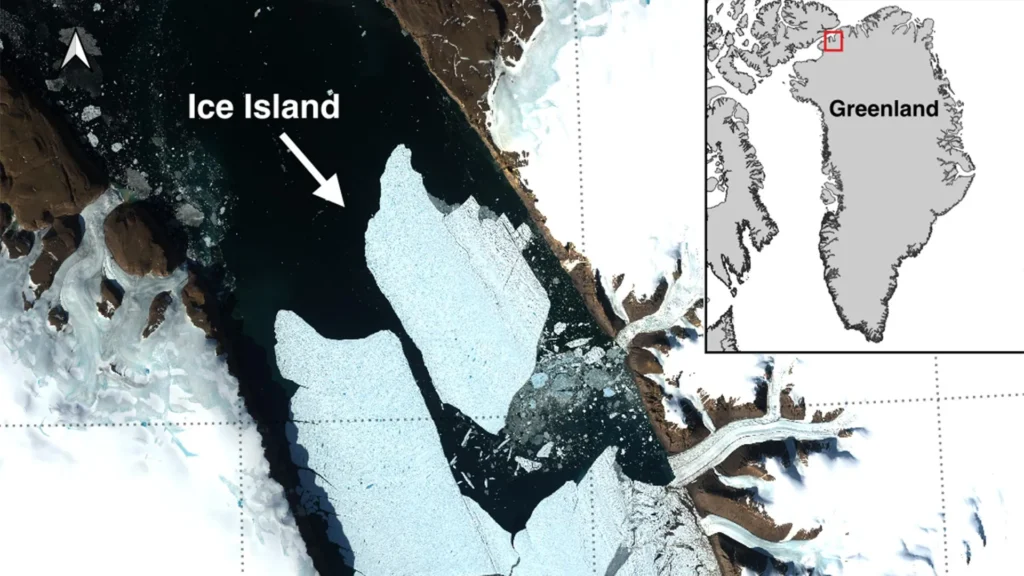
In a stark reminder of the accelerating changes reshaping the Arctic, a massive tabular iceberg—roughly the size of Manhattan—has detached from the Petermann Glacier in northwest Greenland. The event, which occurred on August 4, 2026, marks the largest loss of floating ice from the glacier since 2012 and stands as the most significant Arctic calving event recorded since 2020.
The breakaway, involving a 76.4-square-kilometer ice island estimated to be up to 150 meters thick, has captured the attention of the global scientific community. Led by researchers at the University of Ottawa (uOttawa) in collaboration with a coalition of international institutions, the observation of this event provides a critical, real-time window into the physical processes governing the retreat of polar ice shelves.
The Chronology of a Fracture
The separation of the ice island was not a sudden, unpredictable anomaly, but the culmination of years of structural degradation. Scientists have been monitoring the Petermann Glacier’s floating ice tongue—one of the largest remaining in Greenland—with persistent satellite surveillance since 2019.
Years of Building Instability
As early as five years ago, glaciologists began noting the expansion of significant fractures along the centerline of the ice tongue. These rifts served as the "canary in the coal mine," signaling that the structural integrity of the floating shelf was being systematically compromised.
Adam Garbo, a PhD student in glaciology at uOttawa’s Department of Geography, Environment and Geomatics, spearheaded the monitoring efforts. "Petermann Glacier has long been one of Greenland’s largest remaining ice tongues," Garbo noted. "We’ve anticipated this break for years, and seeing it finally happen is remarkable. It confirms that the underlying mechanisms we’ve been tracking via satellite are translating into tangible physical change."
The Final Hours
The final stages of the detachment were captured with clinical precision by the European Space Agency’s (ESA) Sentinel-1 mission. On August 3, 2026, satellite imagery revealed acute deterioration along the central axis of the ice tongue. By 20:00 UTC on August 4, the connection between the main glacier and the eastern ice mass had been severed, sending a massive slab of glacial ice into the Nares Strait.
Supporting Data: By the Numbers
The scale of the August 4 event is significant, but it is merely the first act in a larger drama of ice shelf retreat. The data provided by the research consortium paints a concerning picture of the glacier’s immediate future.
Current and Projected Losses
- The August 4 Event: 76.4 km² of ice, with a thickness of approximately 150 meters.
- Near-Future Projections: Researchers have identified two additional massive sections of the floating tongue that are currently unstable. These sections measure approximately 94 km² and 84 km² respectively.
- Cumulative Impact: Should these two remaining sections detach—a scenario deemed highly likely by the team—the total area lost by the Petermann Glacier’s tongue would reach 254 km².
- Total Reduction: This cumulative loss represents a reduction of approximately 22% of the total floating ice tongue, a substantial contraction in a very short timeframe.
The research team, which includes experts from the University of Stirling, Environment and Climate Change Canada (ECCC), Lancaster University, and the University of Leeds, continues to synthesize this data to model the long-term viability of the remaining ice tongue.
A Window Into Polar Change: The Rarity of Arctic Ice Islands
While tabular icebergs—flat-topped, steep-sided masses of ice—are a staple of the Antarctic landscape, they are an anomaly in the Arctic. This makes the Petermann event a high-value case study for researchers.
"While large, tabular icebergs are relatively common in the Southern Ocean that surrounds the Antarctic Ice Sheet, Arctic ice islands are far rarer," explains Dr. Anna Crawford of the University of Stirling. "By studying Arctic ice islands, we will gain knowledge that can be transferred across Polar regions, helping us understand how these massive ice bodies move, fragment, and eventually melt as they migrate through changing ocean currents."
The study of these ice islands is crucial for several reasons:
- Oceanic Interaction: Observing how the iceberg interacts with the warmer, changing waters of the North Atlantic provides data on the thermodynamic exchange between ice and sea.
- Structural Dynamics: The way the iceberg fragments after detachment helps scientists understand the "fracture mechanics" of glaciers, which is vital for predicting future sea-level contributions.
- Longevity: Because these islands can persist for years, they act as long-term floating laboratories, carrying glacial history and environmental data far from their point of origin.
Official Responses and Safety Implications
The detachment of a 76-square-kilometer block of ice is not merely a scientific interest; it is a significant maritime concern. Environment and Climate Change Canada (ECCC), through the Canadian Ice Service, has already initiated tracking protocols to monitor the ice island’s trajectory.
Risks to Maritime Infrastructure
"These are thick blocks of ice that can drift for years," says Dr. Abigail Dalton of the Canadian Ice Service. "Over time, they fracture into smaller, harder-to-track pieces that pose hazards to vessels and resource operations."
The danger lies in the iceberg’s transition. As it drifts south, it will inevitably experience "calving of its own," shedding smaller, jagged bergs that are difficult for radar to distinguish from waves or other clutter. For commercial shipping lanes and offshore resource extraction operations in the Arctic, these remnants represent a persistent, moving hazard that requires constant vigilance.
ECCC is working in tandem with the international research team to provide updated forecasts to mariners, ensuring that the movement of the island is accounted for in navigational safety protocols.
Implications: The Future of the Petermann Glacier
The events of August 2026 are part of a broader, more systemic trend of Arctic retreat. The Petermann Glacier serves as a vital indicator of the health of the Greenland Ice Sheet. As the floating ice tongue continues to thin and fracture, the "back pressure" it provides to the grounded ice upstream is reduced. This can lead to an acceleration of the glacier’s flow, contributing more significantly to global sea-level rise.
A Multidisciplinary Path Forward
The collaboration between uOttawa, the University of Stirling, and their partners is a model for modern glaciology. By combining satellite telemetry, aerial surveillance, and on-the-ground modeling, the team is attempting to move from reactive observation to predictive analysis.
"We are not just watching the ice break," Adam Garbo remarked in a follow-up interview. "We are documenting the processes responsible for the retreat of Arctic ice shelves. Every piece of data we collect helps us understand the threshold at which these ice tongues collapse."
The Road Ahead
As the August 4 ice island continues its journey, the research team is deploying every available tool to track its evolution. Satellite imagery remains the primary diagnostic tool, but plans are in place for aerial reconnaissance as the ice reaches more accessible zones.
The scientific community agrees on one point: the Petermann Glacier is entering a new phase of its life cycle. Whether this phase leads to a complete loss of the floating tongue or a temporary stabilization remains the subject of intense investigation. For now, the world is watching a massive, shifting monument of ice, a silent witness to the profound environmental shifts occurring at the top of the world.
As the Arctic continues to warm at a rate significantly faster than the global average, the "Manhattan of ice" serves as both a scientific opportunity and a stark, visual warning of the fragility of the polar environment. The coming months, as the two additional sections of the Petermann tongue face their own potential detachment, will be critical in determining the trajectory of this iconic glacier.