

The global art market witnessed a seismic shift this Tuesday as Sotheby’s London concluded its modern and contemporary South Asian art auction with a staggering total of £19.8 million ($26.2 million). This result stands as the highest figure ever realized for this specific category in the auction house’s storied history.
The sale, which featured 73 meticulously curated lots, achieved a near-perfect sell-through rate of 99%. Perhaps most impressively, 89% of the works sold exceeded their high-end presale estimates, signaling a robust and aggressive appetite from international collectors. This performance comfortably eclipses the previous category record of £18.9 million ($25.5 million), which was established by Sotheby’s London just one year prior, proving that the market for South Asian masterworks is not merely steady—it is accelerating.
A Chronology of Market Momentum
The trajectory of South Asian art over the last decade has been nothing short of transformative. Once considered a niche area of interest primarily for regional collectors, the category has successfully transitioned into a pillar of the global contemporary art market.
Looking back at the recent history of this evolution, the 2019 sale of Bhupen Khakhar’s Two Men in Benares for $3.2 million served as a major turning point, placing the artist firmly in the international spotlight. By 2023, the market momentum gained further velocity when M.F. Husain’s Untitled (Gram Yatra) shattered records at Christie’s New York, selling for $13.8 million to preeminent collector Kiran Nadar.
This Tuesday’s auction acts as the latest chapter in this narrative. The event saw a flurry of bidding activity that resulted in fresh auction records for a diverse cohort of artists, including Antonio Piedade da Cruz, Sunayani Devi, Olinto Ghilardi, Gopal Ghose, Bhupen Khakhar, Dhruva Mistry, Hugo Vilfred Pedersen, Mohan Sharma, and the literary and artistic titan Rabindranath Tagore. The breadth of these records suggests that collectors are no longer focusing solely on a handful of blue-chip names, but are actively seeking depth and historical breadth across the South Asian canon.
The Titans of the Sale: Key Performances
The auction was defined by three standout lots that dominated headlines and commanded intense competitive bidding.
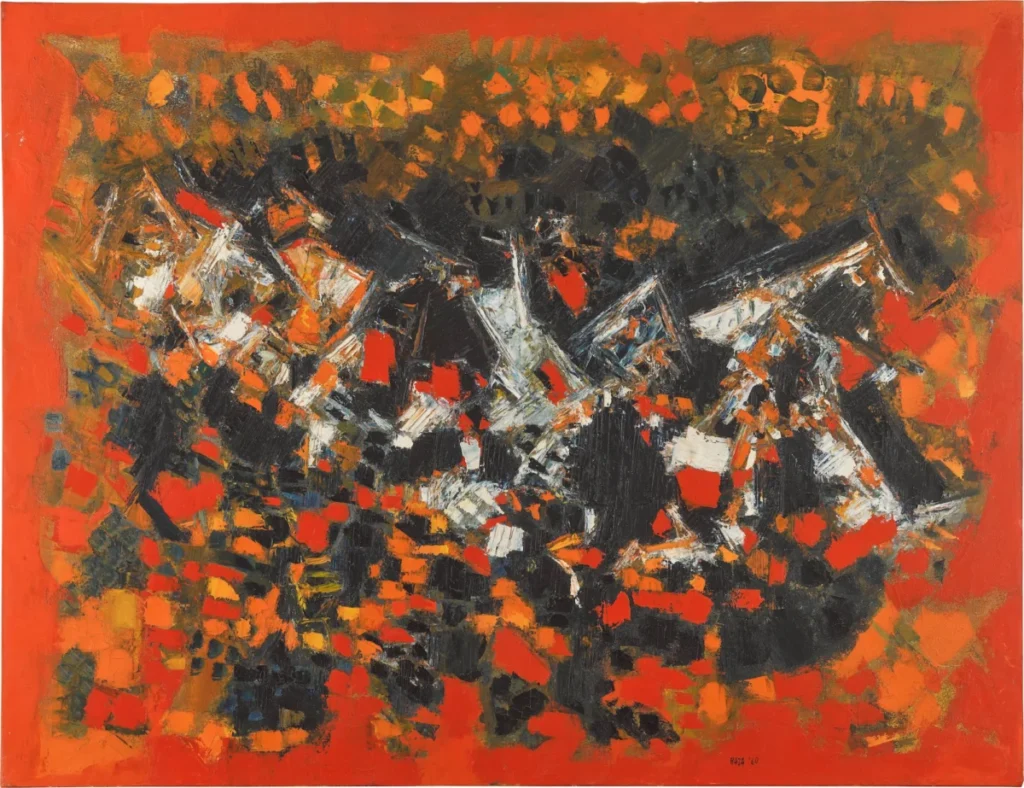
S.H. Raza’s Paysage Rouge (1960)
The crown jewel of the evening was undoubtedly Sayed Haider (S.H.) Raza’s 1960 abstract landscape, Paysage Rouge. Estimated conservatively, the work defied expectations to fetch £3.8 million (nearly $5 million)—a figure ten times its high estimate. This result marks the third-highest price ever paid for an S.H. Raza work, sitting just behind his current auction record of $5.6 million, set at Sotheby’s New York in 2024. As noted in ARTnews during the artist’s 2023 Centre Pompidou retrospective, Raza’s work captures a "fascinating life of artistic question and response, battled out on canvas." This sale confirms that his status as a titan of modernism remains unassailable.
Bhupen Khakhar’s Old Men Playing Chess
Securing the second-highest price of the night was Bhupen Khakhar’s undated painting, Old Men Playing Chess. Carrying a presale estimate of £700,000 ($926,000), the work was the subject of an intense bidding war that eventually drove the final price to £3.1 million ($4.2 million). This represents a new auction record for Khakhar. The painting, which depicts a vast, sun-drenched orange landscape dwarfing two elderly figures, serves as a quintessential example of the artist’s unique ability to blend intimate human moments with a surreal, expansive sense of place.
M.F. Husain’s Mithuna Crimson
Rounding out the top three was M.F. Husain’s Mithuna Crimson, which sold for £2.7 million ($3.5 million), significantly outpacing its £600,000 high estimate. The provenance of this piece tells a remarkable story of market appreciation: the seller originally acquired the painting at Sotheby’s New York in 2000 for a modest $28,350. The leap from that initial investment to its current valuation represents a 123,000-fold increase, a testament to the surging institutional and private interest in Husain’s body of work, further bolstered by the opening of a dedicated museum for the artist in Doha last year.

Official Perspectives: The Institutional View
Manjari Sihare-Sution, Sotheby’s worldwide head of modern and contemporary South Asian art, expressed deep satisfaction with the results in a post-sale press announcement.
"This has been an extraordinary sale for the department—our highest total in history, surpassing the record we set in London only last year," Sihare-Sution noted. "With nine new artist records, the results reflect both the depth of the market and the increasingly international appreciation for South Asian art."
Her sentiment highlights a critical shift: the "internationalization" of the category. No longer reliant on a purely domestic base, the South Asian art market is now sustained by a global network of museums, institutional buyers, and private collectors from Europe, North America, and the Middle East who recognize the historical significance of these artists.
Implications for the Future of the Market
The implications of Tuesday’s results are significant for both the auction house and the broader art world.
Institutional Validation
The sustained high prices are fueling a virtuous cycle of institutional interest. When paintings like those of M.F. Husain or Rabindranath Tagore—whose Untitled (Head of a Woman) achieved a record-breaking $1.4 million in this sale—regularly fetch seven-figure sums, they become "must-haves" for major international museums. This institutional validation, in turn, drives further interest among private collectors, who see these works as both cultural treasures and sound financial assets.
The Widening Scope of Collection
Perhaps the most encouraging takeaway from the sale is the success of lesser-known or historically significant artists such as Sunayani Devi and Antonio Piedade da Cruz. The fact that nine distinct artists achieved new records suggests that the market is currently in a "discovery phase." Collectors are moving beyond the most famous names and are willing to pay significant premiums for works that demonstrate technical mastery, historical importance, and unique provenance.
Sustainability of Growth
While some market observers often caution against the volatility of high-growth sectors, the 99% sell-through rate at Sotheby’s suggests a healthy, liquid market. There is a clear appetite for high-quality works, and provided that fresh, high-quality inventory continues to surface, there is little indication that this momentum will wane in the near term.
Looking Ahead
As we look toward the 2026-2027 auction cycle, the question remains: what is the ceiling for South Asian art? With major exhibitions in Doha, Paris, and beyond, the narrative of South Asian modernism is being rewritten to reflect its rightful place in the global canon. For now, Sotheby’s has set a high bar, and the eyes of the art world will undoubtedly remain fixed on London as the next benchmark for this vibrant, rapidly expanding market.



