

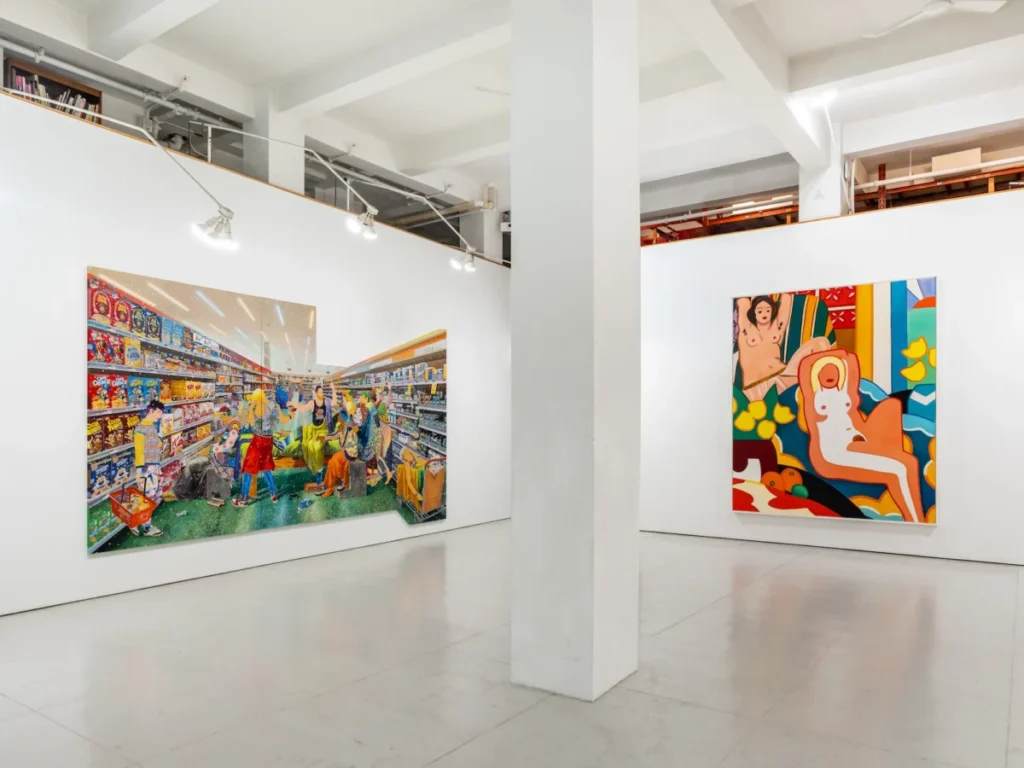
In the high-stakes, fast-paced ecosystem of New York’s art scene, where blue-chip galleries often feel like sanitized, white-cube cathedrals, a rare and intimate encounter has emerged in the East Village. The estate of Pop Art titan Tom Wesselmann has opened the doors to the artist’s final studio—a space largely untouched since his passing in 2004—to host a singular, immersive exhibition featuring Japanese American contemporary artist Tomokazu Matsuyama.
Open to the public by appointment through September 27, the exhibition coincides with the frenetic energy of Armory Week, providing a contemplative, historical anchor for the thousands of collectors, curators, and dealers descending upon the city. It is not merely an exhibition; it is a séance of sorts, where the physical vestiges of Wesselmann’s creative process—from paint-caked brushes to his labeled studio gloves—serve as the backdrop for Matsuyama’s vibrant, neon-drenched exploration of global consumerism.
A Ghostly Residency: The Setting as Subject
To walk into Wesselmann’s 4,000-square-foot studio is to step into a time capsule of 20th-century American art. The walls breathe with the history of a man who helped define the Pop aesthetic. For Tomokazu Matsuyama, the act of exhibiting here has been a transformative, albeit surreal, experience.
"It’s like wearing someone else’s underwear and saying it’s mine!" Matsuyama quipped during an interview in the studio, gesturing toward the surrounding ephemera. The juxtaposition is deliberate. By placing his own highly complex, layered canvases alongside Wesselmann’s crisp, graphic compositions, Matsuyama creates a dialogue that spans generational and cultural divides. The studio—a place of labor, solitude, and invention—becomes a third participant in the show, bridging the gap between the mid-century American master and the contemporary global artist.
The Chronology of a Collaboration
The genesis of this partnership can be traced back to the 2024 exhibition Pop Forever, Tom Wesselmann &… at the Fondation Louis Vuitton in Paris. The retrospective was a landmark event, positioning Wesselmann not as a historical artifact, but as a living force capable of standing alongside current luminaries like Derrick Adams, Jeff Koons, and Mickalene Thomas.

As noted by ARTnews critic Sarah Douglas at the time, the Paris exhibition successfully "bookended" Wesselmann with his Pop peers and the hottest contemporary voices, cementing his relevance in the 21st-century market. It was during this period of renewed critical scrutiny that the Wesselmann estate, represented by Jeffrey Sturges, recognized an intellectual and aesthetic kinship between the late artist and Matsuyama.
Following the success of the Paris show, the estate invited Matsuyama to deepen his engagement with Wesselmann’s legacy. The result is a curated selection of seven Wesselmann works, spanning from the 1960s to 2003, and five of Matsuyama’s latest pieces, three of which were created specifically for this studio environment.
Supporting Data: Market Presence and Artistic Scale
The professional stature of both artists provides a compelling foundation for the exhibition. Matsuyama has become a formidable force in the contemporary market, with a current auction high of $647,125, achieved at Sotheby’s Hong Kong in 2023. His consistent performance—with 33 works having cleared the six-figure threshold—suggests a growing institutional and private appetite for his brand of hyper-saturated, culturally hybrid art.
Conversely, Wesselmann occupies the firmament of established art history. With roughly 65 works achieving prices north of $1 million, his market is robust. However, as some analysts have noted, his $10.7 million auction record, set at Sotheby’s New York in 2008, is arguably modest compared to some of his Pop Art contemporaries like Warhol or Lichtenstein. This discrepancy, however, often highlights the unique, non-commercial nature of the estate’s current projects, which focus on intellectual legacy over mere market speculation.
Analytical Juxtapositions: From Bread to Froot Loops
The heart of the exhibition lies in the direct visual correlations between the two artists. Nowhere is this more apparent than in the pairing of Wesselmann’s 16-foot-wide Still Life #35 (1963) with Matsuyama’s We the People (2025).

Wesselmann’s Still Life #35 is a quintessential Pop statement: a hyper-real rendering of supermarket staples—bread, cigarettes, and Royal Crown cola. It is a work of clinical detachment, capturing the banality of the American dream. Matsuyama’s response, We the People, acts as a maximalist evolution of that concept. Referencing Jacques-Louis David’s The Death of Socrates, Matsuyama transports the scene to a modern-day Costco. The "hemlock" is replaced by a cup of Froot Loops, and the background is cluttered with diabetes medications. It is a commentary on the "consumer-citizen," where moral philosophy is inextricably tangled with the aisles of mass-market retail.
While Wesselmann’s influence on Matsuyama is clear, the latter’s process is distinctly more labor-intensive. During the installation, Jeffrey Sturges remarked on the depth of Matsuyama’s research, to which the artist replied that the preparatory study often outlasts the actual painting process. This intensity is visible in the final works, which function as dense, encyclopedic collages of art history—pulling from Matisse, Yves Klein, Whistler, and Japanese textiles—rendered with an almost digital precision.
Intimacy and Exposure: The Bedroom Series
Perhaps the most poignant selections in the show are the pieces from Wesselmann’s "Bedroom Paintings" series, which began in 1967. These works, featuring intimate, cropped views of the human form alongside domestic objects, resonate with the personal nature of the studio.
One standout, Bedroom Painting #19 (1969), is a provocative inclusion that borders on the pornographic, depicting the artist’s own genitalia. For Matsuyama, these works provide a window into a specific American vulnerability. Having migrated to New York from Japan, Matsuyama recalls his fascination with American home design magazines, which encouraged a level of domestic exposure that felt alien in his native culture. The "Bedroom Paintings" represent that intersection of the private self and the public gaze, a theme that Matsuyama continues to navigate in his own practice.
Official Responses and Strategic Implications
When asked if the exhibition might travel, the representatives from the estate remained circumspect. The site-specificity of the show—the way it is anchored to Wesselmann’s physical tools, his ghosts, and his workspace—is fundamentally irreproducible.

"You see a lot of shows pairing artists, but it’s not always clear what they bring beyond what two solo exhibitions might," Jeffrey Sturges explained. Yet, his tone suggests that this project is intended to be more than a one-off. By treating the studio as a living gallery, the estate is testing a new model for artistic legacy management—one that favors experiential, context-heavy curation over the standard museum retrospective.
Sturges describes the current exhibition as a "proposal"—a way of seeing art that demands a different kind of engagement from the viewer. For the collector or the casual visitor, the experience is designed to be disruptive. It forces one to consider how the "Pop" impulse has evolved from the mid-century critique of the supermarket to the contemporary, fragmented reality of a globalized digital existence.
Conclusion: A Living Legacy
As Armory Week brings a surge of commerce to New York, the Wesselmann X Matsuyama exhibition stands as a quiet, powerful anomaly. It is a rare opportunity to see an artist’s final workspace not as a tomb, but as a site of continued innovation. By allowing Matsuyama to inhabit this space, the Wesselmann estate has managed to bridge the distance between two eras, proving that the questions raised by Pop Art—about consumerism, identity, and the American experience—are as urgent today as they were in 1963.
For those interested in witnessing this dialogue, appointments can be requested by contacting the studio directly at [email protected]. As the final days of the exhibition approach, it serves as a timely reminder that while art objects may be bought and sold at auction, the true value of an artist’s legacy lies in their ability to speak to the future.



