

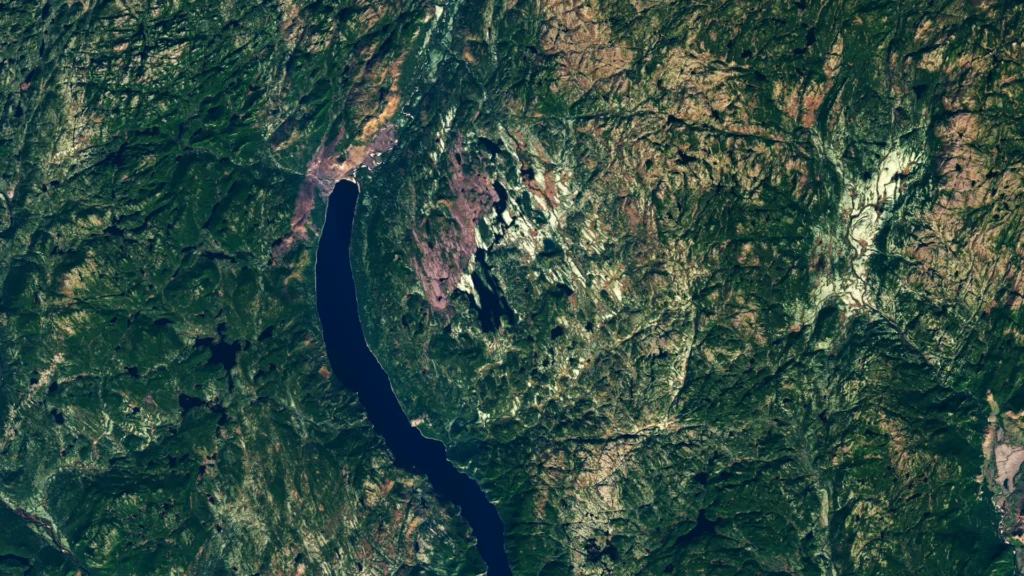
In the vast, untamed wilderness of Quebec’s Côte-Nord region, a monumental secret lay buried beneath layers of dense forest and rugged, unforgiving terrain for hundreds of millions of years. It remained hidden in plain sight, visible only to those who knew exactly how—and where—to look. That changed in 2024, when Joël Lapointe, an amateur astronomer with a penchant for satellite imagery and a planned camping trip, stumbled upon a feature that would fundamentally reshape the geological map of North America.
What Lapointe initially mistook for a curious geographic oddity has now been confirmed by an international team of planetary geologists as a massive, 25-kilometer-wide impact crater. Now dubbed "Uhackatik," this ancient scar serves as a stark reminder of Earth’s violent cosmic history and the profound role that citizen science plays in modern discovery.
The Discovery: From Satellite Maps to Remote Wilderness
The story of Uhackatik began not in a high-tech laboratory, but on a computer screen. Joël Lapointe, while meticulously planning a trek into the remote reaches of Quebec, was scouting the area near Lake Marsal using online satellite mapping software. His eyes were drawn to an unmistakable, near-perfect circular depression in the landscape.
Driven by curiosity, Lapointe reached out to experts in Europe and North America, asking a simple but profound question: Could this be an impact crater? His inquiry caught the attention of a group of French researchers who, upon analyzing the topography, presented the site as a potential 11th impact structure in Quebec during a 2024 meeting of the Meteoritical Society.
The potential discovery eventually crossed the desk of Dr. Gordon Osinski, a preeminent planetary geologist at Western University and the director of the Impact Earth database. Though seasoned in the study of terrestrial impact structures, Osinski was initially skeptical. "Circular features in geology can be deceptive," he noted. "Diatremes, sinkholes, and even volcanic processes can mimic the signature of an impact."
However, the sheer scale of the feature near Lake Marsal was enough to warrant an on-site investigation. In October 2025, Osinski organized an expedition into the heart of the Côte-Nord, a journey that would push his team to their physical limits.
Chronology: A Trial by Nature
The expedition to Uhackatik was, by all accounts, a grueling ordeal. Reaching the site required a combination of aviation and sheer grit. The team arrived via floatplane, but the landing was only the beginning. The terrain proved so inaccessible that the aircraft could not reach the shoreline, forcing the scientists to wade through 50 meters (165 feet) of frigid, marshy water, hauling their specialized equipment on their backs.
Once on land, the situation worsened. Osinski described the environment as a labyrinth of "deep, twisty, gnarly vegetation" combined with treacherous, swampy ground. Having conducted geological fieldwork on six continents, Osinski ranked the Uhackatik site among the most difficult environments he had ever navigated.
For the first day, the team found only frustration. Previous geological surveys of the region had classified the local breccia—a rock composed of broken fragments of minerals or rock cemented together—as evidence of a "diatreme," or a volcanic pipe formed by explosive magma. It wasn’t until the second day of the expedition that the narrative changed. As the team pushed further into the outcrop, they discovered the "smoking gun" of planetary science: shatter cones.
The Geological Evidence: Shatter Cones and Ancient Impacts
Shatter cones are rare geological features that form only under the extreme, instantaneous pressure generated by the shockwaves of a hypervelocity meteorite impact. They appear as radiating, conical fractures in bedrock. For a geologist, finding a shatter cone is the equivalent of finding a signed confession from the universe.
"It’s the only unequivocal evidence of an impact event that you can see in the field with the naked eye," Dr. Osinski explained. The presence of these cones, combined with the site’s central uplift and high cliffs displaying columnar jointing, confirmed that the area was not volcanic, but the result of a massive celestial collision.
The Physics of Catastrophe
The impact that created Uhackatik was an event of apocalyptic proportions. Roughly 390 million years ago, a massive bolide—an asteroid or comet—struck the Earth’s surface with such force that it carved out a complex crater 25 kilometers (16 miles) wide.
Dr. Osinski’s team estimates that if such an event were to occur in modern-day Quebec, the result would be catastrophic. "It would cause regional devastation on a scale that would wipe out major cities and have global climate impacts," he said. The energy release would trigger widespread firestorms, atmospheric disturbances, and, depending on the angle of entry, a significant injection of pulverized rock and aerosolized material into the upper atmosphere, potentially altering the global climate for years.
Official Responses and Implications
The scientific community has responded with cautious excitement. While the team considers the impact origin to be effectively confirmed, the Meteoritical Society—the international authority on such matters—is expected to provide formal, final recognition of Uhackatik during its next assembly.
The name "Uhackatik" was chosen following respectful consultations with the Innu Council of Ekuanitshit, honoring the indigenous history of the land upon which this celestial event occurred.
A Wider Pattern?
The timing of the Uhackatik impact is particularly intriguing to geologists. At approximately 390 million years old, the crater formed roughly 100 million years before a known, significant "spike" in terrestrial cratering. Some researchers hypothesize that this surge was linked to a massive breakup event in the asteroid belt, which sent a flurry of debris toward the inner planets. Uhackatik may represent an early warning sign of this period of increased solar system instability.
The Limits of Accessibility: Why Uhackatik Won’t Train Astronauts
Given Dr. Osinski’s role as a member of NASA’s first Artemis Geology Team, one might assume that a newly discovered, well-preserved impact crater would be an ideal training ground for future lunar explorers. However, Osinski is quick to dampen those expectations.
"The logistics are simply too severe," he explained. While NASA has utilized the Kameshtashtan (Mistastin Lake) crater in Labrador for astronaut training, that site is significantly more accessible. The "gnarly" vegetation, swampy terrain, and isolation of Uhackatik make it a scientific treasure but a logistical nightmare for training missions. For now, the crater will remain a site for dedicated geologists rather than a classroom for the next generation of moonwalkers.
The Power of Citizen Science
The discovery of Uhackatik stands as a testament to the democratization of scientific exploration. Joël Lapointe, an amateur with no formal background in geology, utilized the same satellite tools available to millions of people to make a discovery that had eluded professional geologists for decades.
"I encourage everyone to not ignore intuition or an observation, even if it isn’t part of your field of expertise," Lapointe told the press. His journey from a casual mapper to a contributor to a major scientific finding is a powerful reminder that the era of the "armchair explorer" is far from over.
For those inspired by Lapointe’s success, the path to contribution is clearer than ever. NASA’s citizen science programs, such as the Daily Minor Planet project, allow volunteers to scan data for asteroids and comets that could pose a threat to our planet. Others, like the Impact Flash initiative, invite participants to monitor the lunar surface for flashes caused by meteoroid strikes, while the Exoasteroids project pushes the search for debris into the far reaches of our galaxy.
Conclusion: A Living Planet
As we look toward the stars, it is easy to forget that Earth itself is a record of our violent, formative past. Uhackatik is more than just a geological curiosity; it is a time capsule from 390 million years ago, a bridge between the quiet, green wilderness of modern Quebec and the fire-and-brimstone reality of the early solar system.
The discovery of this crater confirms that there is still much to learn about our own backyard. With the aid of global satellite imagery and the collective curiosity of the public, researchers are slowly uncovering the hidden history of the planet—one circle in the forest at a time. The next great discovery may not be waiting in a deep space telescope, but on a map of a remote, swampy, and seemingly ordinary patch of earth, just waiting for someone to notice that something is not quite right.



