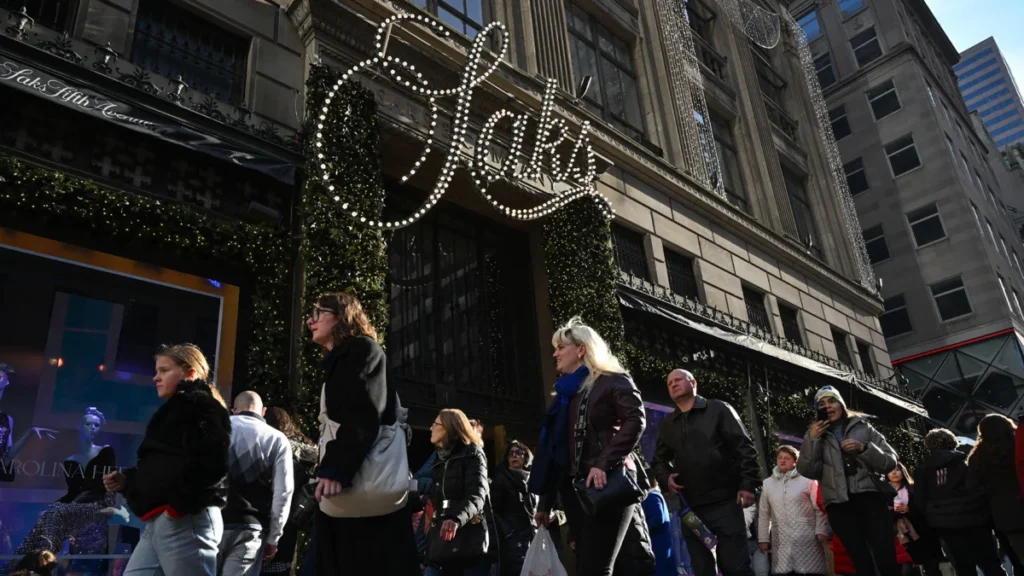
Long before the era of algorithmic retail and hyper-personalized digital feeds, the luxury shopping experience in America was defined by a single, towering institution: Saks Fifth Avenue. For generations, the name was synonymous with prestige, an arbiter of elegance that curated the finest goods from the world’s most storied fashion houses. From the butter-soft calfskin gloves and exquisite cashmere cardigans under its own private label to the curated racks of Oscar de la Renta, Armani, and Zegna, Saks was the undisputed "destination" for the discerning buyer.
"Saks is New York," Donatella Versace once famously declared inside the retailer’s Midtown flagship. That sentiment, however, transcended the city’s geography. Whether in a sprawling suburban mall or the heart of Manhattan, a Saks store was a sanctuary of style. Yet, today, the brand stands at a precarious crossroads, having navigated a tumultuous period of financial instability, a high-profile merger, and a bankruptcy filing that threatened to erase its legacy entirely.
A Chronicle of Decline: From 10022-SHOE to Chapter 11
The prestige of Saks was perhaps best encapsulated by its Manhattan flagship, which in 2007 achieved a level of cultural immortality when the United States Postal Service granted its legendary eighth-floor designer-shoe department its own zip code: 10022-SHOE. It was a massive, bustling temple to footwear, featuring labels like Manolo Blahnik, Roger Vivier, and Christian Louboutin. It was a place where, as the 2008 film The Women put it, "Nobody. Hates. Saks."

But the luster began to fade as the retail landscape shifted. The rise of e-commerce, the direct-to-consumer model, and a post-pandemic shift in fashion sensibilities—away from formal suits and ties toward more casual attire—left the grand department store model looking increasingly antiquated.
The turning point, however, was internal. The company’s trajectory darkened following the 2024 acquisition of Neiman Marcus. This consolidation, intended to create a luxury powerhouse, instead saddled the newly formed entity, Saks Global, with a staggering $3.4 billion in debt. The financial strain became visible to the public, as the store’s once-curated floors began to suffer from sparse inventory, inconsistent sizing, and a general loss of the "Saks magic." By January 2026, the company was forced to file for Chapter 11 bankruptcy protection. Following a restructuring, the entity emerged in June under a new banner: Exemplar Luxury Group.
The Real Estate Entanglement: A Governance Controversy
At the center of the controversy sits Richard Baker, the former Hudson’s Bay Company (HBC) governor and executive chairman of Saks Global. Baker’s tenure has been marked by intense scrutiny from retail analysts and creditors alike. Critics argue that Baker’s background—he is a real estate magnate first and a retailer second—led to a strategic focus on property monetization rather than the delicate, relationship-heavy business of luxury fashion.

The evidence of this "real estate first" philosophy was apparent in the company’s own corporate communications. A July 2024 press release described the merger not as a fashion union, but as "a combination of world-class luxury retail and real-estate assets."
This approach alienated the very partners that sustained the business. Lorenzo Marinuzzi, a partner at the law firm Morrison Foerster, which represented unsecured creditors like Chanel and LVMH, notes that the company’s financial obligations to HBC and the burden of debt-servicing left little liquidity for vendors. "When you’re telling your vendors that you don’t have money to pay them for goods they’ve sold or shipped, yet you’re paying off this Hudson’s Bay debt, it rubs people the wrong way," Marinuzzi explains.
The Human and Financial Cost: Voices from the Floor
The breakdown in the supply chain caused a ripple effect that devastated both small and large businesses. As the company struggled to pay its debts, it began routing communications to offshore support centers in Bengaluru, India. For many designers, this was the final straw.

"You’re trying to explain to India how you work," says Daniel Wingate, founder and creative director of the apparel brand Wingate. "In the end, it felt like that was a stunt to just delay your payments."
The impact on smaller, independent labels was particularly brutal. One executive at a critically acclaimed beauty brand revealed that they were owed "six figures," a loss that forced them to cut staff and abandon marketing initiatives. Another fashion brand reported that the "cash vacuum" created by Saks Global’s non-payment would likely stall their growth trajectory by five years.
Anita Berger, a former senior salesperson at the St. Louis Saks location—which closed in May 2026—described the daily reality of working on a dying floor. "Customers would come in and say, ‘Are you closing? This looks like Saks Off 5th,’" she recalls. "There was nothing new and exciting because they couldn’t get anything—they owed money to everybody."

Supporting Data: The Scale of the Debt
The court filings from January 2026 painted a grim picture of the retailer’s obligations to the fashion world:
- Chanel: $136 million
- Kering (Gucci, Saint Laurent, Bottega Veneta): $60 million
- Richemont (Cartier, Montblanc, Chloé): $30 million
- Estée Lauder Companies: $16 million
While industry giants were able to absorb these losses through their diverse distribution channels, independent brands faced an existential threat. Gary Wassner, CEO of the financing firm Hilldun, which guarantees payments for roughly 180 brands, noted that while his firm was able to protect many clients, the overall inventory depletion was a "noticeable" failure that shattered consumer confidence.
Implications: The "Doom Loop" of Retail
The restructuring process involved the closure of 21 department stores and over 60 off-price outlets. While Exemplar Luxury Group claims that $1.75 billion in new capital has allowed operations to stabilize—with nearly 600 brands resuming shipments and sales figures reportedly trending upward—the reputational damage is profound.

Aaron Cheris, a partner at Bain & Company, characterizes the current situation as a "doom loop." "It’s hard to come out of that with both your brand partners and your consumers," Cheris notes. "Can you convince both suppliers and customers that there’s a new day one?"
The answer remains uncertain. For many consumers, the experience of visiting a store that felt "apocalyptic" and understocked has left a lasting impression. Julia Stedman, a longtime loyalist and brand-strategy consultant, remains skeptical. "It’s going to take a while to rebuild my trust," she says. "Going there during that funky period, there was no stock, everything was on sale—it was madness."
Looking Ahead: The New Competitive Landscape
As Exemplar Luxury Group attempts to redefine the luxury experience, it faces a market that has fundamentally changed. The rise of competitors like Bloomingdale’s and Nordstrom, which are being eyed by brands as the "new Barneys," suggests that the vacuum left by the Saks crisis is being rapidly filled by others.

The "new day one" promised by Exemplar management hinges on more than just capital; it requires a return to the human-centric service model that originally built the brand’s reputation. Whether the company can pivot away from its real estate-centric past to rediscover the art of retail remains the defining question of its survival. For now, the industry is watching, waiting to see if a titan of industry can find its footing or if the era of the grand American department store has finally, and irrevocably, come to a close.