

By International Correspondent
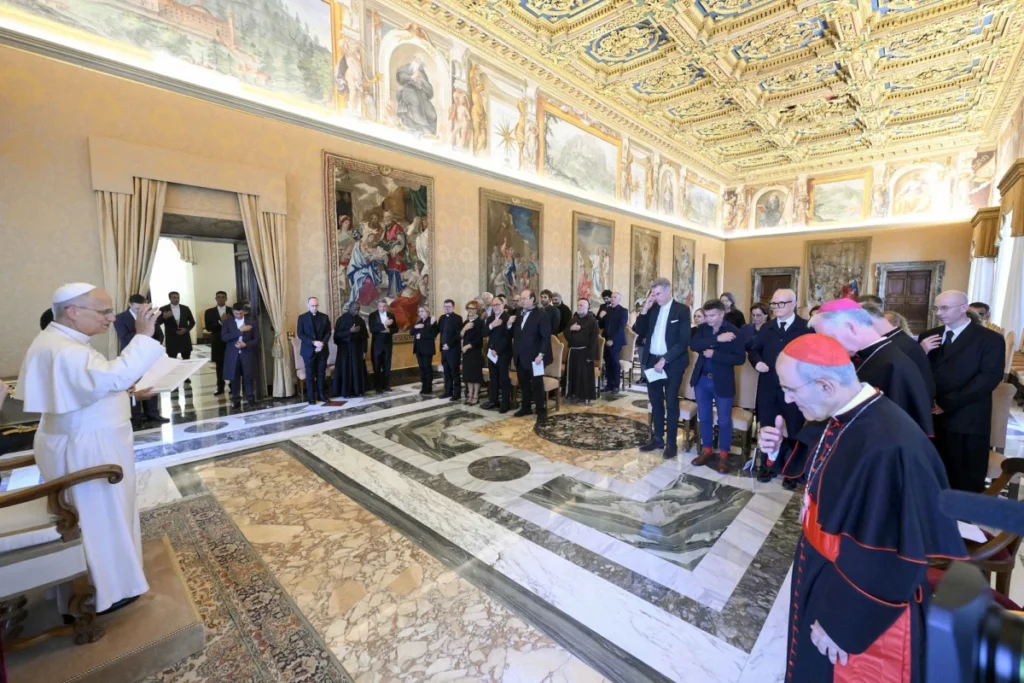
In a profound address delivered from the historic halls of the Vatican’s Apostolic Palace this past Friday, Pope Leo XIV issued a clarion call to the global creative community. Addressing a gathering of prominent artists and curators, the Pontiff positioned the Church as a sanctuary for human expression, specifically challenging the artistic community to serve as a bulwark against the encroaching tide of artificial intelligence.
The Pope’s remarks arrive at a geopolitical and technological inflection point. As existential anxiety mounts regarding the rapid evolution of frontier AI models—with some industry experts predicting a catastrophic collapse of human civilization within the next decade—the Vatican has positioned itself as a primary moral arbiter in the debate. The address followed a high-stakes meeting at the White House just three days prior, where U.S. President Donald Trump convened the world’s leading architects of generative AI to establish a framework for self-regulation.
The Ontological Divide: Man vs. Machine
At the heart of Pope Leo’s message was a stark philosophical distinction between human creativity and algorithmic production. "There is an ontological difference—even before an aesthetic one—between art and what a machine can generate through statistical calculation based on millions of images created by others," the Pope stated.
Drawing from his May 2026 encyclical, Magnifica Humanitas: On Safeguarding the Human Person in the Time of Artificial Intelligence, the Pontiff argued that machine-generated content is fundamentally devoid of the "spark" that defines the human experience. While algorithms excel at pattern recognition and the synthesis of existing datasets, the Pope maintained that they lack the interiority required for true artistic creation.
"Algorithms lack the spark of the human," Leo emphasized. "Authentic culture and art preserve this spark." By framing the issue as an ontological—or "being-based"—crisis rather than merely a stylistic one, the Vatican has elevated the stakes of the AI debate from one of copyright and labor to one of spiritual and existential survival.
A Chronology of Conflict and Cooperation
The current tension between technological acceleration and the preservation of human culture can be mapped through a series of rapid developments:
- May 15, 2026: Pope Leo XIV publishes Magnifica Humanitas, outlining the Church’s stance on the moral hazards of unchecked AI development.
- September 29, 2026: President Donald Trump hosts a summit at the White House with the CEOs of major AI firms. The meeting focuses on establishing a "voluntary regulatory guardrail" to prevent systemic societal destabilization.
- October 2, 2026: Pope Leo XIV shares a summary of his upcoming address on X (formerly Twitter), highlighting the urgency of distinguishing human-made art from machine synthesis.
- October 2, 2026 (Friday): The Pope delivers his address to artists and curators at the Vatican’s Apostolic Palace during the opening of "The Art of Possibility: Weaving Together," an exhibition organized by the Dicastery for Culture and Education.
This timeline reflects a growing international consensus that AI is no longer a peripheral technical concern, but a core component of global governance and spiritual discourse.
Supporting Data: The Illusion of Discovery
A central theme of the Pope’s address was the critique of "instantaneous answers." In an era dominated by large language models (LLMs) and predictive search engines, the Pontiff suggested that the modern human relationship with information is becoming dangerously passive.
"We live in the age of search engines that offer us thousands of instantaneous answers," Leo observed. "Yet, no matter how powerful they may be, they merely return what already exists and tend to give us what we already want."
This critique aligns with growing concerns from digital sociologists regarding "filter bubbles" and the "homogenization of culture." When an AI model trains on the sum of human digital output, it inherently creates a feedback loop of existing tropes and styles. It cannot, by definition, produce a "rupture" in the cultural fabric—it can only iterate on what has already been established.
Art, according to the Pope, functions as the antithesis of this process. "It does not proceed by indexing but by inquiry," he noted. "Indeed, its inquiry is a focused attention that is not satisfied with the mere sum of facts, for it never ceases to dig deeper, seeking the thread that unites them."
Official Responses and Ethical Implications
The Vatican’s intervention is not merely a critique of technology but an invitation to a partnership. By invoking Pope Paul VI’s 1964 plea to artists—"We need you"—Leo XIV is signaling a return to the Church’s historical role as the preeminent patron of the arts. The implication is that the Church and the artist share a common goal: the translation of the "invisible world into accessible, intelligible forms."
The reaction from the tech sector has been muted but observant. Critics of the Church’s stance argue that AI tools are simply the latest iteration of artistic media—no different from the camera obscura or the synthesizer. However, proponents of the Vatican’s view point to the rapid erosion of creative labor markets and the proliferation of "deepfake" culture as evidence that the "ontological difference" the Pope speaks of is becoming a practical, daily reality for creators.
The Future of the Human "Spark"
The implications of the Pope’s address are profound, particularly for how society values labor and creativity in the coming decade. If the Vatican succeeds in framing art as a "spiritual and cultural regeneration" that resists homogenization, it may lead to a cultural movement that prioritizes "human-made" certification in the same way the food industry prioritizes "organic" labeling.
The Pontiff’s challenge to artists is to move beyond the aesthetic and into the transformative. "Your art, when it resists homogenization, when it draws our gaze, when it compels us to pause before that which cannot be consumed, is a form of cultural and spiritual regeneration," he said.
This language serves as a rebuke to the "gig economy" model of art, where creators are increasingly pressured to produce high-frequency, low-latency content for social media feeds. The Vatican is advocating for a "slow art" movement—work that requires deep contemplation, demands attention, and refuses the consumption patterns of the digital age.
Conclusion: A Covenant of Cooperation
As the world stands on the precipice of the "AI Era," the Vatican’s message serves as both a warning and an invitation. Pope Leo XIV concluded his address with a promise of companionship: "Dear artists, dear curators, know that the Church looks upon you with esteem, gratitude and hope; that she needs you, and that she wishes to walk alongside you, so that together we may safeguard the grandeur of humanity entrusted to us."
Whether this alliance between the ancient institution of the Church and the modern creative community can successfully navigate the complexities of machine intelligence remains to be seen. However, by establishing a clear ethical and philosophical boundary, the Vatican has ensured that the question of what it means to be human will remain at the forefront of the technological revolution.
The exhibition "The Art of Possibility: Weaving Together," now open at the Vatican, stands as the first physical manifestation of this call—a space where, for the moment, the human hand and the human soul remain the primary authors of the narrative. As the world debates the future of artificial intelligence, the Pope’s message is clear: the most important things that humanity possesses are those that cannot be calculated, indexed, or replicated by a machine.



