

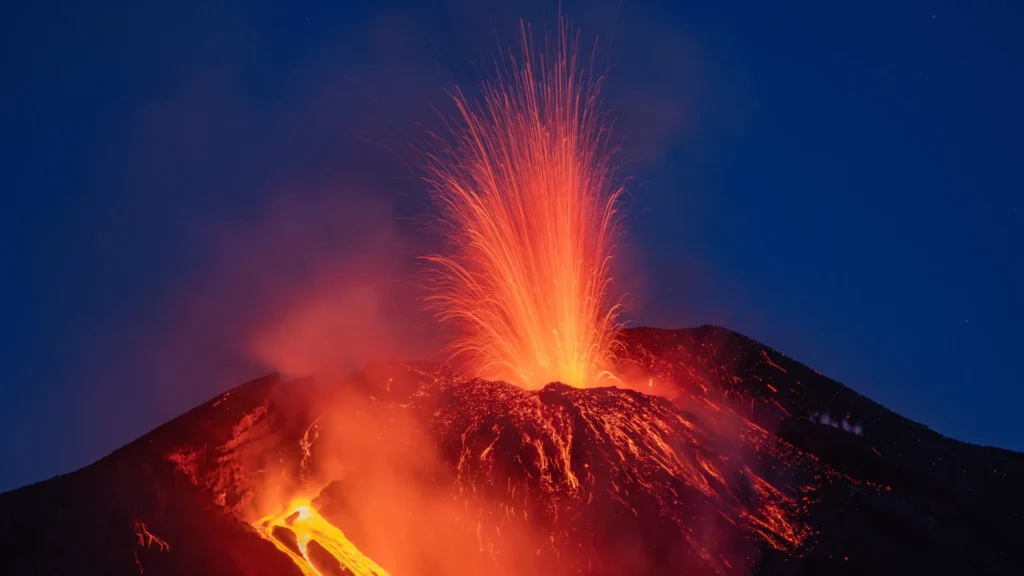
Volcanoes are often perceived as monolithic, static entities—mountains that simply "erupt." However, geologists have long understood that beneath these geological giants lies a complex, dynamic circulatory system of magma, gas, and molten rock. A groundbreaking study led by researchers at Cornell University has now unveiled that even a single volcano, such as Sicily’s iconic Mount Etna, can operate through vastly different internal "plumbing" systems, producing eruptions that vary significantly in speed, depth, and intensity.
By reconstructing the chemical signatures of two ancient eruptions, scientists have successfully mapped the hidden pathways of magma, revealing how the volatile competition between carbon dioxide ($CO_2$) and water determines whether an eruption is a slow-building disaster or a lightning-fast explosion.
The Science of Volcanic Explosivity
To understand why a volcano erupts, one must understand its "volatile" budget. Volatiles—gases such as water vapor and carbon dioxide—are dissolved within magma deep underground. As magma rises toward the surface, the pressure exerted by the surrounding rock decreases. This drop in pressure causes these gases to exsolve, or separate from the liquid rock, forming bubbles.
Esteban Gazel, the Charles N. Mellowes Professor in the Department of Earth and Atmospheric Sciences at Cornell’s Duffield College of Engineering, offers a simple analogy for a complex process: "Imagine a bottle of soda. If you open that bottle without agitating it, you can drink it, but if you shake it up, all the bubbles get separated really fast, and you have an explosion. Volcanoes work in a similar way, and my lab is trying to quantify these processes."
Historically, the scientific consensus held that water was the primary driver of volcanic explosivity. However, in 2023, Gazel’s team challenged this dogma by proving that $CO_2$ is not merely a bystander but a potent trigger for explosive activity. The recent findings, published in Geochemistry, Geophysics, Geosystems, provide the empirical backbone for this theory.
Reconstructing the Plumbing: A Technical Feat
The Cornell-led team, spearheaded by former postdoctoral researcher Maxim Gavrilenko, utilized a sophisticated technique known as Raman spectroscopy to peer into the volcanic past. By examining crystals trapped within volcanic rocks, the researchers were able to measure microscopic gas bubbles—some as small as 1% to 10% the thickness of a human hair—embedded within those crystals.
"That technique gives us the density of $CO_2$, and using a state equation we can transform that density into pressure, and pressure can be transformed into depth," Gavrilenko explained. "Then we apply those techniques to these explosive eruptions, and we are able to reconstruct the plumbing system with an unprecedented precision."
This level of forensic geology allows researchers to effectively "time travel," determining exactly how deep magma originated and how long it lingered before breaching the surface.
Chronology of Catastrophe: Comparing Two Eruptions
To test their methodology, the researchers looked at two major events in Mount Etna’s history: the Plinian eruption of 122 B.C. and the Fall Stratified event, which occurred approximately 4,000 years ago.
The 122 B.C. Event: A Lingering Threat
The 122 B.C. eruption was classified as both "mafic"—rich in iron and magnesium with low viscosity—and "Plinian," the most violent category of eruption. Through crystal sequencing, the team discovered that this magma began its ascent from a depth of approximately 22 kilometers.
However, the magma did not reach the surface immediately. Instead, it stalled in a shallow reservoir, roughly 2 to 5 kilometers beneath the summit. It remained trapped there for several weeks, slowly degasifying before the pressure reached a critical threshold, resulting in a massive eruption. This "stall-and-release" mechanism highlights the danger of magma residing in shallow chambers, where it can build pressure over time.
The Fall Stratified Event: The Fast-Track
In stark contrast, the Fall Stratified event (approx. 4,000 years ago) followed a far more aggressive trajectory. The data indicated that this magma originated even deeper, between 24 and 30 kilometers below the surface. Crucially, it did not stall. The magma raced toward the surface, erupting in a matter of hours. The defining difference? A significantly higher concentration of $CO_2$.
Supporting Data: The Volatile Tug-of-War
The comparison between these two eruptions reveals a fundamental "threshold" governing volcanic behavior. According to Professor Gazel, Mount Etna is a unique laboratory because it is one of the few places on Earth where both water and carbon dioxide are in constant competition as the primary drivers of eruptions.
- $CO_2$ Dominance: High levels of $CO_2$ facilitate rapid, deep-mantle ascent. Because $CO_2$ exsolves at greater depths than water, it can "kick-start" the ascent of magma from the mantle, allowing it to bypass shallow storage zones entirely.
- Water Dominance: Water becomes the primary driver when magma is allowed to dwell in shallow chambers. As the magma sits, the water-driven pressure builds until the eruption occurs.
"This shows that at a certain threshold of $CO_2$, the eruption will come from very deep and really fast," Gazel noted. "But when you have a higher threshold of water, then the process is controlled at shallow levels."
Implications for Global Risk Assessment
The implications of this research extend far beyond the slopes of Mount Etna. Current volcanic risk models often rely on generalized assumptions about how magma moves. By quantifying the specific roles of $CO_2$ and water, the Cornell team is providing the raw data necessary to build more accurate, physics-based simulations of future eruptions.
"Ideally, this should be done in every volcano on the planet," Gazel said. "This is data we need for physical models of eruptions that are the base of risk assessment."
The team is already applying these techniques to volcanic systems in Chile, Hawaii, and beyond. By identifying the gas signatures within eruptive products, volcanologists may eventually be able to predict whether an impending eruption is likely to be a slow-moving lava flow or an explosive, high-velocity event—a distinction that could save countless lives in populated volcanic regions.
Cultural and Scientific Synergy
While the science is rigorous, the researchers acknowledge the unique character of their study site. Mount Etna has been a cornerstone of Mediterranean culture for millennia. In Greek mythology, the mountain served as the prison for the giants Typhon and Enceladus, struck down by Zeus.
Professor Gazel finds a poetic symmetry in the ancient myths and his team’s discoveries. "There may be the two giant mythological monsters under Etna," he joked. "The plumbing system of the Plinian eruption is like Typhon, because it’s elongated and serpentine, and the other one is Enceladus, because it’s kind of smaller. If you work in Etna, it’s hard not to be connected to history, classical work, and great food."
Conclusion: A New Era of Predictive Volcanology
The research conducted by Gavrilenko, Gazel, and their collaborators—including Terry Plank of Columbia University, Bruce Houghton of the University of Hawaii at Manoa, and others—marks a significant leap forward in our understanding of volcanic mechanics. By moving past the assumption that eruptions are uniform, the team has illuminated the complex, gas-driven decisions that occur miles beneath our feet.
As the scientific community continues to refine these Raman spectroscopy techniques, the "hidden plumbing" of the world’s most dangerous volcanoes will become increasingly transparent. Through this deeper understanding, the path from scientific discovery to public safety becomes much clearer, ensuring that we are better prepared for the next time the giants beneath us decide to wake.
The research was supported by the National Science Foundation. Co-authors include postdoctoral researchers Kyle Dayton and Ellyn Huggins, and Anna Barth of the University of California, Berkeley.



