

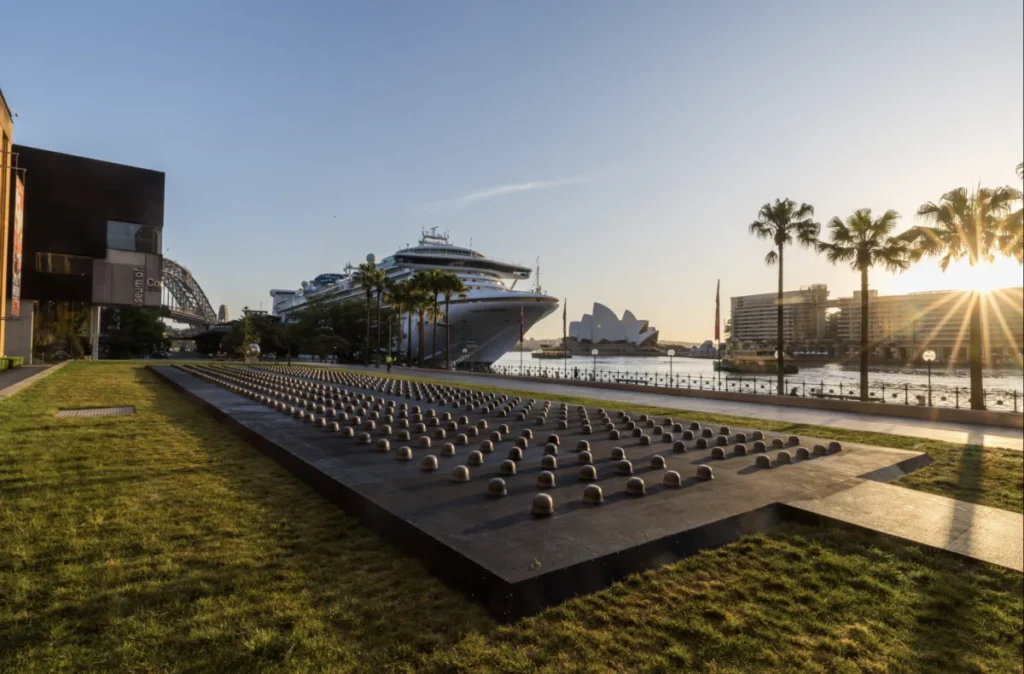
On a crisp Friday in Sydney, the city’s bustling Tallawoladah Lawn, nestled at the foot of the Museum of Contemporary Art Australia (MCA), underwent a haunting transformation. Where tourists usually pause for a fleeting photo of the harbor, they are now confronted by a vast, rigid grid of iron. Ai Weiwei, the globally renowned Chinese artist and activist, has unveiled his latest commission: Mushrooms, an installation of 500 cast-iron combat helmets arranged in ten precise, orderly lines. Stretching 131 feet across the green space, the work is an imposing, tactile reminder of the thin line between civilization and catastrophe.
Main Facts: A Sculpture of Steel and Shadow
Mushrooms is an exercise in both minimalism and crushing weight. The installation, commissioned as the second Neil Balnaves Tallawoladah Lawn Commission, consists of 500 individual helmets, each cast in iron and complete with realistic inner padding. They are elevated on a platform that bisects a primary pedestrian walkway, forcing a literal encounter between the artwork and the thousands of daily commuters and harbor-goers.
The title, Mushrooms, carries a multi-layered significance that defies a singular reading. Ai Weiwei has explained that the moniker evokes a triad of associations: the biological metaphor of "growth in darkness," the terrifying visual silhouette of nuclear mushroom clouds, and the linguistic nuance in Chinese, where the term can also suggest "endless delays." By choosing a medium as heavy and industrial as cast iron, Ai ensures that the viewer feels the gravitas of the subject matter—war, history, and the state’s relationship with the individual.
Chronology: From Bureaucratic Folly to Artistic Monument
The genesis of Mushrooms is deeply rooted in the geopolitical climate of the early 2020s. To understand the gravity of the installation, one must look back to early 2022.
- February 2022: Russia launches its full-scale invasion of Ukraine. As the world watches, the German government, navigating complex historical and diplomatic waters, hesitates to provide lethal military aid.
- March 2022: In a move that drew international ridicule, Germany offers to send 5,000 military helmets to Ukraine. Vitali Klitschko, the Mayor of Kyiv, famously dismissed the offer as "an absolute joke," highlighting the disparity between the reality of heavy artillery and the symbolic gesture of protective headgear.
- April 2022: The philanthropist and businessman Neil Balnaves, a titan of the Australian cultural sector, dies in a tragic boating accident near Tahiti at the age of 77. The commission at the MCA is subsequently named in his honor.
- 2023: The MCA inaugurates the commission with Thomas J. Price’s Ancient Feelings, a 10-foot-tall golden-bronze head that centered on human connection.
- October 2024: Ai Weiwei’s Mushrooms is installed, marking a stark tonal shift from the inaugural commission, moving from the internal reflection of human emotion to the external, often brutal, realities of geopolitical theater.
Supporting Data: The Logistics of the Installation
The installation is not merely a collection of objects; it is a meticulously engineered landscape. The 500 helmets occupy a 131-foot span, creating an environment that feels both like a military graveyard and an assembly line of production.
The weight of the materials used is significant. Cast iron, a material synonymous with the industrial age and the production of weaponry, anchors the piece. Unlike ephemeral art installations that rely on lighting or digital projection, Mushrooms demands physical space. Its placement on the Tallawoladah Lawn, an area with high foot traffic, ensures that the work acts as an obstacle—a physical manifestation of the "endless delays" the artist references.
The commission is supported by the Balnaves Foundation, which continues the legacy of Neil Balnaves. The foundation’s dedication to public art aims to democratize the experience of high-level contemporary art, ensuring that works like Ai’s are not sequestered in galleries but are instead thrust into the public consciousness.
Official Responses and Artistic Intent
Ai Weiwei has been clear about his objectives for Mushrooms. Despite the work’s origins in a specific political incident—the German helmet offer—the artist emphasizes that the piece is not meant to be a mere satirical jab at a past event.
"We continue to exist in a time where war and peace interchangeably assume each other’s roles, shaping the identity of our age," Ai stated during the unveiling. "I hope this work prompts people to reflect on war and peace."
In a candid interview with The Art Newspaper, the artist clarified that Mushrooms is not a "political joke." Instead, he positions the work as a critique of the intellectual poverty of modern leadership. He argued that the piece is designed to "demonstrate how shallow an understanding today’s national leadership can have of the human condition and of what may happen in the future."
The MCA, in its role as curator and host, has framed the work as a pivotal moment for the lawn. While Thomas J. Price’s Ancient Feelings served as a meditative anchor—gazing toward the harbor and inviting viewers to connect through "universal emotions"—Ai’s Mushrooms serves as a confrontation. It is an invitation to engage with the uncomfortable, the historical, and the looming possibility of conflict.
Implications: The Role of Public Art in a Fragile World
The installation of Mushrooms arrives at a moment of global instability. As tensions rise across multiple theaters of war, the sight of 500 discarded or waiting helmets in a peaceful Sydney park creates a powerful dissonance.
The Dissonance of Place
Sydney Harbor is a site of leisure, tourism, and economic activity. By introducing an installation that recalls the grim reality of trench warfare and the looming specter of nuclear conflict, Ai Weiwei is effectively disrupting the "leisure-scape." The implication is clear: the safety of the harbor is a privilege that exists in a fragile balance, one that is easily disrupted by the decisions made in political halls thousands of miles away.
The Critique of Symbolism
The artist’s focus on the helmet as an object is profound. A helmet is designed to protect, yet in the context of the German-Ukraine controversy, it became a symbol of inadequacy—a bureaucratic gesture that failed to address the existential threat at hand. By multiplying this symbol by 500, Ai transforms a gesture of "shame" into an army of ghosts. The "growth in darkness" he refers to suggests that these helmets are not just relics of the past but seeds of a future conflict that continues to germinate in the silence of political inaction.
Legacy and Future Commissions
The Neil Balnaves Tallawoladah Lawn Commission has now established a reputation for commissioning works that carry significant social weight. By alternating between the humanistic, bronze-cast intimacy of Price and the industrial, conceptual rigidity of Ai, the museum is curating a dialogue about the role of the individual within the state.
As visitors walk past the ten orderly lines of Mushrooms over the next seven months, they are not just looking at a sculpture; they are participating in a performance of memory. The helmets, which will remain on the lawn until the spring, will weather, collect rainwater, and perhaps gather dust. They will be exposed to the very elements of nature that Ai describes as "growth in darkness."
Ultimately, Mushrooms serves as a barometer for our collective anxiety. It asks the viewer: How do we perceive the tools of our own protection? Are they shields, or are they, as the artist suggests, signs of a deeper, systemic failure to grasp the gravity of the human condition? In the heart of Sydney, Ai Weiwei has provided a stark, cold, and necessary answer. The installation does not provide closure; rather, it demands that we stay awake to the realities that our leadership often chooses to ignore.



