

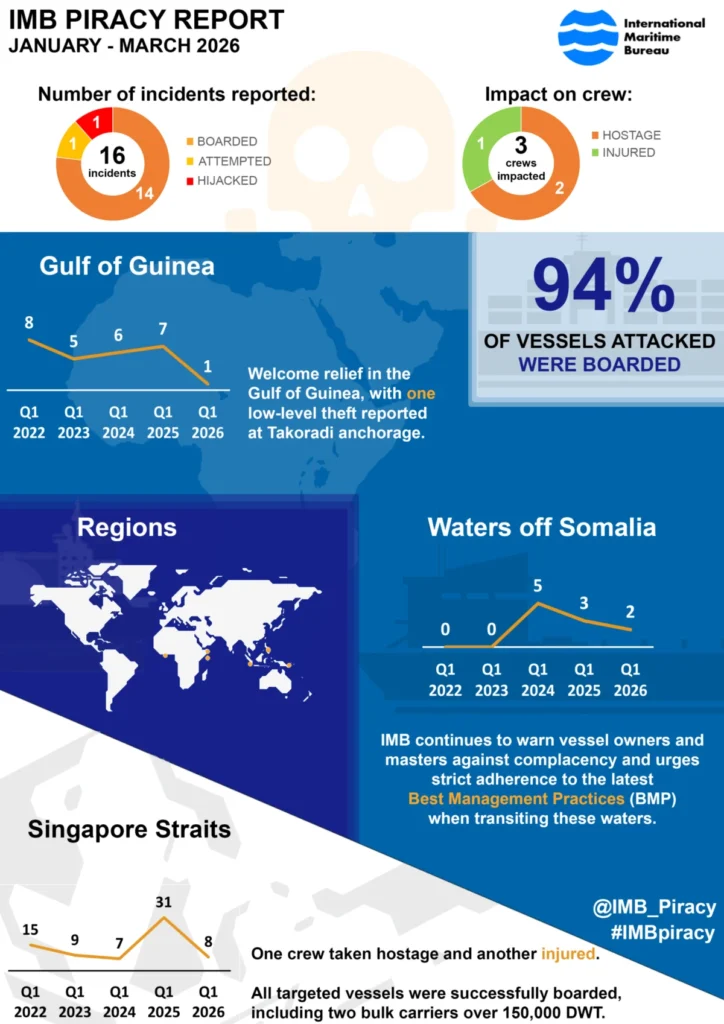
Introduction: The Invisible Shield of Global Trade
The global economy is anchored by the silent, relentless movement of merchant vessels traversing the world’s oceans. With over 80% of global trade by volume carried by sea, the safety of maritime corridors is not merely a logistical concern; it is a fundamental pillar of international stability. However, the open ocean remains a theater of vulnerability, where piracy, armed robbery, and maritime crime pose a persistent threat to seafarers and global supply chains.
At the heart of the defense against these threats sits the International Maritime Bureau (IMB) Piracy Reporting Centre (PRC). Serving as a 24-hour, single point of contact, the PRC acts as an invisible shield for vessels under duress. By bridging the gap between distressed ships and local law enforcement, the IMB PRC has become an indispensable node in the maritime security architecture. This report examines the operational mechanisms, historical context, and critical implications of the work performed by the IMB and its parent body, the International Chamber of Commerce (ICC).
Main Facts: The Operational Mandate of the IMB PRC
The IMB Piracy Reporting Centre was established to address the growing complexity of maritime threats. Unlike traditional security apparatuses, the PRC is a specialized, non-governmental entity that provides real-time support to vessels operating in high-risk zones.
Core Functions
- 24/7 Monitoring and Response: The PRC maintains a constant vigil, operating a round-the-clock emergency line. When a vessel reports a suspicious approach or an active boarding, the PRC initiates immediate coordination with coastal authorities and regional navies.
- Data Integrity and Transparency: The Bureau collects, vets, and disseminates data on maritime crime. This information is crucial for shipping companies to conduct accurate risk assessments, influencing insurance premiums and routing decisions.
- Independent Advocacy: By providing reliable, transparent data, the IMB serves as a credible source for governments and international regulatory bodies, including the International Maritime Organization (IMO), to formulate policy based on objective incident reports.
Chronology: The Evolution of Maritime Security
To understand the necessity of the IMB PRC, one must look at the evolution of maritime crime over the past three decades.
1990s: The Rise of Modern Piracy
The early 1990s marked a significant uptick in piracy, particularly in the Malacca Strait and the waters off Southeast Asia. During this period, the IMB recognized that individual shipping companies lacked a unified platform to report incidents. The PRC was formalized to provide that central reporting mechanism, ensuring that "lone wolf" incidents were recognized as systemic patterns.
2000s: The Somali Crisis
The turn of the millennium saw the rise of large-scale, ransom-driven piracy off the coast of Somalia. Vessels were being hijacked with increasing frequency, and the scale of the crisis threatened the viability of the Suez Canal route. The PRC became the primary information clearinghouse for the international naval task forces that eventually coalesced to combat the Somali pirate syndicates.
2010s to Present: Diversification of Threats
In recent years, the nature of piracy has shifted again. While high-seas hijacking has decreased in some regions, armed robbery against ships at anchor has risen in West Africa’s Gulf of Guinea and in the anchorages of the Singapore Strait. The PRC has adapted by utilizing satellite tracking and improved digital communication protocols to provide instantaneous alerts to ships in the vicinity of reported incidents.
Supporting Data: The Impact of Reporting
Data is the primary tool of the IMB. By maintaining an accurate, longitudinal database of incidents, the PRC provides the maritime industry with the empirical evidence needed to implement security measures like the Best Management Practices (BMP).
Why Reporting Matters
- Risk Mitigation: Shipping lines use IMB data to adjust their "Citadel" protocols and onboard security measures.
- Resource Allocation: Governments use IMB reports to justify the deployment of naval assets to specific "hot zones," ensuring that patrols are concentrated where they are most effective.
- Insurance and Liability: The PRC’s verified reports serve as critical documentation for insurance claims, helping to distinguish between criminal acts and other maritime perils.
The IMB’s work is underpinned by the reach of the International Chamber of Commerce (ICC). With a mandate representing more than 45 million companies in over 170 countries, the ICC provides the structural support and diplomatic weight required to engage with global regulators. This synergy between the IMB’s technical expertise and the ICC’s advocacy power ensures that maritime security remains a priority on the global economic agenda.
Official Responses: The Institutional Framework
The effectiveness of the IMB PRC is contingent upon its neutrality and its ability to communicate across borders. According to Michael Howlett, Director of the ICC International Maritime Bureau, the mission remains clear: "The IMB PRC operates as a single point of contact, providing free support to vessels under threat and delivering transparent, reliable data to the maritime industry, authorities and governments worldwide."
The ICC’s Holistic Approach
The International Chamber of Commerce is more than a trade association; it is an institutional representative of the global private sector. Its mission is to "make business work for everyone, every day, everywhere." This philosophy informs the IMB’s approach to piracy. The Bureau does not view piracy merely as a security issue, but as a barrier to the fundamental human right of international commerce. Through standard-setting and dispute resolution, the ICC works to ensure that international trade is not stifled by the threat of criminal interference.
Implications: The Future of Maritime Security
As the maritime industry faces new challenges—ranging from cyber-attacks on shipping logistics to the rise of autonomous vessels—the role of the IMB PRC is poised to evolve further.
Technological Integration
The next frontier for the IMB involves the integration of Artificial Intelligence and satellite analytics to predict, rather than just report, piracy. By analyzing patterns in vessel behavior and movement, the IMB can provide proactive warnings to captains before a vessel enters a high-risk perimeter.
Global Advocacy for Responsible Conduct
The ICC continues to push for a global approach to maritime regulation. The implications of the IMB’s data extend to:
- Legal Prosecution: By providing consistent documentation, the PRC assists in the creation of a chain of evidence that can be used by national judicial systems to prosecute captured pirates.
- SME Protection: Large shipping conglomerates have the resources to harden their vessels. However, the IMB’s work is arguably more vital for Small and Medium Enterprises (SMEs) that lack private security teams. The PRC’s free, universal reporting service levels the playing field, ensuring that the smallest vessel has the same access to threat intelligence as the largest tanker.
The Human Cost
Beyond the balance sheets and trade volumes, the ultimate goal of the IMB is the preservation of human life. Every incident report processed by the PRC represents a potential tragedy averted. The psychological toll of piracy on seafarers is immense, and the PRC’s ability to provide reassurance and coordination during a crisis is a humanitarian service that transcends the economic mandate of the ICC.
Conclusion: A Call for Continued Vigilance
The global maritime industry remains a complex, often perilous environment. As global supply chains become more interconnected, the vulnerability of any single link in the chain—be it in the Gulf of Guinea, the Singapore Strait, or elsewhere—is a vulnerability for all.
The IMB Piracy Reporting Centre stands as a testament to what can be achieved through cooperation, data-driven strategy, and a commitment to the rule of law. By maintaining the flow of information and providing an anchor for vessels in distress, the IMB ensures that the high seas remain a conduit for prosperity rather than a theater of chaos.
For stakeholders—from governments to individual business owners—the message is clear: the safety of the seas is not a passive condition, but an active, ongoing effort. The partnership between the IMB and the ICC continues to serve as the global vanguard in this effort, proving that when the international business community speaks with a unified, transparent voice, it can secure the pathways of progress for the entire world.
Contact Information for Further Engagement
For those seeking to collaborate, report incidents, or gain further insight into the state of maritime security, the IMB remains accessible:
- Director: Michael Howlett, ICC International Maritime Bureau
- Phone: +44 207 423 6960
- Email: [email protected]
- Institutional Hub: The International Chamber of Commerce (ICC) remains the primary point of advocacy for businesses worldwide, ensuring that the regulatory environment supports the security and efficiency of international trade.



