
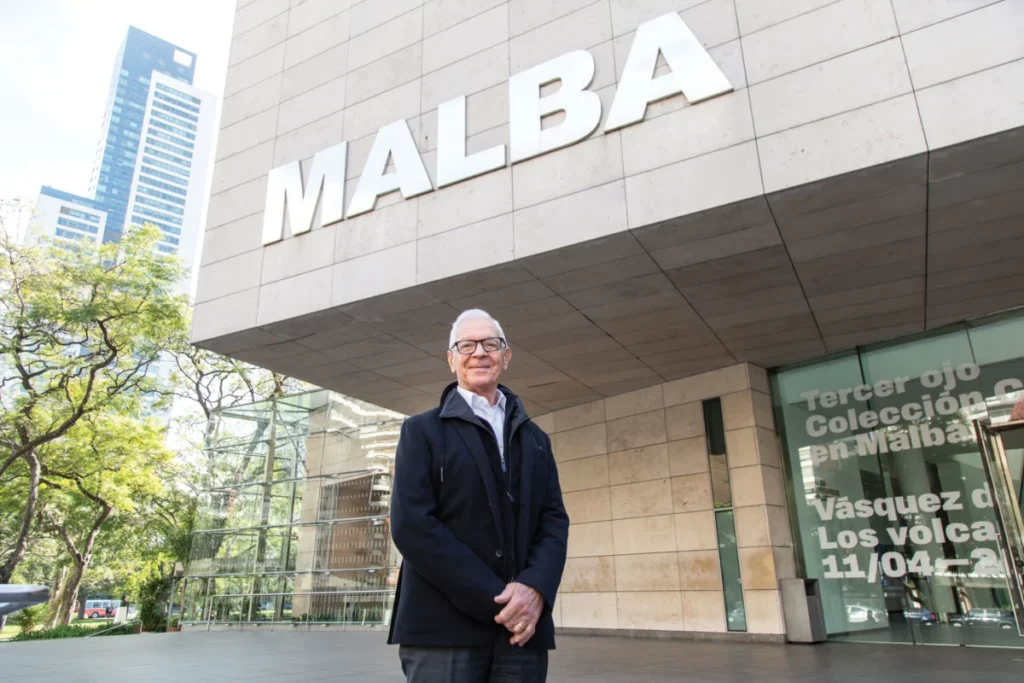
As the Museo de Arte Latinoamericano de Buenos Aires (MALBA) approaches its 25th anniversary, it stands not merely as a repository of historical artifacts, but as a testament to the singular, unwavering vision of its founder, Eduardo F. Costantini. Since its inception in 2001, the institution has evolved from a boutique collection into a global powerhouse, fundamentally altering how the world perceives the artistic output of the Southern Hemisphere. With a massive new acquisition and ambitious architectural expansions on the horizon, MALBA is currently undergoing what its founder describes as a "second birth."
The Genesis of a Mission: A Public Strategy
When Eduardo F. Costantini first opened the doors of MALBA in the Palermo Chico neighborhood of Buenos Aires, the global art market was largely Eurocentric and US-focused. Latin American artists, despite their profound influence on modernism and contemporary practice, were often relegated to the margins of international institutional discourse.
"The global perception of Latin American art at the time was still far behind, and I felt it deserved greater recognition and visibility," Costantini told ARTnews. This was not a passive goal; it was an act of cultural reclamation.
Costantini’s methodology was as deliberate as it was bold. Recognizing that prestige in the art world is often tied to market visibility, he eschewed the common practice of anonymous bidding. "I never bought a work anonymously; I did it openly, on purpose," he explained. "I would go to auctions, raise my hand, and make the price public, so it would become news." By making the acquisition of Latin American masterworks a public spectacle, he forced a recalibration of the market’s valuation of the region’s artists.
Chronology: Two Decades of Growth
The history of MALBA is a story of exponential scaling.
- 2001: MALBA is founded with an initial endowment of 200 works from Costantini’s private collection. Among these were seminal pieces that would define the museum’s identity, including Frida Kahlo’s Autorretrato con chango y loro (1942) and Tarsila do Amaral’s Abaporu (1928).
- 2004–2008: The museum establishes its curatorial rigor, fostering internal talent such as Inés Katzenstein, who would go on to become a pivotal voice in the international curatorial circuit.
- 2020–2024: A period of aggressive and historic acquisitions. Costantini sets multiple auction records, including the $34.9 million purchase of Frida Kahlo’s Diego y yo in 2021, which cemented the museum’s status as a top-tier destination for modern art.
- 2026 (Upcoming): The museum celebrates its 25th anniversary, marking the official integration of the Daros Latinamerica Collection and the commencement of a major expansion project beneath Plaza Perú.
The Daros Acquisition: A "Refounding" of the Collection
The most significant development in the museum’s recent history is the acquisition of the Zurich-based Daros Latinamerica Collection. This massive addition—comprising 1,233 works by 117 artists—represents a tectonic shift for the institution.
While MALBA was previously renowned for its strength in the first half of the 20th century (the era of modernism), the Daros collection fills the critical void of the post-1950s through the 2010s. This acquisition effectively bridges the gap between historical modernism and contemporary practice. Major acquisitions now include Hélio Oiticica’s 1959 sculpture Relevo espacial, Ana Mendieta’s haunting 1972 photo series Untitled (Glass on Body Imprints), and the iconic Analogía I (1971) by Víctor Grippo, which features 40 potatoes wired with electrodes—a symbol of the biological and electrical tension inherent in the region’s art.
The inclusion of 42 works by Julio Le Parc, alongside significant holdings from Lygia Clark, Gego, and Doris Salcedo, allows MALBA to tell a comprehensive, nuanced story of Latin American artistic evolution. "This is a refounding of the museum," Costantini remarked. The institution now holds roughly 2,800 objects, moving far beyond its foundational 200 pieces.
Supporting Data: Market Records and Institutional Influence
The financial commitment required to maintain this trajectory has been substantial, but Costantini insists that the market numbers are merely a byproduct of the quality of the work. The data, however, tells a compelling story of influence.

Between 2020 and 2024, Costantini broke record after record:
- Wifredo Lam: Omi Obini (1943) at $9.6 million (June 2020).
- Remedios Varo: Armonía (Autorretrato sugerente) (1956) at $6.2 million (June 2020).
- Frida Kahlo: Diego y yo (1949) at $34.9 million (2021).
- Leonora Carrington: Las distracciones de Dagoberto (1945) at $28.5 million (2024).
These purchases have not only enriched MALBA’s walls but have also made the museum a required partner for international institutions. When the Museum of Modern Art (MoMA) in New York, the Tate in London, or the Reina Sofía in Madrid curate exhibitions on Latin American art, they look to Buenos Aires. "They are constantly asking us for works because we have major pieces by major artists," Costantini noted.
Official Perspectives: The Institutional Impact
Inés Katzenstein, a former MALBA curator now at MoMA, provides an authoritative perspective on the museum’s trajectory. According to Katzenstein, MALBA’s success is not just about the accumulation of objects, but the creation of a "dialogue across generations."
"MALBA has established itself as one of the leading platforms for Latin American art," Katzenstein stated. "Its exceptional collection creates a dialogue across geographies and artistic traditions in a way that few museums in the region have been able to achieve. More broadly, MALBA has been a crucial part of a larger institutional, professional, and geopolitical transformation that has profoundly reshaped the global perception of Latin American art over the past decades."
Implications: Architecture and the Future
The expansion plans for the museum are as ambitious as its acquisitions. To house the influx of the Daros collection, MALBA is undertaking a structural expansion beneath the adjacent Plaza Perú. This project will double the museum’s total footprint to approximately 90,000 square feet.
Furthermore, the museum is expanding its infrastructure to include a 13,500-square-foot technical reserve at Malba Puertos, an outpost in Escobar, designed to ensure the long-term preservation of its growing assets. Construction in the heart of Buenos Aires is scheduled to commence immediately following the 25th-anniversary celebrations in September, with the unveiling of the new galleries slated for 2029.
For the art world, these developments signify more than just an increase in floor space. They represent the solidification of a "Latin American Canon." By curating, preserving, and displaying these works within the context of their origin, MALBA is stripping away the "peripheral" status often assigned to the region’s artists.
Conclusion: A Renaissance in Motion
As MALBA marks its 25th year, the mood is one of forward-looking ambition rather than nostalgic reflection. The "renaissance" that Costantini describes is a clear signal that the museum has moved past its formative years.
"We are celebrating these 25 years not only by looking in the rearview mirror and acknowledging the museum’s history, but also by looking ahead, with a great deal of work and financial commitment," Costantini concluded. As the new galleries take shape and the Daros collection is integrated into the permanent rotation, MALBA is poised to spend its next quarter-century not just as a guardian of Latin American art, but as the primary engine for its ongoing global discovery. The once-modest dream of a collector has become an essential pillar of international art history.