
Introduction: A Decade of Sartorial Metamorphosis
In the rapidly shifting landscape of contemporary fashion, few designers have managed the delicate pivot from teenage streetwear enthusiast to high-concept creative director as deftly as Keith Herron. Since founding Advisry in 2014, Herron has navigated the industry not merely as a label creator, but as a cultural archivist. What began as a venture into graphic-heavy hoodies and T-shirts—a staple of the mid-2010s urban aesthetic—has blossomed into a sophisticated, narrative-driven design house.
This evolution reached a fever pitch this Tuesday morning during New York Fashion Week, where Herron unveiled his Spring 2027 collection, titled “America, Still.” The presentation was a masterclass in thematic depth, drawing a capacity crowd that included industry luminaries such as Public School’s Maxwell Osborne and KidSuper’s Colm Dillane, alongside a cohort of influential musicians and visual artists. The show served as definitive proof that Advisry has transcended its roots, firmly cementing its place in the upper echelon of modern American design.
The Chronology of a Creative Vision
To understand the weight of Herron’s latest collection, one must examine the timeline of his creative output. When Herron launched Advisry at the age of 14, he was part of a burgeoning generation of digital-native designers who leveraged social media to bypass traditional gatekeepers. For nearly a decade, the brand was synonymous with the democratization of style—accessible, graphic-led, and community-focused.
However, the 2027 runway show marked a distinct departure from those humble beginnings. The transition was not an erasure of his past, but a synthesis of it. Upon entering the venue, guests were greeted with a personal touch: a handheld fan resting on every seat, emblazoned with a vintage photograph of a young Herron with his family. It was a subtle, poignant nod to his upbringing, framing the upcoming collection as a deeply personal exploration of national and individual identity.
The show itself was structured as a three-act theatrical performance, a departure from the traditional runway walk that mirrored the narrative arc of the collection’s titular theme: "America, Still."
Act I: The Antihero and the Aesthetics of Distress
The first act of the show drew heavily from the gritty, introspective atmosphere of the 1976 Martin Scorsese classic, Taxi Driver. By invoking the character of Travis Bickle, Herron signaled a move toward a more cinematic and psychological approach to design.
On the runway, this translated into a raw, tactile exploration of isolation and urban decay. Models moved through the space draped in crocodile-leather straitjackets—a provocative garment that spoke to the "end of the world" anxiety Herron referenced backstage. Distressed denim, a long-time favorite of the streetwear community, was elevated through deconstruction, while oversized trench coats with pronounced drop shoulders provided a silhouette that felt both timeless and menacing. This act was not about commercial appeal, but about establishing a mood: the palpable tension of a city on the edge.
Act II: Rigidity, Heritage, and the Civil Rights Era
If the first act was the internal monologue of the individual, the second act was the external reality of the nation. Herron drew inspiration from the mid-20th century, specifically the era of Muhammad Ali and Malcolm X.
"I wanted to look at the current state of a nation through the lens of 50 years ago," Herron explained to the press. "Because every generation believes it’s living through the end of the world."
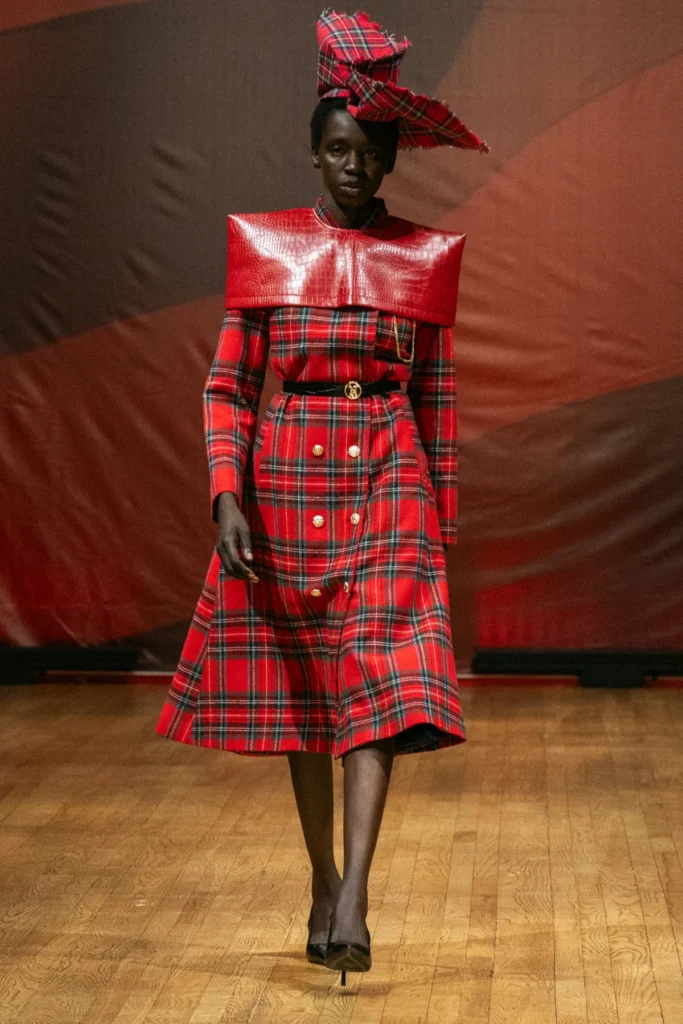
The tailoring here was sharp, intentional, and purposefully constrained. Black suits and plaid dresses were punctuated by red-and-black checkerboard patterns, creating a visual rhythm that felt distinctly mid-century yet entirely contemporary. The square-shouldered overshirts were the standout pieces of this segment; Herron described them as representing "rigidity," a sartorial manifestation of the social and political barriers that defined that historical period. The collection felt like a dialogue between the past and present, asking the audience to consider whether the "rigidity" of the 1970s has truly dissipated or simply shifted form.
Act III: The Optimistic Synthesis
The final act provided the necessary catharsis. Taking the motifs of the previous two acts—the leather, the plaid, the oversized tailoring—Herron recontextualized them through a lens of celebration. The gloom of the Taxi Driver era and the rigidity of the civil rights-inspired tailoring were replaced by a shimmering, festive palette.
Sequins, glitter, and metallic fabrics transformed sweaters, pants, and wide-legged shorts into expressions of resilience. It was as if Herron was suggesting that even when the world feels as though it is unraveling, there is an inherent human capacity for joy and reinvention. The transition from the stark, muted tones of the first two acts to the kaleidoscopic sparkle of the third was a powerful stylistic choice, framing the "Still" in his collection title not as a state of stagnation, but as a state of enduring survival.
Official Responses and Industry Reception
The reaction from the industry was overwhelmingly positive, with many noting the maturity of Herron’s tailoring. Maxwell Osborne, of Public School, noted that "the growth is undeniable. Keith isn’t just making clothes anymore; he’s building a universe."
Backstage, Herron remained humble despite the mounting pressure. When asked about the burden of interpreting "America" in a polarized climate, he was measured. "Fashion is the most accessible form of history," he stated. "My goal isn’t to provide a political platform, but to provide a mirror. If people look at these clothes and think about where we’ve been and where we’re going, then I’ve done my job."
The inclusion of influential figures in the audience—from traditional fashion editors to avant-garde artists—underscored the brand’s unique position in the industry. Advisry is no longer a streetwear brand, nor is it a traditional couture house; it occupies a hybrid space that appeals to the "hypebeast" demographic while simultaneously engaging the high-fashion establishment.
Implications: The Future of the Brand
The success of "America, Still" suggests that Advisry is poised for significant international expansion. The move toward more complex, artisanal manufacturing techniques indicates that Herron is looking to compete with established luxury houses, yet he retains the scrappy, grassroots ethos that made him a success in the first place.
For the wider fashion industry, the implications are clear: the generation of designers who cut their teeth on Instagram and limited-drop culture is entering a new phase of professional maturity. They are bringing with them a different set of priorities—one that values narrative, social commentary, and archival inspiration over mere brand ubiquity.
As Herron moves forward, the challenge will be to maintain this delicate balance. He must continue to innovate without losing the authenticity that his fan base prizes. However, if this spring collection is any indication, he has found a rhythm that allows him to remain relevant to the youth while earning the respect of his peers.
Conclusion: A Visionary in Progress
Keith Herron’s "America, Still" is more than a seasonal collection; it is a declaration of intent. By weaving together the threads of his own personal history, the cinematic tropes of American culture, and the historical gravity of the mid-20th century, Herron has created a body of work that feels both urgent and enduring.
The optimism of the final act suggests a designer who believes in the future—not just for his brand, but for the culture at large. As he moves into the next phase of his career, Herron stands as a symbol of what is possible when a creative voice is allowed to evolve, mature, and eventually, command the center stage. The "end of the world" may be a recurring anxiety for every generation, but if Advisry is any guide, we are not quite at the finale—we are merely in the middle of a very long, very stylish, and very necessary act.