
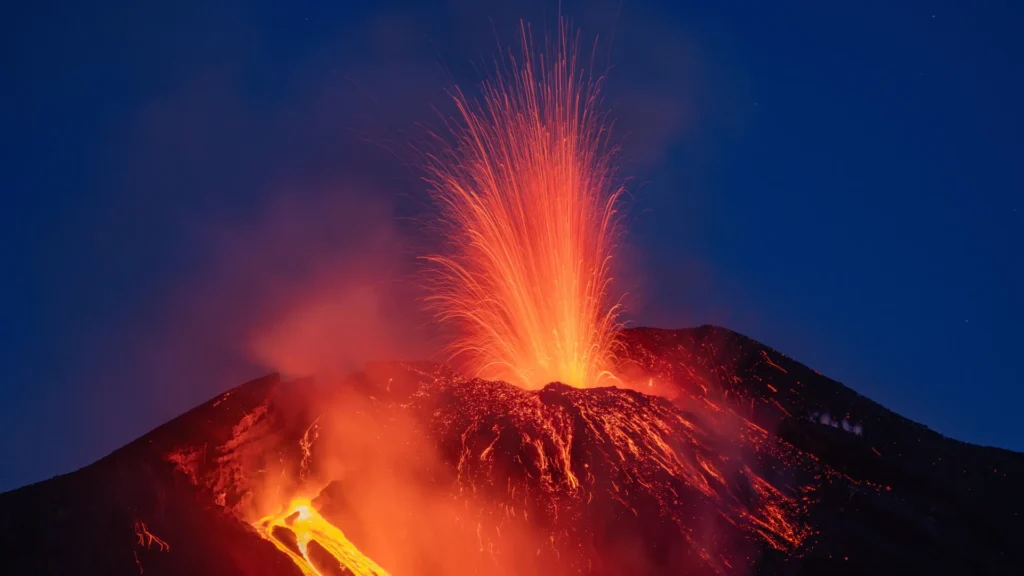
Volcanoes are often envisioned as monolithic conduits—singular pipes funneling molten rock from the bowels of the Earth to the surface. However, modern volcanology is revealing a far more complex reality: the “plumbing systems” beneath these mountains are dynamic, multifaceted, and capable of radically different behaviors even within the same volcanic edifice.
A groundbreaking study led by Cornell University has shed new light on this subterranean complexity at Mount Etna in Italy. By reconstructing the life cycles of two major prehistoric eruptions, researchers have demonstrated that magma does not follow a set path. Instead, it utilizes vastly different routes and ascends at wildly varying speeds, a discovery that fundamentally alters our understanding of volcanic risk assessment.
The Science of Sudden Violence: Why Volcanoes Explode
At the heart of the research is a simple, yet volatile, question: What makes a volcano explode? According to Esteban Gazel, the Charles N. Mellowes Professor in the Department of Earth and Atmospheric Sciences at Cornell, the answer lies in the volatile gases trapped within magma.
“Imagine a bottle of soda,” Gazel explains. “If you open that bottle without agitating it, you can drink it. But if you shake it up, all the bubbles get separated really fast, and you have an explosion.”
Volcanoes operate on similar principles. When magma rises from the mantle, the decrease in pressure allows dissolved gases—primarily water and carbon dioxide—to exsolve and form bubbles. If these gases expand rapidly enough to shatter the surrounding rock, an explosive eruption occurs. For decades, the scientific community operated under the assumption that water was the primary driver of these cataclysmic events. However, Gazel’s group recently upended that consensus, proving that carbon dioxide can act as an equally potent, and perhaps more dangerous, trigger for explosive activity.
Reconstructing the Past: A High-Precision Timeline
To map the "hidden plumbing" of Mount Etna, the research team—led by former postdoctoral researcher Maxim Gavrilenko—utilized a sophisticated technique known as Raman spectroscopy. This method allows scientists to peer inside the microscopic crystals that form within cooling magma.
These crystals act as geological time capsules, trapping microscopic gas bubbles that are often just 1% to 10% the thickness of a human hair. By measuring the density of the carbon dioxide within these bubbles, the team can calculate the pressure at the time of entrapment. Because pressure correlates directly with depth, the researchers were able to reconstruct the ascent of magma with unprecedented precision.
The 122 B.C. Plinian Event: A Slow Ascent
The team focused on the 122 B.C. eruption, a "mafic" and Plinian event. Plinian eruptions—named after Pliny the Elder’s account of the destruction of Pompeii—are among the most violent in nature. Despite its ferocity, the 122 B.C. eruption followed a surprisingly measured path. Analysis revealed that the magma originated at a depth of approximately 22 kilometers. Rather than surging directly to the surface, it rose slowly, eventually stalling at a shallow depth of 2 to 5 kilometers. It remained in this holding pattern for several weeks, allowing for a gradual release of gas before the final, catastrophic outburst.
The Fall Stratified Event: A High-Speed Ascent
In stark contrast, the "Fall Stratified" eruption, which occurred nearly 4,000 years ago, followed a much more aggressive trajectory. Data indicated that this magma rose from the deep mantle, starting 24 to 30 kilometers below the surface. Unlike the 122 B.C. event, this magma bypassed long-term storage in the crustal reservoir, racing toward the surface and erupting in a matter of hours. The defining difference? A significantly higher concentration of carbon dioxide.
The Volatile Tug-of-War
The study identifies a critical "threshold" effect. Gazel notes that Etna is a unique laboratory because it is one of the few volcanoes on Earth where both water and carbon dioxide compete as the primary volatile drivers.
"This shows that at a certain threshold of CO₂, the eruption will come from very deep and really fast," Gazel explains. "But when you have a higher threshold of water, the process is controlled at shallow levels."
This discovery provides a predictive framework for volcanologists. When monitoring an active volcano, detecting shifts in the ratio of gas emissions—specifically the balance between CO₂ and water—could indicate whether a magma chamber is preparing for a slow, protracted release or a sudden, deep-seated explosive event.
Implications for Global Risk Assessment
The implications of this research extend far beyond the slopes of Mount Etna. Current volcanic hazard models often rely on generalized assumptions about how magma moves beneath a specific volcano. If those assumptions are wrong—if a volcano is capable of two completely different eruption styles driven by different gas thresholds—the danger posed to nearby populations could be severely underestimated.
The Cornell team is now applying their Raman spectroscopy-based methodology to other high-risk volcanoes in Chile, Hawaii, and beyond. “Ideally, this should be done in every volcano on the planet,” Gazel says. “This is data we need for physical models of eruptions that are the base of risk assessment.”
By identifying the "plumbing" architecture of diverse volcanic systems, researchers are moving away from reactive observation toward proactive, data-driven forecasting. Understanding the specific trigger—whether it is deep-seated CO₂-driven magma or shallow-seated water-driven magma—is the difference between a successful evacuation and a regional disaster.
A Legacy of Myth and Science
Mount Etna has long occupied a central place in both human history and mythology. The ancient Greeks associated the mountain’s periodic fury with the imprisonment of the giants Typhon and Enceladus. Interestingly, the research team found an uncanny parallel between these myths and the physical reality of the volcano’s structure.
The plumbing system of the 122 B.C. Plinian eruption, characterized by its elongated, serpentine path, mirrors the myth of Typhon. The secondary, smaller system resembles the smaller, more localized activity associated with Enceladus. While these comparisons are metaphorical, they underscore the deep connection between the mountain’s volatile history and the human imagination.
Conclusion: The Future of Volcanology
The work of Gavrilenko, Gazel, and their collaborators—including Terry Plank of Columbia University and Bruce Houghton of the University of Hawaii, Manoa—represents a significant leap forward in our ability to interpret the signals from beneath the Earth’s crust.
As the team continues to refine their models, the integration of microscopic data—crystals, gas bubbles, and chemical signatures—into macro-level hazard assessments is becoming the new gold standard. In a world where millions live in the shadow of active volcanoes, the ability to predict the "speed" and "depth" of an eruption is not merely an academic exercise; it is an essential component of global safety.
By deconstructing the hidden pathways of Mount Etna, science has provided a clearer window into the subterranean forces that shape our world, offering a glimpse into the mechanics of the Earth’s most powerful and unpredictable phenomena. Through the lens of modern geochemistry, we are finally learning how to read the geological autobiography of our planet, one crystal at a time.