
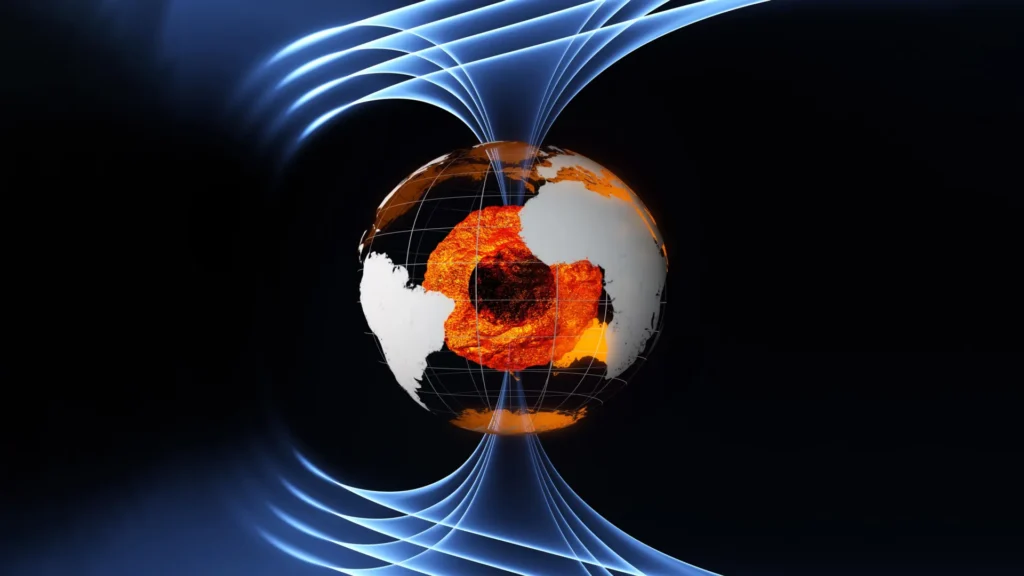
Deep beneath the crust, 2,200 kilometers under our feet, lies a churning, liquid inferno of molten iron. This outer core, a metallic ocean swirling around the planet’s solid inner center, is the engine of the Earth’s existence. It is the birthplace of the geomagnetic field—the invisible, protective shield that guards our atmosphere and modern technology from the blistering solar winds. For decades, geophysicists believed this deep-seated furnace operated in a steady, predictable rhythm. However, a groundbreaking study published in the Journal of Studies of Earth’s Deep Interior has shattered that consensus, revealing a dramatic, unexplained, and rapid reversal in the flow of Earth’s liquid core beneath the Pacific Ocean.
The Main Event: A Sudden Shift in the Deep
For generations, the standard model of the Earth’s core held that the electrically conducting molten iron was locked in a predominately westward flow. This circulation was thought to be a relatively stable feature of our planet’s interior dynamics. However, in 2010, the "steady" nature of this flow vanished.
Data analysis reveals that beneath the equatorial Pacific, a massive, region-wide flow of molten material abruptly abandoned its westward trajectory and began moving strongly eastward. This was not a subtle drift but a profound reversal in the heart of the planet. Scientists were left baffled; the forces required to shift such an immense volume of liquid metal are colossal, and the mechanisms behind this sudden change remain a mystery.
A Chronology of Discovery (1997–2025)
The revelation of this event is the culmination of nearly three decades of high-precision satellite monitoring and historical data integration. By synthesizing ground-based magnetic observations with measurements from a suite of dedicated ESA missions, researchers have built a near-real-time map of the planet’s internal "weather."
- 1997–2009: The Era of Stability: During this period, ground-based magnetic observatories and data from the Danish Ørsted mission and Germany’s CHAMP mission provided a picture of a consistent, westward-dominant flow in the outer core.
- 2010: The Reversal: The critical inflection point. Researchers identified that the broad flow beneath the Pacific shifted to an eastward direction. This transition is now believed to be the catalyst for subsequent geomagnetic anomalies, including the 2017 "geomagnetic jerk."
- 2013: The Swarm Era: The European Space Agency (ESA) launched the Swarm mission, a trio of satellites equipped with highly sensitive magnetometers. These satellites allowed for unprecedented spatial resolution, enabling scientists to separate the signals originating from the core from the noise of the crust and ionosphere.
- 2020–2025: The Cooling of the Flow: Recent data indicate that the strong eastward flow has begun to weaken. This suggests the 2010 event may have been a temporary oscillation or part of a previously unknown long-term cycle in the Earth’s core dynamics.
Supporting Data: The Power of Satellite Constellations
The ability to peer into the Earth’s core without physically touching it is one of the triumphs of modern space science. Because the outer core is made of liquid iron, its motion creates magnetic signals that radiate through the mantle and crust. By measuring these tiny variations in the magnetic field from space, scientists can "see" the currents of the deep.
The Swarm mission has been instrumental in this endeavor. By flying in coordinated orbits, the three satellites create a "constellation" that captures the global magnetic field with exceptional precision. According to the research team, this continuous global coverage is what allowed them to detect wave-like accelerations and rapidly shifting flow structures that were previously buried in the "noise" of less sophisticated datasets.
The study highlights that the core is far more variable than the slow-moving, steady-state models of the 20th century suggested. The ability to distinguish between magnetic signals generated by the core and those generated by the oceans, ionosphere, and magnetosphere has effectively allowed geophysicists to perform an "ultrasound" on the center of the planet.
Official Perspectives: Experts Weigh In
Frederik Dahl Madsen, the lead author of the study from the University of Edinburgh’s School of Geosciences, emphasizes that the discovery raises fundamental questions about the Earth’s deep architecture. "The large-scale flow reversal beneath the Pacific raises new questions about the behavior of Earth’s deep interior," Madsen stated. He notes that the scientific community is now racing to determine whether this was a short-lived fluctuation, part of a repeating oscillation, or a shift toward a new stable equilibrium.
Madsen also proposed a compelling theory regarding the interaction between the core’s layers: "The rise of the strong eastward flow in the Pacific is contemporary with a change in behavior in the inner core, as inferred from geodesy and seismology. We hypothesize that these changes in the deep interior are associated with the changes in flow beneath the Pacific."
Anja Stromme, ESA’s Swarm Mission Manager, highlighted the vital role of long-term data collection. "Although Swarm was launched after the dramatic reversal event of 2010, it has provided high-precision data that tell us about Earth’s inner core in the period that followed," she said. "Swarm provides continuous global coverage over many years, allowing scientists to track how core dynamics evolve over time rather than relying only on ground-based magnetic observatories."
Elisabetta Iorfida, an ESA Swarm Mission Scientist, added that the findings challenge the "stable" dogma. "This study shows that regional changes can emerge rapidly within just a decade," Iorfida explained. "The findings may also help scientists investigate possible interactions between Earth’s outer core, inner core, and lower mantle, giving more insights into the core-mantle boundary—a critical region for deep Earth dynamics."
Implications: Why the Heart of the Planet Matters
While the churning of the outer core occurs thousands of kilometers below the surface and poses no direct threat to human safety or the climate, the implications of this instability are profound.
Protecting the Planet
The magnetic field is our primary defense against solar radiation and the stripping of our atmosphere. Changes in the core’s circulation directly influence the geometry and intensity of the geomagnetic field. If the core enters a phase of increased turbulence or unpredictable shifting, the magnetic field will reflect those changes, potentially affecting navigation systems, satellite operations, and our understanding of space weather.
A New Model for Earth’s Interior
The discovery suggests that the core is dynamically connected to the mantle and the inner core in ways that were previously underestimated. The fact that the Pacific reversal correlates with changes detected in the inner core via seismology suggests a "deep-Earth coupling." This implies that the planet’s layers are not merely stacked shells, but a complex, interconnected system where energy and momentum can be exchanged across thousands of kilometers of rock and metal.
Scientific Outlook
Moving forward, the goal is to refine our models of the "geodynamo"—the process by which the core generates the magnetic field. With the data provided by Swarm and the historical records from CHAMP and Ørsted, scientists are moving toward a state of "near-real-time" observation of the core.
The mystery of the Pacific reversal is a reminder of how little we truly know about the world beneath our feet. As the magnetic field continues to fluctuate, researchers are poised to watch in real-time as the Earth’s deep engine readjusts its gears. Whether this was a singular, anomalous event or a rhythmic pulse in the heartbeat of our planet, the data confirms one thing: the Earth’s interior is a far more active, complex, and unpredictable environment than we ever dared to imagine. As we continue to monitor these deep-seated flows, we are not just observing the history of our planet—we are witnessing the hidden, chaotic forces that define our future.