
By Political Correspondent
In a bold assertion of executive influence over the nation’s cultural repositories, President Donald Trump has issued a series of sweeping demands aimed at the Smithsonian Institution. The President’s directives, broadcast in a flurry of late-night posts on Truth Social this past Friday, call for a fundamental restructuring of the National Museum of American History’s aesthetic and historical narrative, prioritizing traditionalist iconography over the institution’s established modernist curation.
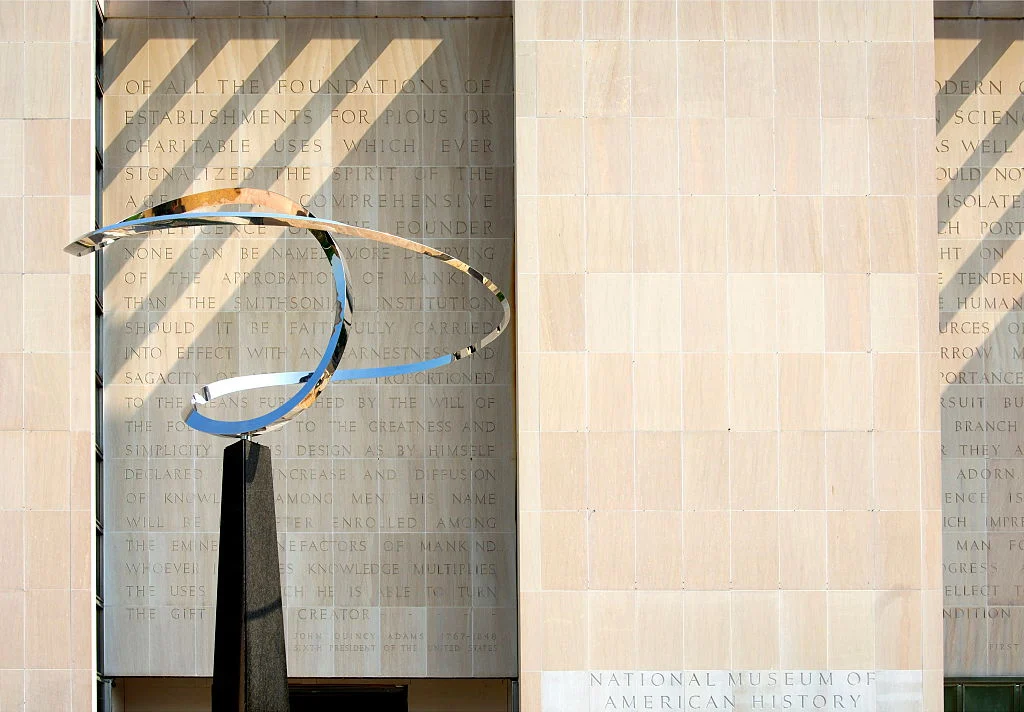
The President’s primary objective involves the removal of Infinity—a seminal 1967 kinetic sculpture by renowned artist José de Rivera—at the museum’s south entrance. In its place, Trump has demanded the installation of a 30-foot statue of George Washington, a figure he describes as "America’s Greatest Hero." This latest intervention marks a deepening rift between the Trump administration and the Smithsonian, an institution that has long operated with a degree of autonomy from the executive branch.
The Core Demands: A Monumental Shift
Writing while in transit to his golf estate in Ireland, President Trump framed his demands as a corrective measure to restore what he perceives as a patriotic focus within the national museum network. The centerpiece of this initiative is an 11-foot statue of George Washington, which recently gained visibility at the Freedom 250 IndyCar race in the museum’s Flag Hall. Trump has stipulated that this monument should be permanently erected on September 17, coinciding with Constitution Day.
Furthermore, the President has called for the immediate launch of an exhibition dedicated to the nation’s first president, intended to run through February 22, 2032—the 300th anniversary of Washington’s birth.
"Replace a sculpture that says nothing about America with the man who, more than anyone else, says everything about America," Trump wrote. "Without him, our Country and our Freedoms wouldn’t exist."
The target of his criticism, Infinity, holds a unique place in American art history. As the first work of modern art commissioned by the U.S. government under the Art and Architecture Program for the National Mall, the polished stainless steel ribbon has served as a fixture of the museum’s architecture for over five decades. De Rivera’s work, which rotates once every six minutes atop a black granite base, is regarded by art historians as a hallmark of mid-century American public art. For the President, however, the work represents a disconnect from the values he believes the Smithsonian should champion.
Chronology of a Growing Conflict
The tensions between the White House and the Smithsonian have been simmering for over a year, characterized by a series of disagreements over the institution’s historical framing.
- 2019: A blue, stick-like sculpture by artist Joel Shapiro is gifted to the Kennedy Center. Years later, it is abruptly dismantled without public explanation, signaling a shift in how the administration views contemporary art in federal spaces.
- 2023–2024: President Trump and the administration frequently criticize the Smithsonian’s "Center for Restorative History" and its "Decolonization Plan." The President argues these initiatives shift the spotlight away from the triumphs of the Founding Fathers in favor of narratives regarding oppression.
- Late 2024: Smithsonian Institution Secretary Lonnie G. Bunch III announces his retirement. His tenure was marked by a commitment to inclusive history, which the Trump administration repeatedly characterized as "twisted" and "unflattering."
- Friday, October 2025: President Trump issues the formal demand for the removal of Infinity and the installation of Washington-themed statuary via social media.
The Battle Over Historical Memory
The President’s critique extends beyond aesthetics into the realm of historical pedagogy. Trump explicitly accused the Smithsonian of failing to provide the "celebration they deserve" to the Founding Fathers, particularly in the lead-up to the 250th anniversary of American independence. He specifically lamented the absence of a prominent display dedicated to Washington’s crossing of the Delaware.
"Washington’s Heroic Crossing of the Delaware on December 25, 1776—one of the greatest moments and turning points of the Revolution—is not even mentioned in the Museum," Trump claimed.
However, internal data from the Smithsonian’s collection reveals a different picture. The museum holds several significant artifacts related to this event, including a 19th-century engraving based on Emanuel Gottlieb Leutze’s iconic painting, as well as period-accurate prints by Thomas Kelly. Furthermore, the museum’s numismatic collection includes a 2021 U.S. quarter featuring the image of Washington rallying his troops during the crossing.
The administration’s frustration seems rooted in a philosophical disagreement over the interpretation of history. Trump took specific aim at an exhibit labeling the period between 1492 and 1776 as the "Great Unsettling" of the continent. For the President, such terminology represents a radical departure from the traditional patriotic narratives he wishes to see promoted in federal institutions.
Official Responses and Administrative Hurdles
The Smithsonian Institution operates as an independent federal trust, meaning its leadership is generally insulated from direct presidential orders regarding the placement or removal of specific artworks. However, the legal landscape is shifting.
The institution is governed by a Board of Regents, which includes high-ranking federal officials. Vice President JD Vance, a member of the Board, has emerged as a central figure in the administration’s efforts to exert influence over the museum network. By leveraging the power of the purse—as federal funding accounts for a substantial portion of the Smithsonian’s annual operating budget—the administration possesses significant leverage to enforce these changes, regardless of traditional institutional autonomy.
This push reflects a broader pattern of bypassing congressional oversight to reshape the cultural landscape of Washington, D.C. A recent, albeit divided, Supreme Court ruling regarding the White House East Wing ballroom project—which dissenting justices labeled "likely unlawful"—has provided the administration with a blueprint for asserting executive authority over federal properties and cultural sites.
Implications for the Cultural Sector
The implications of this intervention are far-reaching. By targeting works like Infinity and attempting to dictate the content of historical exhibitions, the administration is effectively challenging the standard of "rigorous scholarship" that Secretary Lonnie Bunch III championed throughout his tenure.
Critics of the President’s plan argue that the removal of modern art in favor of political statuary sets a dangerous precedent. The dismantling of the Joel Shapiro work at the Kennedy Center—subsequently purchased by former chairman David Rubenstein—serves as a cautionary tale for curators and artists alike. If the executive branch assumes the power to dictate the artistic and historical content of national museums, the role of independent scholarship and artistic expression in public spaces may be fundamentally altered.
Conversely, supporters of the President’s initiative argue that the Smithsonian has lost its way, becoming "out of touch" with the public it is meant to serve. They contend that federal institutions have a responsibility to reflect the values and heroes of the nation’s founding, rather than engaging in what they perceive as revisionist critiques of American history.
As the Smithsonian prepares for a transition in leadership following Secretary Bunch’s retirement, the institution faces a critical juncture. The outcome of this standoff over Infinity and the proposed Washington monuments will likely serve as a defining moment for the future of federal cultural policy in the United States. Whether the institution maintains its scholarly independence or bows to the pressures of the executive branch remains a matter of significant public and legal debate.