In the shifting landscape of modern luxury, where the pressure to innovate often outweighs the desire to create lasting relevance, Rachel Scott’s second collection for Proenza Schouler serves as a masterclass in balance. Presented in the architectural grandeur of the former Rubin Museum, the spring collection marked a departure from the deliberate, restrained foundation of her debut, leaning instead into a narrative of profound liberation.
The show was not merely a display of garments; it was a meditation on the spirit of the New York woman—a figure Scott describes as being defined by her lack of rigid sartorial rules. By weaving together the house’s archival history with a newfound sense of tactile freedom, Scott has signaled that she is not merely a caretaker of the Proenza Schouler legacy, but a dynamic force shaping its future.
The Aesthetic Philosophy: A Study in Friction and Flow
The collection’s trajectory was telegraphed well before the first model stepped onto the runway. The invitation, an acidic yellow image with blurred, dark markings, served as a cryptic preamble. It suggested a visual slippage—the feeling of encountering something familiar that has been reimagined through a distorted, contemporary lens.
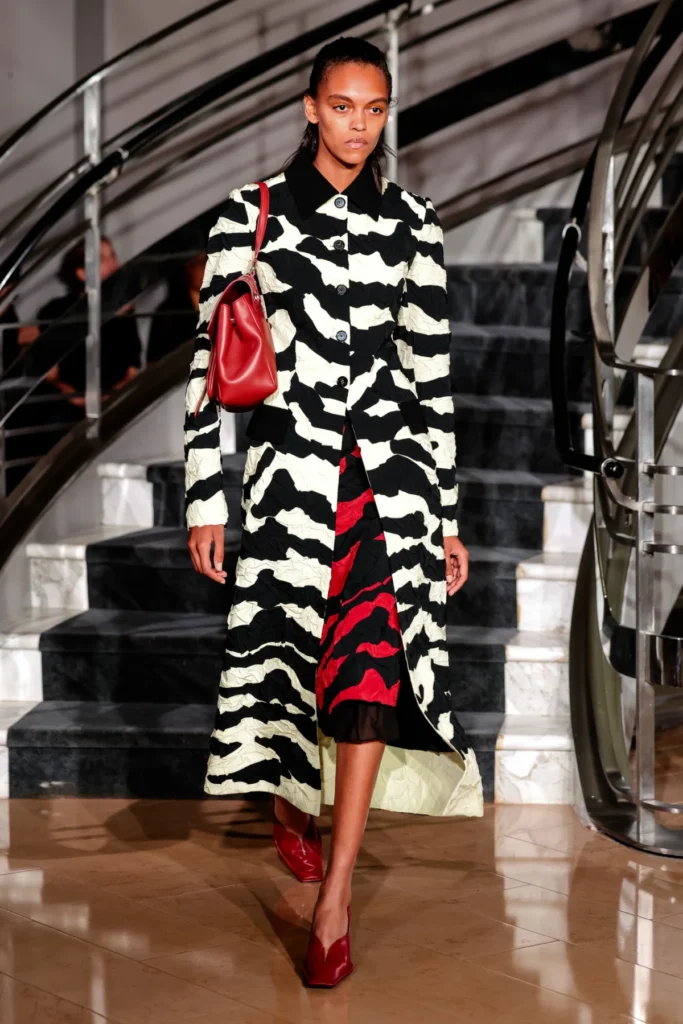
This "slippage" defined the collection’s aesthetic. Scott moved away from the sharp, architectural rigidity that has historically defined Proenza Schouler, opting instead for a silhouette that prioritizes the body. While sharp shoulders remained—a nod to the brand’s enduring DNA—they were softened by the introduction of curving hips and fluid, lithe hemlines.
The color palette was intentionally jarring, designed to evoke the chaotic beauty of New York City. Ultramarine, chrome, and quartz yellow stood in defiant contrast to grounded tones like sienna, cream, and black. These colors did not merely sit next to one another; they cohabitated in a way that forced the viewer to reconcile the unexpected.
Chronology of a Collection: From Rooftop Cyanotypes to the Runway
The development of the collection was as much a technical feat as it was an artistic one. Scott’s process began with a deep dive into the natural and the handmade.
One of the most compelling elements of the show was the integration of organic imagery. The floral prints were not the product of digital manipulation or stock photography; they began as cyanotypes made from real flowers gathered on a New York rooftop. These raw, spectral images were then transformed into prints that appeared on organza, creating a sense of ethereal movement that felt both grounded in the city’s concrete reality and elevated into something dreamlike.
The handiwork was pervasive but never precious. A tiger motif, appearing as a feral punctuation point amidst the collection’s more polished pieces, was meticulously hand-knit and rendered through complex intarsia and tufting. This focus on craft served to complicate the imagery rather than merely decorate it. By ensuring that every texture had a physical, human weight, Scott moved the clothes away from the "fetishized" body and toward a space where the woman is at the center of the garment’s existence.
Supporting Data: The PS1 Walker and Archival Reimagination
No discussion of Proenza Schouler is complete without addressing the house’s accessories. For this collection, Scott took on the challenge of revisiting the iconic PS1, a bag that defined the 2000s era of the brand.
Working in collaboration with Reed Krakoff, Scott introduced the "PS1 Walker." The bag is a tribute to the house’s original Walker Street studio, yet it represents a radical departure from the structured, hardware-heavy designs of the past. The new iteration is marked by a deliberate "suppleness and softness." By reducing the visible hardware and utilizing intricate stitching and hand-tacked details, Scott has successfully translated the nostalgia of the original into a modern object of desire.
This approach to the archives is emblematic of Scott’s broader strategy: she is not treating the brand as a relic to be preserved in glass, nor as a blank slate to be overwritten. She is treating it as a living language, one that can be spoken with a new, more contemporary inflection.
Official Responses and Creative Vision
In a post-show conversation, Scott reflected on the nature of the "New York woman," emphasizing that the city itself dictates the terms of engagement with fashion. "The woman of New York kind of reflects the city, and they kind of reflect each other," she noted.
For Scott, the goal was to achieve a level of technical mastery that disappears into the final look. "The clothes don’t wear her," she stated. "There’s a space for her. They adapt to the body."
This philosophy of "admissible" dressing—where a gown can function as a casual piece and a day-to-day item can serve as eveningwear—is the cornerstone of her creative vision. It is a reaction to the overly prescriptive nature of current trends. By allowing for a sense of "undone" refinement, Scott has created a collection that feels remarkably ageless, designed for a woman who has already reached a state of self-knowledge.
Implications: The Future of New York Fashion Week
The choice of the former Rubin Museum as a venue was not incidental. Its spiraling staircase provided a kinetic, vertical movement that mirrored the fluid nature of the clothes. As models moved through the space—a location layered with the history of New York—the collection seemed to capture the very essence of the city’s current cultural moment: a blend of high-concept refinement and the gritty, beautiful reality of the street.
The industry has spent recent seasons in a state of hand-wringing, questioning whether New York Fashion Week still holds the weight it once did in the global fashion calendar. Collections like this one offer a definitive answer: fashion matters when it is both grounded in technical rigor and capable of evoking a sense of possibility.
By leaning into the "friction" of color and the "ease" of silhouette, Scott has proven that Proenza Schouler can evolve without losing its soul. She is successfully navigating the tension between the brand’s history and her own instincts, ensuring that the house remains at the vanguard of American fashion.
Ultimately, this collection was a bold assertion of intent. Scott has moved past the introductory phase of her tenure and into a period of self-assured expansion. She has curated a wardrobe that is not about the clothes themselves, but about the woman who chooses to inhabit them. In a landscape that often prioritizes the fleeting, Rachel Scott is building something that feels remarkably, and refreshingly, permanent.