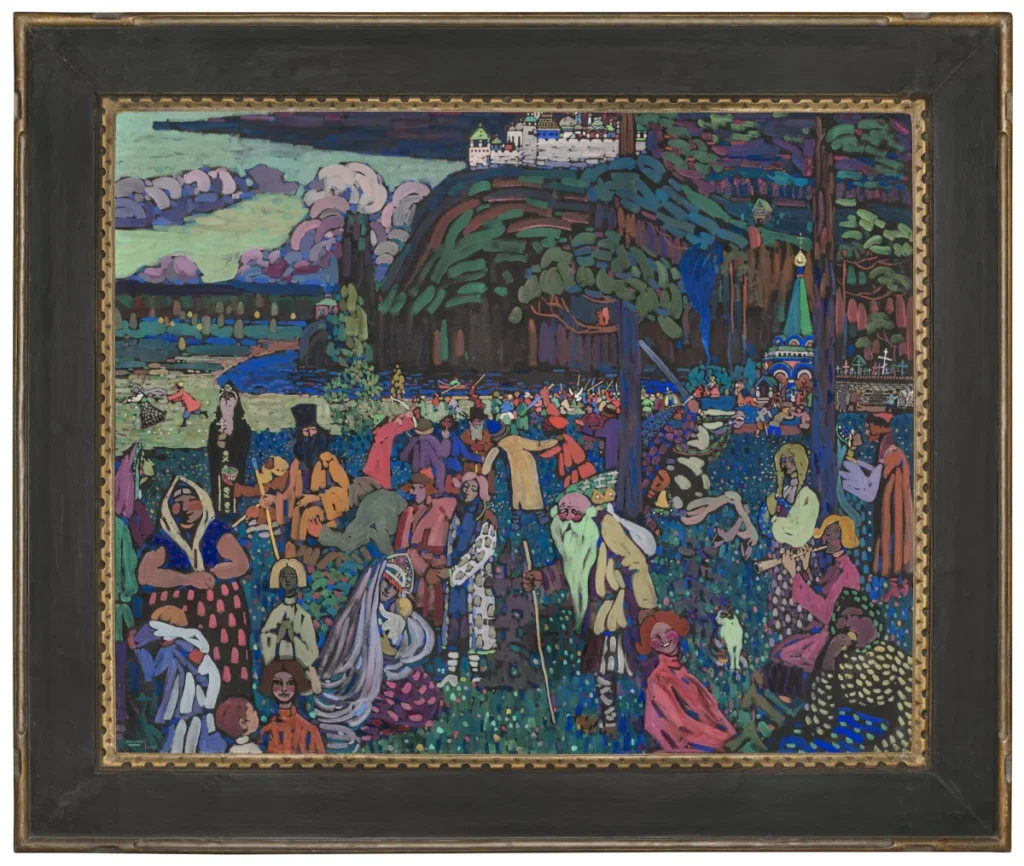
LONDON — On October 14, during the high-octane atmosphere of Frieze Week, the international art world will converge at Christie’s London for a sale that transcends mere commerce. The centerpiece of the evening is Wassily Kandinsky’s 1907 tempera masterpiece, Das bunte Leben (The Colorful Life). Estimated to fetch in excess of $30 million, the painting is not only a pivotal artifact of early 20th-century Modernism but also a profound symbol of historical justice.
Restituted to the heirs of Hedwig Lewenstein-Weyermann in 2023 following a grueling six-year legal odyssey, the work’s appearance on the auction block marks the conclusion of a century-long saga of loss, displacement, and eventual recovery. Its sale follows a growing trend in the art market where "restitution provenance"—once a legal liability—now serves as a testament to the work’s authenticity, survival, and the moral imperative of the current era.
I. The Main Facts: A Monumental Return
Wassily Kandinsky’s Das bunte Leben is widely regarded as one of the most significant works from the artist’s "transitional" period. Measuring approximately 51 by 63 inches, it was his largest canvas to date when completed in 1907. The painting captures a panoramic view of a stylized Russian landscape, teeming with figures that bridge the gap between folklore and spirituality.
The auction at Christie’s follows a landmark decision by the German Advisory Commission on the return of cultural property seized as a result of Nazi persecution (the Limbach Commission). In early 2023, the commission recommended that the Bavarian State Bank return the painting to the heirs of the Lewenstein family, a Jewish textile dynasty from Amsterdam. For over 50 years, the painting had been the crown jewel of the Lenbachhaus in Munich, where it was viewed by millions as a foundational pillar of the museum’s collection.
The current estimate of $30 million is considered conservative by many analysts. Given the recent performance of restituted Kandinsky works—most notably Murnau mit Kirche II, which set a record of $44.9 million at Sotheby’s in 2023—Das bunte Leben is poised to become one of the most expensive works by the artist ever sold.
II. Chronology: From Amsterdam to Munich and Back
The history of Das bunte Leben is a mirror of the 20th century’s darkest and most triumphant moments.
1907–1927: Creation and Acquisition
Kandinsky painted the work in Sèvres, France, during a period of intense creative searching. It was exhibited at the Salon d’Automne in Paris in 1907, where it stood as a bold declaration of the artist’s move away from traditional representation. In 1927, the painting was acquired by Emanuel Albert Lewenstein, a Dutch sewing machine magnate and prominent art collector in Amsterdam.
1940: The Nazi Occupation and Dispersal
Following Emanuel’s death, the painting passed to his wife, Hedwig Lewenstein-Weyermann. In 1940, as the Nazi regime occupied the Netherlands, the family’s world collapsed. Their collection was targeted, and the children, Robert and Wilhelmine, were forced to flee. Under duress and the threat of confiscation, the family’s assets were dispersed. Das bunte Leben was sold at Frederik Muller & Co. in Amsterdam under circumstances later determined to be a forced sale. It was purchased by the collector Salomon B. Slijper.
1972–2023: The Munich Era
In 1972, the Bavarian State Bank purchased the painting from Slijper’s widow. A year later, it was placed on permanent loan to the Städtische Galerie im Lenbachhaus in Munich. For five decades, it was a centerpiece of the museum’s world-renowned "Blue Rider" collection.
2017–2023: The Legal Battle
The Lewenstein heirs, represented by the Mondex Corporation, initiated legal proceedings in 2017. The case was initially met with resistance, involving complex jurisdictional disputes in New York and Germany. The breakthrough came when the case was brought before the German Advisory Commission, which eventually recognized the sale as a direct result of Nazi persecution, leading to the 2023 restitution.
III. Supporting Data: Artistic and Market Significance
The Artistic Pivot
Das bunte Leben is a technical marvel, painted in tempera on canvas. Art historians view it as the climax of Kandinsky’s "fairytale" period. In this work, the artist employs a technique reminiscent of pointillism but infused with the vibrant, non-naturalistic colors of Fauvism.
The composition is densely packed with over 100 figures:
- The Foreground: Features a "Death" figure in a blue cowl, a flute player, and various pilgrims.
- The Middle Ground: Depicts a mother and child, lovers, and Russian Orthodox monks.
- The Background: Dominated by a shimmering, multi-colored hill crowned by a Kremlin-like citadel.
Marc Porter, Chairman of Christie’s Americas, notes that the painting "points towards the radical move into abstraction." Indeed, the fragmentation of color in Das bunte Leben prefigures the geometric explosions of his later "Compositions."
The Kandinsky Market
The market for Kandinsky has seen a dramatic upward trajectory, specifically for works with impeccable provenance and historical weight.
- Previous Record: Murnau mit Kirche II (1910) sold for $44.9 million in 2023.
- Pre-Restitution Benchmark: Bild mit weissen Linien (1913) sold for $41.6 million in 2017.
The "Restitution Premium" is a documented phenomenon in the high-end art market. Collectors are often willing to pay more for works that have been formally cleared of title disputes, as these paintings come with a "clean" history and a poignant narrative of justice served.
IV. Official Responses: A Consensus on Justice
The restitution of Das bunte Leben was met with a mix of mourning from the museum community and celebration from advocates of human rights.
The Heirs’ Perspective:
The Lewenstein family, through their legal representatives, expressed a profound sense of closure. James Palmer, founder of the Mondex Corporation, which spearheaded the recovery, has been vocal about the difficulties faced during the process. While early interactions with the Bavarian State Bank were reportedly adversarial, the final recommendation by the Limbach Commission was hailed as a victory for the "Washington Principles on Nazi-Confiscated Art."
The Museum’s Response:
The Lenbachhaus, which lost its most famous resident, issued a statement acknowledging the historical necessity of the return. Matthias Mühling, the museum’s director, stated that while the loss of the painting is "painful" for the public collection, the museum stands by the ethical obligation to address the injustices of the Nazi era. "The history of the work is inseparable from the history of the 20th century," Mühling noted.
The Auction House:
Keith Gill, Vice Chairman of 20th and 21st Century Art at Christie’s, emphasized the work’s universal appeal. "Kandinsky is no longer simply depicting the world around him, but beginning to imagine how painting might communicate something beyond the visible. This work is a larger vision of human experience."
V. Implications: The Future of Restitution and the Art Market
The sale of Das bunte Leben carries implications that reach far beyond the walls of Christie’s.
1. The Erosion of "Statutes of Limitations"
For decades, museums and banks relied on legal technicalities and statutes of limitations to retain works acquired during or after the war. The Das bunte Leben case reinforces the shift toward "moral title" over "legal title." The German Advisory Commission’s decision underscores that in the realm of Nazi-looted art, the ethical context of the original loss outweighs the duration of the current owner’s possession.
2. The Role of Private Recovery Firms
The involvement of the Mondex Corporation highlights the increasing professionalization of art recovery. These firms act as historians, genealogists, and litigators, often taking on significant financial risk to pursue claims that can take decades to resolve. Their success is changing how museums vet their permanent collections.
3. The "Museum Gap"
As high-value restituted works like this move from public museums to private auction blocks, there is a growing concern about the "privatization" of cultural heritage. While the heirs have every right to sell the property to recoup the value stolen from their ancestors, the public often loses access to these masterpieces. This has led to calls for "buy-back" funds, where governments or philanthropists assist museums in purchasing restituted works to keep them on public display.
4. A New Standard for Provenance Research
The global art market is now operating under a "new normal" where provenance research is not just an academic exercise but a financial necessity. Auction houses are investing more heavily in researchers to ensure that any work with a "gap" in its history between 1933 and 1945 is thoroughly vetted, preventing the legal and reputational nightmares seen in previous decades.
Conclusion
As Das bunte Leben prepares to take the stage in London, it stands as more than a collection of tempera pigments on a canvas. It is a survivor of the 20th century’s attempt to erase entire cultures. Its $30 million price tag is a reflection of its artistic genius, but its true value lies in its role as a beacon of restorative justice. When the gavel falls on October 14, it will signal the end of a family’s long wait and a new chapter for one of the most vibrant visions in the history of Modern art.