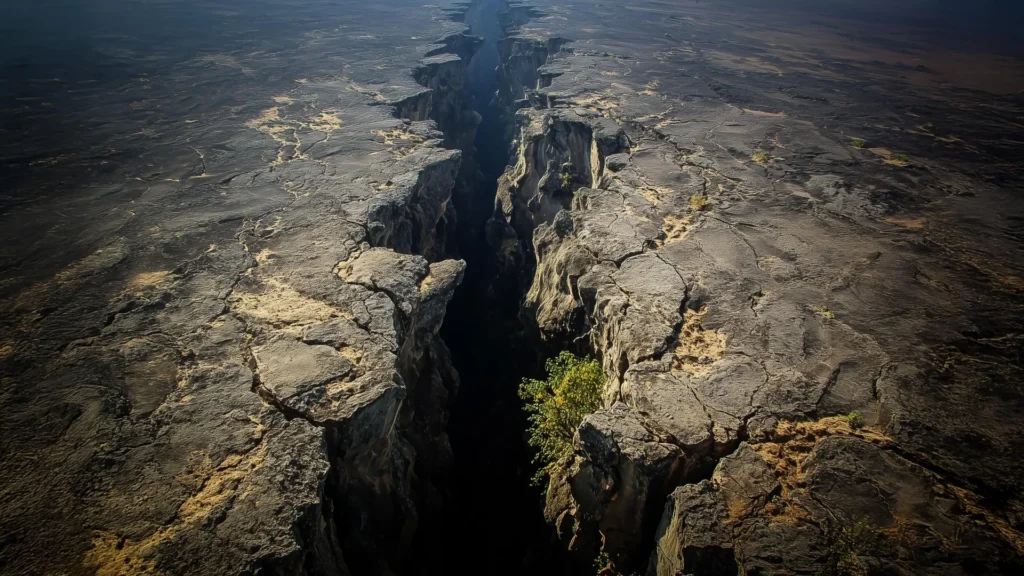
The East African Rift System (EARS) is more than just a geological feature; it is a sprawling, active laboratory where the very fabric of the African continent is being pulled apart. For decades, geoscientists have viewed continental rifting through a relatively straightforward lens: the lithosphere—the rigid, outer shell of our planet—stretches and thins under stress, eventually fracturing to create the deep basins and volcanic peaks that characterize East Africa.
However, recent, high-precision data have revealed a structural anomaly that challenges this conventional narrative. By employing cutting-edge 3D thermomechanical models, a team of researchers led by the Geodesy and Tectonophysics Lab has identified a "hidden" force at play. The findings suggest that the continent’s surface is not merely responding to shallow gravitational pulls, but is being subtly manipulated by the massive, churning currents of the African Superplume deep within the Earth’s mantle.
The Mechanics of a Breaking Continent
To understand the complexity of the EARS, one must first understand the duality of the lithosphere. Composed of the crust and the uppermost mantle, the lithosphere behaves like a paradox depending on the timescale of the force applied to it.
Geophysicist D. Sarah Stamps, an associate professor in the Department of Geosciences at the Virginia Tech College of Science, utilizes a relatable analogy to explain this phenomenon: "If you hit Silly Putty with a hammer, it can actually crack and break. But if you slowly pull it apart, the Silly Putty stretches. So on different time scales, Earth’s lithosphere behaves in different ways."
Near the surface, where the rock is brittle and cool, the stress of rifting results in faults and earthquakes. Yet, as one descends into the Earth, the higher temperatures allow the material to become ductile, deforming gradually over geological time. In most rifts, this deformation is predictable: the crust pulls apart perpendicularly, mirroring the direction of the tension. But in the East African Rift—the largest active continental rift system on the planet—Stamps discovered a persistent, baffling movement running parallel to the rift itself. This "rift-parallel" motion did not fit the textbook model of continental breakup, setting the stage for a scientific investigation that would span over a decade.
A Chronology of Discovery: From GPS to Supercomputers
The mystery began in earnest when Stamps, then a postdoctoral researcher, began deploying GPS stations across the East African landscape. These stations, receiving signals from more than 30 satellites orbiting at an altitude of 25,000 kilometers, allowed for precision measurements at the millimeter scale.
Phase I: The Observation (2010–2020)
For over 12 years, the Geodesy and Tectonophysics Lab meticulously collected data. While the expected rift-perpendicular movement was clearly documented, the consistent "anomalous" movement parallel to the rift remained an outlier. Standard models relying solely on lithospheric buoyancy—the force generated by variations in elevation and density—could explain the opening of the rift, but they remained silent on why the land was sliding laterally.
Phase II: The 2021 Simulation
In 2021, the research team published a landmark study in Geophysical Research Letters using 3D computational simulations. The goal was to isolate whether the rifting was driven by buoyancy forces (shallow) or mantle traction (deep). The study confirmed that while buoyancy forces were the primary drivers for the familiar east-west spreading, they were entirely insufficient to explain the north-south rift-parallel deformation. The scientists hit a wall: they knew the motion existed, but the mechanism behind it remained speculative.
Phase III: The Superplume Connection (2024)
The breakthrough arrived through the work of Dr. Tahiry Rajaonarison, a postdoctoral researcher at New Mexico Tech and a Virginia Tech alumnus. Utilizing advanced 3D thermomechanical modeling, Rajaonarison focused specifically on the mysterious lateral drift. The models revealed a compelling correlation: the northward flow of the African Superplume—a massive, hot upwelling of mantle material originating beneath southwest Africa—was perfectly aligned with the anomalous surface motion.
The African Superplume: A Mantle Powerhouse
The African Superplume is a gargantuan geological feature, a rising column of superheated mantle material that acts as a primary heat engine for the African plate. As it rises from the deep mantle, it spreads northeastward, becoming progressively shallower as it nears the surface.
The recent modeling results indicate that this deep-seated mantle flow exerts a "traction" force on the base of the lithosphere. Like a conveyor belt pulling on a floorboard, the mantle flow drags the underside of the continental plate. Because the mantle flow is directed northward, it creates a subtle, shear-like effect that manifests at the surface as rift-parallel deformation.
Furthermore, the team examined seismic anisotropy—a phenomenon where seismic waves travel at different speeds depending on their orientation through the rock. In the EARS, the orientation of these waves perfectly matches the direction of the mantle flow associated with the Superplume. This serves as a vital "smoking gun," providing a geophysical signature that confirms the mantle’s influence on the lithospheric plate above.
Official Perspectives: A Multi-Factorial Reality
The implications of this research are profound, as they resolve the long-standing debate over the primary drivers of the East African Rift. For years, the scientific community has been polarized between those who championed buoyancy forces—the idea that high topography and density differences drive the rift—and those who argued for mantle-driven traction.
"We are saying that the mantle flow is not driving the east-west, rift-perpendicular direction of some of the deformations, but that it may be causing the anomalous northward deformation parallel to the rift," explained Dr. Rajaonarison. "We confirmed previous ideas that lithospheric buoyancy forces are driving the rift, but we’re bringing new insight that anomalous deformation can happen in East Africa."
Dr. Stamps emphasizes that the study does not invalidate previous theories; rather, it enriches them. By acknowledging that multiple forces are at work, researchers can now build more accurate models of how continents break apart. The EARS is not a simple machine with a single gear; it is a complex system where shallow gravitational forces and deep mantle currents engage in a constant, dynamic tug-of-war.
Implications for Future Geodynamic Research
The discovery that the African Superplume influences surface deformation has several key implications:
- Refined Tectonic Models: Future simulations of continental rifting must account for deep-mantle traction. Relying solely on surface-level topography will no longer suffice for predicting the long-term evolution of rift systems.
- Seismic Hazard Assessment: By understanding the forces driving the movement of the crust, scientists can better analyze the stresses accumulating along the fault lines of the East African Rift, potentially improving earthquake hazard assessments for the millions of people living in the region.
- Understanding Plate Evolution: The EARS is a precursor to the eventual birth of a new ocean. By studying the interaction between the Superplume and the crust, researchers are witnessing the earliest, most complex stages of the process that created the Red Sea and the Atlantic Ocean.
As Dr. Stamps noted, "We’re excited about this result from Dr. Rajaonarison’s numerical modeling because it provides new information about the complex processes that shape the Earth’s surface through continental rifting."
The East African Rift remains one of the most enigmatic regions on the planet. With the integration of deep-mantle dynamics into the geological narrative, scientists have moved one step closer to understanding the grand, slow-motion choreography of the Earth’s interior and its undeniable impact on the world beneath our feet. The interplay between the deep, flowing mantle and the rigid, breaking crust serves as a potent reminder that even the most stable-looking landmasses are part of a continuous, transformative process.