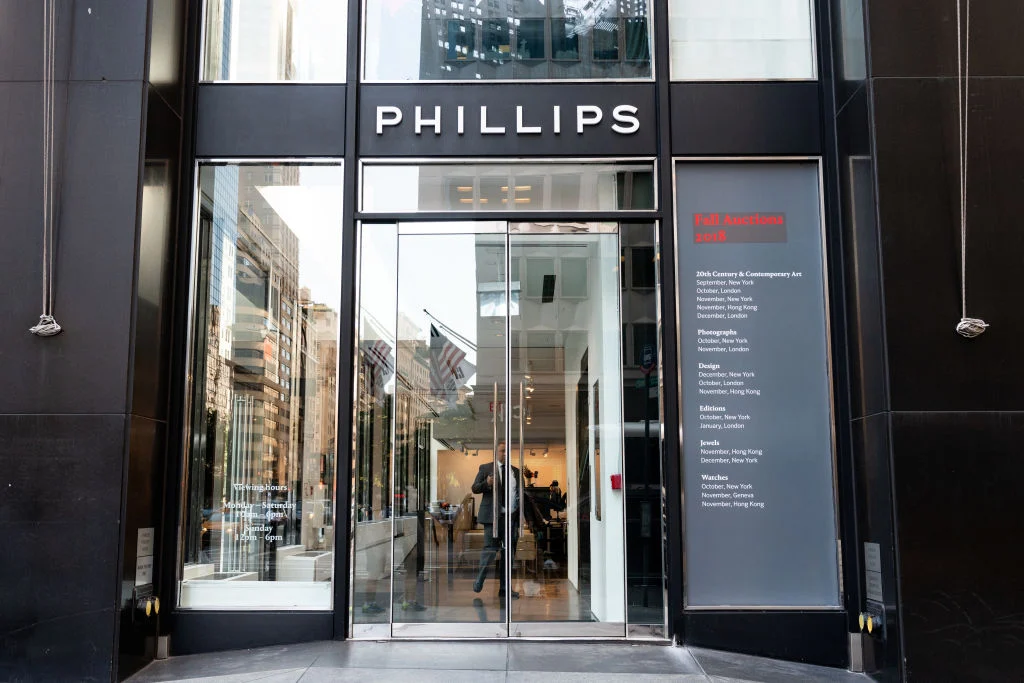
The global art market, often characterized by its discretion and tradition, is currently witnessing a significant restructuring at one of its most prominent institutions. Phillips, the auction house that has carved out a distinct niche in the 20th-century and contemporary art sectors, is undergoing a period of profound internal transformation. In the wake of its highly successful May sales in New York, the house has seen an exodus of veteran talent, including half of its executive leadership team and several senior specialists who were instrumental in the firm’s recent global expansion.
While the auction house maintains that these shifts are part of a natural evolution toward a "leaner" and more "next-generation" focused business model, the sheer volume of departures has sent ripples through the art advisory community. The transition comes at a critical juncture as the house prepares for the high-stakes fall auction season, beginning with the Frieze Week sales in London this October.
Main Facts: A Leadership Team in Transition
The most striking aspect of the recent turnover is the departure of two pillars of Phillips’ executive quartet. Miety Heiden, the Chairman of Private Sales, and Jonathan Crockett, the Chairman for Asia, are both slated to officially vacate their roles next month. Their exits leave a significant void in the top tier of the organization, which, until recently, was composed of Heiden, Crockett, Robert Manley (Chairman and Worldwide Head of Modern and Contemporary Art), and Marianne Hoet (Head of Business Development and Chairman of Europe).
Under the current structure, this leadership team reports to Chief Executive Officer Martin Wilson. Wilson, a legal expert who spent two decades at Christie’s before joining Phillips in 2019 as Chief Legal Officer, ascended to the top role following the departure of Ed Dolman in early 2024. The leadership shakeup began shortly before Wilson’s tenure solidified; in December 2023, Deputy CEO Amanda Lo Iacono also stepped down, marking the beginning of a year defined by administrative volatility.
The departures extend beyond the C-suite into the senior specialist ranks. Over the summer of 2024, the house lost:
- Scott Nussbaum: Deputy Chairman and Senior International Specialist (departed June).
- Vivian Pfeiffer: Deputy Chairman and Head of Business Development (departed August).
- Meiling Lee: Senior International Specialist for 20th-Century and Contemporary Art (resigned September).
- Annette Schwaer: Chief Financial Officer, a veteran of the firm since 2013.
- Jennifer Jones: Senior Vice President and Senior Director for Trusts, Estates, and Valuations.
Chronology: From Record Sales to Executive Exits
The timeline of these departures presents a curious paradox. The exits did not follow a period of financial decline, but rather one of record-breaking performance.
The May 2024 Turning Point
In May 2024, Phillips hosted its marquee sales in New York, which were hailed as a resounding success. The auctions totaled $145.6 million, representing a staggering 90 percent increase year-over-year by lot. The Modern and Contemporary Evening Sale alone brought in $115.2 million and achieved a "white-glove" result—a rare industry feat where 100 percent of the lots offered are sold. This performance suggested a house in its prime, capable of competing aggressively with its larger rivals, Sotheby’s and Christie’s.
The Summer Exodus
Despite the momentum from the May sales, the internal atmosphere appeared to shift as the summer progressed. Scott Nussbaum’s departure in June was followed by Vivian Pfeiffer’s exit in August. Pfeiffer has since founded her own consultancy, VB Art Advisory, a move that highlights a growing trend of senior auction house specialists seeking independence.
The most recent blow came in September with the resignation of Meiling Lee. Lee was a cornerstone of Phillips’ Asian operations, credited with securing the $85 million sale of Jean-Michel Basquiat’s Untitled (1982) from the collection of Japanese billionaire Yusaku Maezawa in 2022. Her departure, coupled with Jonathan Crockett’s exit, signals a total overhaul of the leadership that established Phillips’ Hong Kong outpost in 2015.
Leadership Evolution
The current turnover is inextricably linked to the change in CEO. Ed Dolman, who led Phillips for a decade and was credited with modernizing the brand, stepped down to launch his own consultancy. Martin Wilson’s elevation to CEO in 2024 brought a different management style. Insiders suggest that "anytime you have a new CEO, there are some relationships that just don’t gel," noting that personnel changes are common when a new leader seeks to implement a fresh vision.
Supporting Data: The Value of the Departing Talent
To understand the impact of these departures, one must look at the specific contributions of the individuals involved.
Miety Heiden joined Phillips in 2017 after 18 years at Sotheby’s. During her tenure, she transformed the Private Sales division, which grew by 46 percent under her leadership. Private sales are a high-margin, year-round revenue stream that provides stability between the biannual marquee auction cycles. Losing the architect of this growth creates a strategic challenge for the house.
Jonathan Crockett and Meiling Lee were the faces of Phillips in Asia. Crockett joined in 2016 and was instrumental in building the house’s presence in a region that has become the primary growth engine for the global art market. Lee, who previously managed the prestigious Yageo Foundation collection, provided the deep collector relationships necessary to secure "trophy" lots like the aforementioned $85 million Basquiat.
Financial Context:
- May 2024 Sales Total: $145.6 Million.
- Evening Sale Total: $115.2 Million (100% Sold).
- Private Sales Growth: 46% (Under Heiden’s leadership).
- Key Lot: $85 Million Basquiat (Secured by Lee/Crockett team).
Official Responses: Strategic Pivot vs. Loss of Confidence
The reaction to the departures is divided between internal optimism and external skepticism.
The Institutional Stance
A spokesperson for Phillips emphasized that the departures are part of a forward-looking strategy. "Phillips’ priority firmly remains on delivering uninterrupted performance for our clients and building on the strong momentum we’ve achieved across the business," the house stated. They highlighted a focus on "new talent" and the "next generation," suggesting that the house is looking to promote younger specialists who can adapt to a changing, more digital-centric market.
To support this narrative, Phillips has pointed to several recent hires and promotions:
- Annie Wallington: Joined as Senior Specialist and Head of Modern Art in London (July 2024).
- India Phillips: Appointed Managing Director for Modern and Contemporary Art in Europe (April 2024).
- Rebekah Bowling: Promoted to Head of 21st-Century Art.
- Kristen Yraola: Hired as Global Head of Digital Marketing.
The Market Perspective
The art advisory world has expressed more caution. Gabriela Palmieri, a prominent art adviser, voiced concerns regarding the loss of institutional memory and personal relationships. "I’ve had a strong relationship with Phillips and that relationship was with the people there," Palmieri said. "How can you secure confidence from your clients if you can’t secure confidence from your team?"
Conversely, another New York-based adviser, speaking anonymously, suggested the departures might be a calculated move toward "efficiency." This view posits that Phillips is attempting to "trim the cost basis" by moving away from senior specialists with exceptionally high salaries, particularly those whose value can be replicated by leaner teams or who are ready to transition into independent advisory roles.
Implications: The Road Ahead for Phillips
The immediate implication for Phillips is the looming fall season. With Frieze Week in London and the subsequent November sales in New York, the house must prove it can maintain its "white-glove" momentum without the specialists who built its current reputation.
1. The Relationship Deficit
The auction business is fundamentally built on trust and personal networks. When figures like Heiden and Lee leave, they often take their "black books" of high-net-worth clients with them. Phillips’ challenge will be to ensure that these clients remain loyal to the brand rather than the individual.
2. The Shift to "Lean" Operations
The move toward a leaner business model suggests that Phillips may be moving away from the "star specialist" model that dominated the 2010s. By focusing on "next-generation" talent, the house may be seeking to reduce overhead and create a more agile, corporate structure under Martin Wilson’s legalistic and business-focused leadership.
3. The Asian Strategy
With both Crockett and Lee gone, Phillips’ strategy in Asia is under the microscope. The house recently opened a massive new headquarters in Hong Kong’s West Kowloon Cultural District. Filling that space with high-quality inventory will require new leadership to quickly establish the same level of rapport with Asian collectors that Lee and Crockett spent nearly a decade cultivating.
4. A New Identity
Under Ed Dolman, Phillips was the "boutique" alternative to the big two. Under Martin Wilson, and with a significantly different executive team, the house appears to be entering a new chapter. Whether this chapter will be defined by continued growth or a retreat to a more conservative business model will be determined by the results of the upcoming October and November sales.
As the dust settles on this summer of turnover, the art world will be watching closely. Phillips has demonstrated it can sell art at the highest level; now, it must demonstrate it can retain—or successfully replace—the human capital that made those sales possible.