Introduction: The Silent Witnesses of the Inner Solar System
For eons, the rocky worlds of our inner solar system—Earth, Mars, and our Moon—have been silent participants in a violent celestial dance. While the Earth is a dynamic planet, constantly recycling its surface through the relentless machinery of plate tectonics, volcanism, and erosion, its history remains largely hidden beneath shifting continents and deep oceans. However, a groundbreaking study led by the Southwest Research Institute (SwRI) has unveiled a compelling theory that suggests our neighborhood was once caught in a prolonged, violent crossfire of space debris, triggered by a singular, catastrophic collision in the main asteroid belt approximately 800 million years ago.
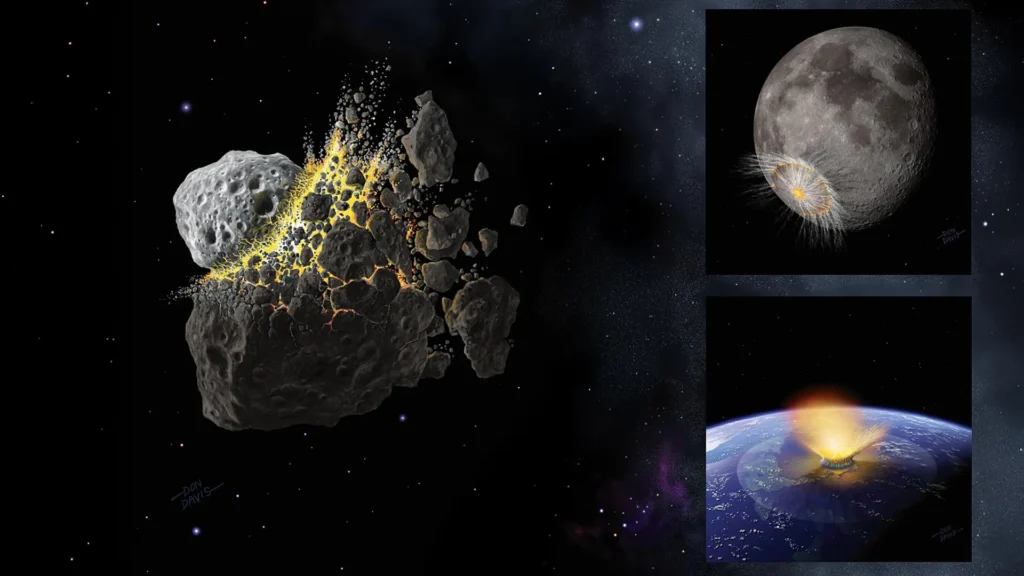
This research, spearheaded by Dr. William Bottke and his team at the Center for Lunar Origin and Evolution (CLOE), posits that the fragmentation of a massive parent body—the progenitor of the modern Eulalia asteroid family—sent a colossal wave of rubble toward the terrestrial planets. This ancient bombardment, the researchers suggest, may have been far more than a mere spectacle; it may have fundamentally altered the course of planetary evolution, influencing climates, triggering seismic events, and potentially even steering the trajectory of life on Earth.
Chronology of a Solar System Siege
To understand the significance of this event, one must view the solar system not as a static arrangement of planets, but as a dynamic, evolving environment.
The Breakup (800 Million Years Ago)
The story begins in the main asteroid belt, located between Mars and Jupiter. A primitive, carbon-rich object—a carbonaceous chondrite—suffered a catastrophic collision. The timing and location were, in cosmic terms, exceptionally unfortunate. The parent body was situated perilously close to a gravitational "escape hatch" known as the 3:1 mean motion resonance with Jupiter.
The Immediate Barrage
Because the parent body shattered on the precipice of this resonance, the physics of the solar system took over. The resonance acted as a gravitational funnel, capturing roughly half of the resulting debris almost immediately and flinging it into elongated, planet-crossing orbits. For millions of years, the inner solar system was subjected to a relentless hailstorm of asteroids, as these fragments crossed the paths of Earth, Mars, and the Moon.
The Long Tail (The Yarkovsky Effect)
The bombardment did not cease with the initial wave. Over the subsequent 100 to 150 million years, a secondary phase of the assault unfolded. The Yarkovsky effect—a phenomenon where sunlight unevenly heats an asteroid, creating a tiny, persistent thrust—slowly nudged another 25% of the remaining debris into the same resonance. This extended the period of instability, ensuring that the inner solar system remained a hazardous environment for geological epochs.
Supporting Data: Why the Moon is Our Archive
The primary challenge for geologists investigating Earth’s ancient history is the planet’s own "self-cleaning" mechanism. Plate tectonics and active weather systems effectively scrub the geological record clean of craters older than 650 million years. To bridge this gap, scientists look to the Moon.
The Lunar Archive
Unlike Earth, the Moon is a geological time capsule. Lacking a significant atmosphere, liquid water, or plate tectonics, the lunar surface preserves the scars of the past with remarkable fidelity. By analyzing the density of craters on the Moon and examining impact glass—melted rock created by the extreme heat of hypervelocity collisions—collected during the Apollo missions, researchers have identified a distinct spike in impact activity around the 800-million-year mark.
Collisional and Dynamical Modeling
The SwRI team utilized advanced computer simulations to model the breakup of the Eulalia family. By recreating the orbital mechanics of the fragments, the team was able to demonstrate that the debris stream perfectly matches the timeline of the lunar impact surge. The "cosmic forensics" performed by the team confirms that the destruction of the Eulalia parent body is the most plausible culprit for the uptick in cratering observed across the inner solar system.
Official Perspectives: The Scientific Implications
Dr. William Bottke, an executive director in SwRI’s Solar System Science and Exploration Division and the lead author of the study, emphasizes that this research is not just about counting craters; it is about understanding the environmental history of our planets.
"The role impacts have played in shaping the origin and evolution of life in our solar system is poorly understood," Dr. Bottke noted. "The heavily cratered surface of the Moon serves as a reminder of the large impacts in Earth’s past, but so far, only the Chicxulub impact event 66 million years ago has been strongly linked to a specific effect on life, namely the mass extinction of the dinosaurs."
Bottke’s team suggests that because Earth possesses a larger gravitational cross-section than the Moon, it would have been hit with roughly 20 times the number of asteroids. While we lack the craters to prove the specific locations of these strikes, the statistical probability of a sustained, 150-million-year bombardment is high.
The Broader Implications for Earth and Mars
The potential consequences of this sustained bombardment are profound and reach into the realms of climatology and planetary geology.
Climate and the Biosphere
The 800-million-year-old window of bombardment overlaps with a period of significant environmental instability on Earth, including major shifts in the climate and the evolution of the biosphere. While the study does not claim definitive causality, the correlation is too striking to ignore. Could the dust and debris from these repeated impacts have triggered a "cosmic winter," driving the climate fluctuations observed in the geological record? It remains a "compelling target for future research," according to the study.
Seismic Activity on Mars
The implications for the Red Planet are equally intriguing. Mars, which has a thinner crust and different geological history than Earth, would have felt the shockwaves of these impacts intensely. The bombardment likely triggered widespread seismic activity and could be linked to surges in volcanic output. This suggests that the internal evolution of a planet can be significantly influenced by external events in the asteroid belt.
A New Understanding of Solar System Evolution
This study challenges the traditional view that the inner solar system is largely influenced by its own internal processes. Instead, it highlights a deep, interconnected relationship between the main asteroid belt and the terrestrial planets. It suggests that our "neighborhood" is susceptible to large-scale, long-term environmental shifts prompted by events occurring millions of miles away.
Conclusion: The Unfinished Story
As we continue to explore the solar system, the study of the Eulalia family breakup serves as a vital reminder of our vulnerability. The history of the inner solar system is one of constant, often violent change. By decoding the history written on the surface of the Moon, we are learning to read the missing chapters of Earth’s own ancient biography.
The research conducted by Dr. Bottke and his colleagues at the Southwest Research Institute provides a roadmap for future planetary science. It moves us away from viewing impact events as isolated, random occurrences and toward a model of solar system history where large-scale, sustained bombardments act as catalysts for geological and biological change. As we look toward the stars, we are reminded that our past is inextricably linked to the debris of the asteroid belt—a history that continues to influence the very ground beneath our feet today.