In the high-stakes race to build general-purpose artificial intelligence, the most precious commodity is no longer just compute power or algorithmic sophistication—it is high-quality, real-world physical data. XDOF, a startup barely three months out of stealth, has emerged as the linchpin in this new industrial revolution. According to reports from several sources familiar with the matter, the Berkeley-born startup is currently in late-stage negotiations for a Series B funding round that would catapult its valuation to approximately $1.2 billion, led by venture capital firm 8VC.
This meteoric rise, coming hot on the heels of a $70 million Series A round in June, signals a seismic shift in how the robotics industry perceives its biggest hurdle. As artificial intelligence moves from the digital confines of chatbots into the physical realm of dexterous manipulation, XDOF is positioning itself as the indispensable "data supply chain" for the next generation of humanoid and industrial robots.
A Rapid Ascent: The Chronology of XDOF
The XDOF story began in 2024, rooted in the halls of UC Berkeley. Co-founded by CEO Philipp Wu and CTO Fred Shentu—both prominent researchers in the field of robotics and machine learning—the company was born out of academic frustration. During his PhD studies, Wu encountered a persistent wall: while researchers had developed sophisticated algorithms for robot learning, they lacked the massive, diverse datasets required to move those robots beyond controlled laboratory settings.
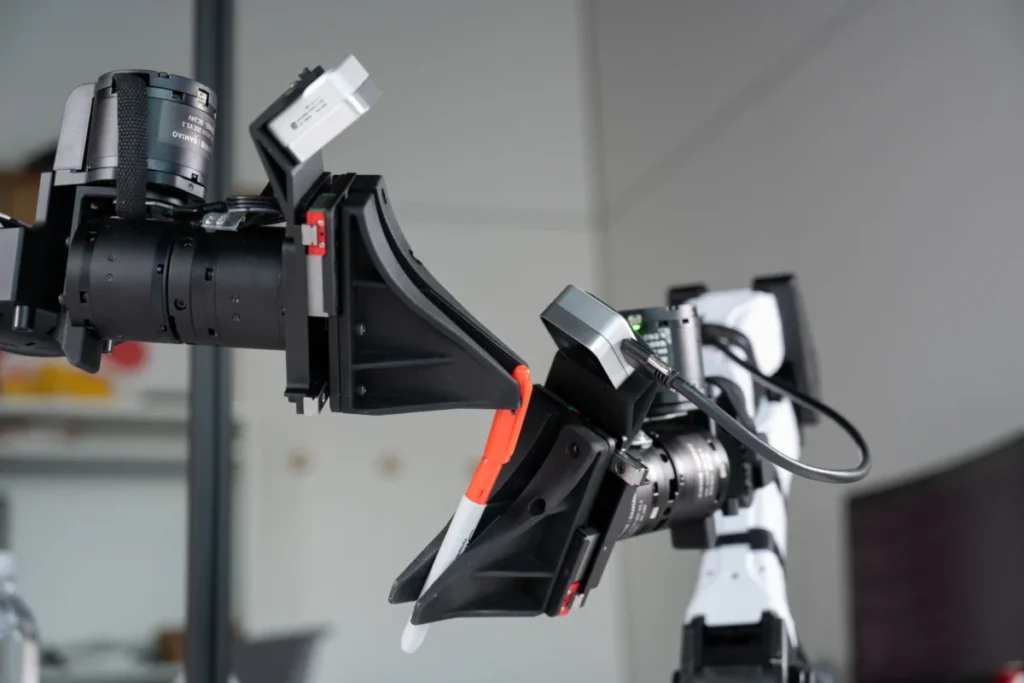
The founders’ initial breakthrough was the development of GELLO, a low-cost, high-fidelity teleoperation system. GELLO allowed human operators to guide robotic arms through complex tasks remotely, generating the precise, labeled movement data needed to train neural networks. This project, which garnered significant academic acclaim, became the technological backbone of XDOF.
By June 2026, the company emerged from stealth, securing a $70 million Series A round with a powerhouse roster of backers, including Thrive Capital, Andreessen Horowitz, Lux Capital, and Spark Capital. While the company initially intended to focus on steady scaling, its performance metrics proved too compelling for the venture market to ignore. With annualized revenue currently approaching $50 million, XDOF has seen a surge in demand from frontier AI labs and robotics manufacturers who are desperate to bypass the "dirty, unglamorous work" of manual data collection.
The Data Bottleneck: Why the Industry Needs XDOF
To understand XDOF’s valuation, one must understand the fundamental difference between Large Language Models (LLMs) and physical robotics. The "AI Boom" of the early 2020s was fueled by the internet—an effectively infinite corpus of text, images, and code that LLMs could scrape and ingest. Physical robots, however, do not have a "digital internet" of movement data.
A robot trying to learn how to fold a laundry pile or navigate a cluttered warehouse cannot learn from a Wikipedia article. It needs to see, feel, and replicate physical movement. This is where XDOF functions as the "Scale AI for the physical world."
XDOF provides a comprehensive infrastructure for data ingestion. Their process is multifaceted:
- Teleoperation: Using systems like GELLO, human operators remotely pilot robots to perform specific tasks, teaching the machine through demonstration.
- Egocentric Data Capture: XDOF employs human collectors who wear sophisticated body sensors, recording their own natural movements as they perform everyday tasks—flattening boxes, organizing shelves, or handling fragile objects.
- Annotation and Curation: The raw sensory input is processed through XDOF’s proprietary annotation systems, turning chaotic physical movement into structured training data that AI models can digest.
By partnering with UC Berkeley’s AI Research lab to release the "ABC" (Autonomous Behavior Collection) dataset—which the company claims is the largest collection of high-quality robot training data ever assembled—XDOF is effectively setting the industry standard.
Supporting Data: A Market in Search of Infrastructure
The financial metrics surrounding XDOF reflect a broader market trend: the transition from software-as-a-service (SaaS) to "physical-AI-as-a-service."
The company is currently serving approximately 20 enterprise-level customers, including some of the most well-funded frontier AI labs in the world. These firms, while brilliant at architecture and model training, often lack the logistics to hire, train, and manage global teams of data collectors.
XDOF’s business model is essentially an outsourced data supply chain. By managing the recruitment and training of teleoperators and sensor-equipped human collectors worldwide, XDOF offloads the most labor-intensive part of the AI development cycle. The fact that the company is approaching $50 million in annualized revenue—a significant milestone for a startup in its infancy—demonstrates that major players are willing to pay a premium to outsource the "ground truth" collection that is essential for robot viability.
Official Responses and Deal Status
As of this writing, neither XDOF nor 8VC have provided formal comments regarding the rumored Series B round. The deal, while deep in the late stages of negotiation, remains fluid. Sources close to the deal suggest that the total capital being raised has not yet been finalized, and it remains unclear whether the $1.2 billion valuation reflects the company’s post-money status or if it includes the new injection of capital.
The silence from the parties involved is characteristic of the highly competitive AI robotics sector, where companies guard their training data strategies and partnership lists with extreme caution. However, the move to raise again so soon after the Series A—typically a 12-to-18-month cycle—suggests that XDOF is looking to aggressively expand its headcount and global data-collection infrastructure to capitalize on its first-mover advantage.
Implications: The Future of Robotics
The potential unicorn status of XDOF carries profound implications for the future of the robotics industry.
1. The Professionalization of Data Collection
For years, robot training data was largely crowdsourced, synthetic, or generated internally by hobbyists. XDOF’s model suggests that the next generation of general-purpose robots will be built on professional, high-fidelity, human-generated data. This turns data collection into a service industry, creating new job categories for "teleoperators" and "physical-AI trainers."
2. The Competitive Landscape
XDOF is not operating in a vacuum. Competitors like Mecka AI are also fighting for market share in the niche of physical data. Meanwhile, established platforms like Scale AI and newer entrants like Micro1 are expanding their reach beyond digital tokens to incorporate physical, multi-modal data. The sector is rapidly consolidating, and companies like XDOF are becoming prime targets for acquisition by larger tech conglomerates or model labs looking to vertically integrate their hardware development.
3. Solving the "General-Purpose" Riddle
The holy grail of robotics is the "general-purpose" robot—a machine that can handle a variety of tasks without needing to be reprogrammed for each specific movement. The bottleneck to this goal has always been the sheer volume of data required to handle the variance of the real world. If XDOF succeeds in creating the "internet of robot movement," it may hold the key to the next decade of robotics progress.
Conclusion
Whether or not the $1.2 billion valuation is finalized in the coming weeks, XDOF has already achieved something more important: it has become an essential pillar of the robotics ecosystem. By bridging the gap between human dexterity and machine learning, XDOF is proving that in the age of AI, the most advanced software is only as good as the physical reality it is fed. As the company continues to scale its global collection efforts, it stands at the forefront of a movement to give robots the one thing they have lacked since their inception: the ability to learn from the real world, one movement at a time.