In the rapidly evolving landscape of autonomous aerial logistics, a three-year-old Indian startup is attempting to rewrite the physics of delivery. Airbound, a Bengaluru-based venture, has secured a significant $37 million Series A funding round, signaling growing investor confidence in the promise of drone-based logistics. This capital infusion—led by Greenoaks with participation from industry heavyweights including DoorDash, Lachy Groom, Lightspeed, and Humba Ventures—brings the company’s total funding to nearly $50 million.
As the logistics industry grapples with the rising costs of last-mile delivery and the persistent congestion of urban road networks, Airbound is positioning itself not just as a drone operator, but as an aircraft manufacturer destined to become the “Boeing of the drone age.”
Main Facts: Redefining the Economics of Flight
At the core of Airbound’s mission is a fundamental challenge: making aerial delivery cost-competitive with ground-based trucking. Historically, drone delivery has been hindered by the inefficiency of traditional aircraft designs, which often expend the majority of their energy lifting their own weight rather than the payload.
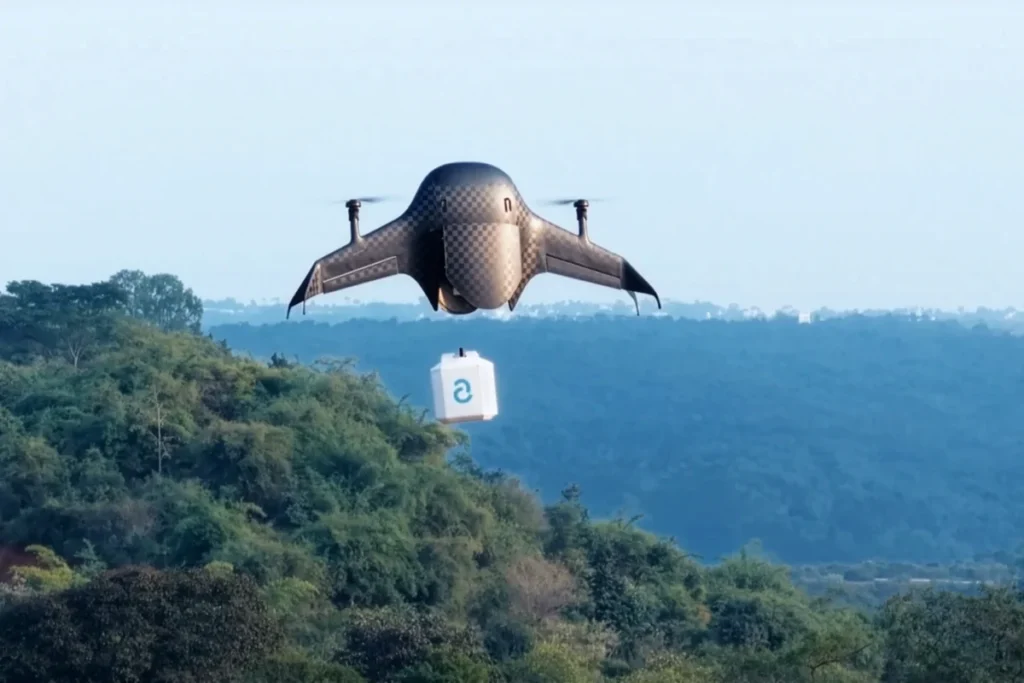
Naman Pushp, the 20-year-old founder and CEO of Airbound, believes the solution lies in a radical design philosophy. By prioritizing an ultra-lightweight architecture, Airbound aims to build aircraft that weigh less than the cargo they carry. The company’s current model, the "TRT," weighs roughly 3.3 pounds yet possesses a 2.2-pound payload capacity. The next iteration currently in development is slated to scale significantly, weighing 6.6 pounds while capable of transporting up to 11 pounds of goods.
The startup utilizes a unique, rocket-like “tail-sitter” design. These drones take off and land vertically in an upright position, transitioning seamlessly to horizontal flight for transit. This configuration allows Airbound to bypass the need for expensive, space-consuming runway infrastructure—a critical feature for dense urban environments where real estate is at a premium.
Chronology: A Rapid Ascent
Founded in 2023, Airbound has demonstrated a blistering pace of development.
- 2023: Airbound is established in Bengaluru, India, with a vision to revolutionize logistics through autonomous, vertical-takeoff-and-landing (VTOL) aircraft.
- October 2024: The company secures an $8.65 million seed round, marking its initial entry into the global spotlight.
- Late 2024–Early 2025: Airbound intensifies its operational testing, clocking over 13,000 autonomous flights across Bengaluru and Guntur.
- Current Date: The company closes a $37 million Series A round, signaling its transition from a R&D-heavy startup to an industrial-scale manufacturing entity.
Throughout this timeline, the company has maintained a dual focus: perfecting its hardware in a 43,000-square-foot facility in Bengaluru while simultaneously proving the utility of its drones in real-world healthcare scenarios.
Supporting Data: The Healthcare Use Case
The efficacy of Airbound’s technology is perhaps best illustrated by its partnership with the Narayana Health hospital network. In a pilot program, an Airbound drone has been tasked with the critical, time-sensitive transport of diagnostic samples between healthcare facilities.
The data provided by these flights is compelling. A distance that takes a drone approximately seven minutes to cover can take three to five hours via conventional two-wheelers. The delay in road transport is often exacerbated by the need to bundle samples to achieve economic efficiency for the courier. By contrast, the drone acts as an on-demand service, facilitating near-instantaneous transfers.
The expansion of this partnership is already underway. Narayana’s new Banashankari hospital in Bengaluru was purposefully designed without an on-site diagnostic lab or blood bank. The facility relies entirely on Airbound’s aerial bridge to connect with centralized diagnostic infrastructure, a move that could serve as a blueprint for the future of "distributed" hospital architecture.
The Three-City Network: A Regulatory Ambition
Beyond individual hospital contracts, Airbound has set its sights on an ambitious regional logistics network. The startup has entered into a strategic agreement with the government of Andhra Pradesh to develop a drone delivery network spanning three cities.
The goal is to reach 10,000 flights per day, encompassing retail, e-commerce, and healthcare logistics. To hit this scale, Pushp estimates the need for a fleet of between 250 and 1,000 aircraft. While the number of drones required remains subject to route-length variables, the company is preparing for a massive deployment.
It is important to note that this agreement is not a government contract or a subsidized project. Instead, it represents a collaborative regulatory push. The Andhra Pradesh government is working closely with Airbound to establish the legal framework necessary for autonomous, beyond-visual-line-of-sight (BVLOS) operations. This regulatory cooperation is the "holy grail" of the industry; without BVLOS certification, drones cannot operate at the distances or scales required to compete with traditional logistics providers.
Official Responses and Strategic Vision
When asked about the competitive landscape in India—a market already crowded with players like Skye Air Mobility, TSAW Drones, and Garuda Aerospace—Naman Pushp is clear about his differentiator. Airbound does not necessarily want to be the world’s largest logistics operator; it wants to be the primary aircraft manufacturer for the industry.
"We want to build towards a world where everything has cost parity with trucking," Pushp stated. By focusing on the hardware—the “Boeing role”—Airbound aims to supply the backbone of other logistics companies’ networks.
Regarding the company’s current financial status, Pushp remains pragmatic. Despite having a workforce of over 150 employees and significant venture backing, the startup is largely pre-revenue. This is a deliberate choice. In a sector where the technology is still maturing, Airbound is prioritizing long-term market dominance over immediate cash flow. "The goal is to be a giant in a few decades, not to make revenue as soon as we can," he added.
Implications: The Road to Scalability
The implications of Airbound’s success reach far beyond the borders of India. If a startup can prove that autonomous, lightweight drones can achieve cost parity with road transport, it effectively renders the last-mile delivery model obsolete.
The Regulatory Bottleneck
While the technology is advancing, regulation remains the primary hurdle. Operating at scale requires national-level permissions for BVLOS flights. Without these, the hardware remains grounded in localized, experimental silos. The work being done in Andhra Pradesh is a vital bellwether for the rest of the world; if India can successfully integrate commercial drone networks into its complex urban landscape, it may force other global aviation authorities to accelerate their own certification processes.
Manufacturing as a Moat
By keeping the manufacturing of airframes and core systems in-house at its Bengaluru facility, Airbound is insulating itself from supply chain volatility. Pushp has indicated that while production capacity is not yet at its peak, it will not be the primary bottleneck as the company scales. This internal control is a classic move for companies that intend to set the industry standard, allowing for rapid iteration based on flight data.
Impact on Retail and E-commerce
The inclusion of retail and e-commerce in the Andhra Pradesh agreement suggests that the company is looking beyond high-margin healthcare deliveries. If Airbound succeeds in reducing the cost of small-package delivery to the level of a trucking fee, the impact on consumer behavior will be profound. The "on-demand" economy would shift from a luxury service to a standard expectation, further accelerating the transition toward decentralized warehousing and automated fulfillment.
Conclusion
Airbound is currently operating at the intersection of extreme ambition and technological reality. With $50 million in capital and a clear, albeit difficult, path toward regulatory integration, the startup is testing the limits of what autonomous aerial systems can achieve.
Whether they become the "Boeing of drones" or simply a successful regional operator remains to be seen. However, their progress in India provides a compelling case study for a future where the sky is not just a transit route, but a vital, cost-effective artery for the global supply chain. As the regulatory climate begins to thaw, the next few years will determine if Airbound can truly deliver on its promise to make the air as accessible as the road.