In a significant development for North American critical mineral exploration, Vancouver-based VR Resources Ltd. (TSX.V: VRR) has released the geochemical findings from drill hole NB26-003, confirming a vast, vertically continuous polymetallic mineral system at its New Boston property in west-central Nevada. The results suggest that the New Boston site is a world-class porphyry-skarn system, rich in copper, molybdenum, tungsten, silver, and zinc—all of which are currently designated as strategic metals by the U.S. government.

The discovery, located just off Highway 95, underscores the potential for domestic supply chain resilience for critical materials. With over 2,800 feet (881 meters) of continuous, sulfide-rich veining, the project represents one of the most promising recent exploration targets in the Great Basin.

Main Facts: A Polymetallic Powerhouse
Drill hole NB26-003 was completed to a depth of 881 meters (2,892 feet) in the western sector of the New Boston system. The geochemical analysis revealed exceptional, multi-element mineral concentrations, highlighting the site’s complexity and depth potential.

Key Intercept Highlights:
- Near-Surface Richness: The hole began with 0.77% Copper Equivalent (CuEq) over 317 meters starting from the surface. An anchor hole sample taken at the drill collar yielded an eye-catching 3.95% CuEq.
- Deep-Seated Mineralization: A deeper interval returned 0.48% CuEq over 419 meters, starting at 460 meters depth.
- High-Grade Discovery: Within the deeper interval, a 31-meter zone at 604 meters depth—hosted within a diorite porphyry intrusion—returned 0.98% CuEq.
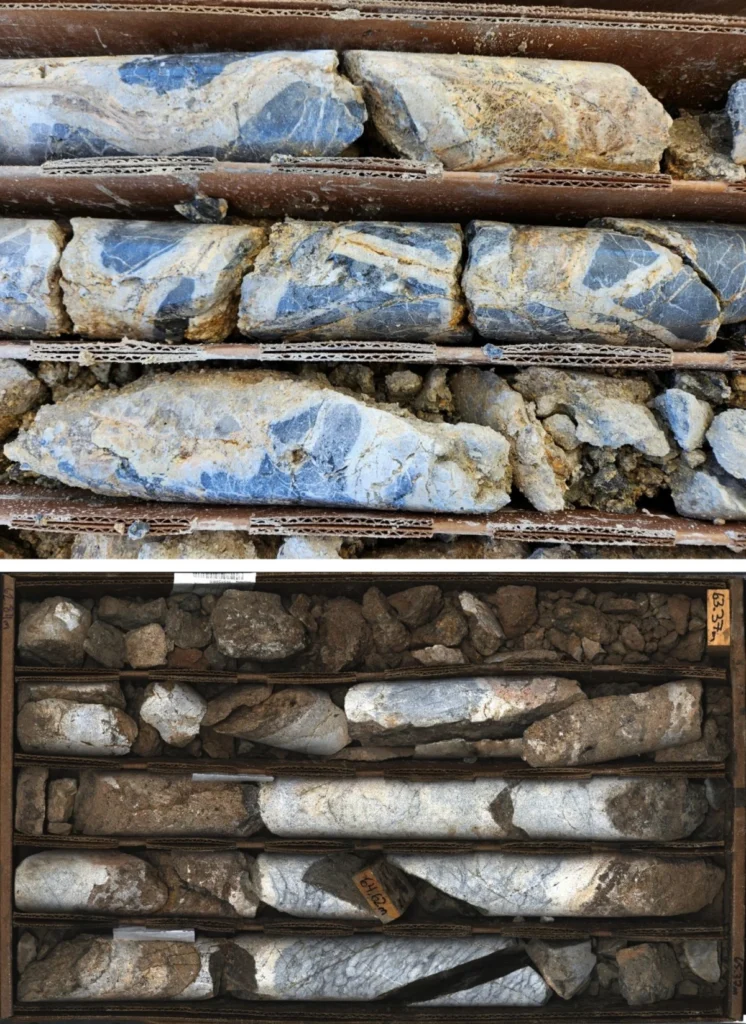
- Exceptional Silver/Tungsten: A two-meter interval in garnet marble skarn at 535 meters yielded 33.4% CuEq, driven by 1.48% tungsten (WO₃), 0.32% copper, and 427 g/t silver.
The presence of these metals in a single, continuous system is rare, and the consistent distribution of sulfides throughout the 881-meter core indicates a massive, long-lived hydrothermal event that remains open at depth.

Chronology of the New Boston Exploration
The New Boston property has been the subject of sporadic, small-scale exploration for over 60 years, primarily dating back to reconnaissance work between 1967 and 1979. However, much of this early activity was shallow and geographically fragmented, failing to grasp the true scale of the underlying system.

- 2023 – Modern Geophysical Breakthrough: VR Resources implemented a sophisticated 3D-array DCIP (Direct Current Induced Polarization) survey. This state-of-the-art technology identified co-spatial conductivity and chargeability anomalies at the "Jeep Mine" area, which had been previously unrecognized.
- 2024 – Initial Validation: The company conducted its first-pass drilling at the East Zone, intersecting continuous, intense stockwork veining over 1,500 feet in Hole 002.
- June 2026 – The Discovery Hole: Building on the 2024 results, VR initiated drilling at the Jeep Mine anomaly. NB26-003 was designed to test the heart of the geophysical anomaly. It successfully reached 881 meters, demonstrating that the system possesses a kilometer-scale vertical dimension to match the 2.1-kilometer strike length identified on the surface.
Supporting Data: Hyperspectral and Geochemical Evidence
The technical rigor applied to the New Boston data is significant. VR Resources utilized ALS Global’s facility in Reno for sample preparation and Vancouver for advanced chemical analysis.

Advanced Analytical Techniques:
- Fusion Analysis: By employing sodium peroxide fusion followed by ICP-MS and ICP-ES, the company ensured high-precision detection of elements in refractory minerals like scheelite and molybdenite.
- Hyperspectral Scanning: The entire 2,892-foot core underwent long-wavelength (LWIR) and short-wavelength (SWIR) hyperspectral scanning at TerraCore Geospectral in Reno. This mapping revealed distinct vertical zonation, moving from high-temperature hornfels and garnet-altered limestone at the surface to intense dolomitization and potassic alteration at the bottom of the hole.
- Intrusive Complexity: The log identified no fewer than 21 separate porphyry intrusions throughout the hole, ranging from quartz monzonite and dacite in the upper levels to diorite and biotite granite at depth. This confirms a "polyphase" system—a hallmark of large, long-lived porphyry deposits.
Official Responses: CEO Dr. Michael Gunning’s Perspective
Dr. Michael Gunning, Chief Executive Officer of VR Resources, expressed optimism regarding the project’s trajectory. "The new data from NB26-003 show us nearly continuous mineralization in moly, copper, tungsten, silver, and zinc," Dr. Gunning stated.

"The mineralized diorite porphyry intrusion discovered at 610 meters is a new and critical addition to our understanding of the New Boston system. It wasn’t visible on the surface, and it wasn’t on any historic maps. It demonstrates that we are looking at a deep-seated, high-temperature system that is only just beginning to be understood."

Dr. Gunning emphasized the strategic importance of the site’s location: "New Boston is literally a few kilometers from state highway, grid power, and rail infrastructure. When you combine this logistical advantage with the fact that we have a suite of critical metals—tungsten, copper, silver, and zinc—all of which are on the U.S. Strategic Metals list, you have a project that is of profound national interest."

Implications for the Future
The results from NB26-003 have several far-reaching implications for VR Resources and the broader mining sector in Nevada:

1. Proof of Concept for 3D Geophysical Targeting
The success of NB26-003 validates the 2023 3D-array DCIP survey. The company now has a high-confidence model for identifying "blind" targets—deposits that do not reach the surface but show up clearly in electrical geophysical surveys. This significantly lowers the risk for future drilling campaigns.

2. A "District-Scale" Opportunity
With a 2.1-kilometer strike length of mineralized veins and a vertical dimension now confirmed to exceed 880 meters, New Boston is evolving from an exploration prospect into a potential district-scale asset. The system remains open at depth, meaning the total resource potential could be significantly larger than current data suggest.

3. Domestic Supply Chain Security
Washington’s current political climate is heavily focused on "reshoring" the production of critical metals. New Boston’s status as a polymetallic system—producing not just copper, but also essential tungsten and molybdenum—aligns perfectly with US domestic resilience initiatives.

4. Next Steps
VR Resources is already planning follow-up drilling. The permitted drill sites, which were identified based on the 2023 geophysical survey and existing historic infrastructure, will allow for cost-effective, high-impact testing of the extensions of the mineralized zones found in NB26-003.

Conclusion
The findings at New Boston represent a milestone for VR Resources. By combining modern geophysical modeling with rigorous geochemical analysis, the company has peeled back the layers of a 60-year-old mystery to reveal a massive, complex, and highly mineralized system.

While the company cautions that these results are based on mathematical averages and that further work is required to determine the economic viability and "true width" of the deposits, the geological evidence is compelling. New Boston stands out as a rare, multi-commodity system located in a jurisdiction with established mining infrastructure, marking it as a critical project to watch in the coming months as VR Resources moves toward the next phase of exploration.

Disclaimer: This article is for informational purposes only and does not constitute financial advice. Exploration for mineral deposits is inherently speculative. Investors are encouraged to review the full technical disclosures filed by VR Resources on SEDAR+ and consult with a professional financial advisor before making investment decisions.