The Architecture of Iconography: Inside Chanel’s 1,800-Hour ‘Imprimé Lion’ Masterpiece
By
•
September 5, 2026
Executive Summary & Main Facts
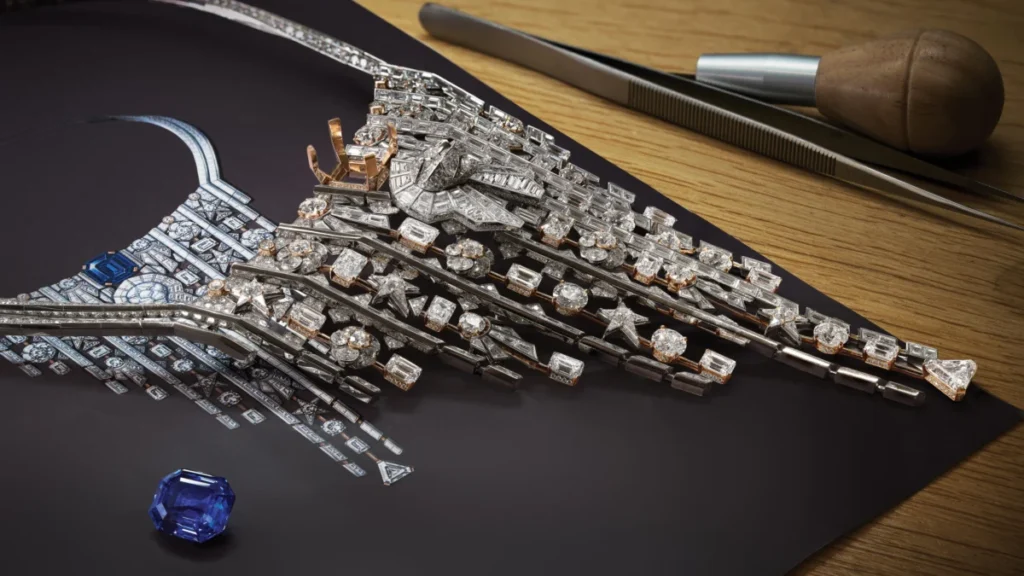
In an ambitious synthesis of archival history, lapidary excellence, and architectural micro-engineering, French luxury maison Chanel has unveiled the centerpiece of its latest High Jewelry (Haute Joaillerie) collection, Signes & Symboles. Named the Imprimé Lion necklace, the one-of-a-kind creation acts as an encyclopedic tribute to the personal lexicon of the house’s founder, Gabrielle “Coco” Chanel.
The hero jewel is anchored by an ultra-rare 20.66-carat Sri Lankan sapphire—celebrated for its exceptional clarity and velvety royal blue hue—and suspended within a supple cascade of custom-cut diamonds. Merging dual-tone metallurgy with advanced articulation techniques, the necklace requires over 1,800 hours of meticulous hand-craftsmanship at the Place Vendôme workshops in Paris.
Far more than a simple gem-encrusted ornament, the Imprimé Lion synthesizes the four foundational emblems of the house’s mythological identity:
The Lion: Coco Chanel’s astrological sign (Leo) and the emblem of Venice, symbolizing strength and majesty.
The Camellia: Her signature bloom, representing purity, geometric perfection, and rebellion against traditional adornment.
The Sun (Le Soleil): An emblem of vitality, radiance, and classic French grandeur.
The Star / Comet (La Comète): A talisman of cosmic destiny and eternal modernity drawn from her historic 1932 collection.
By rendering these four motifs into a fluid, fabric-like diamond textile that transitions seamlessly from 18-karat white gold into warm 18-karat rose gold, Chanel reinforces its position at the apex of global haute joaillerie.
Chronology: From the 1932 Bijoux de Diamants to Modern High Jewelry
The architectural and philosophical lineage of the Imprimé Lion necklace traces back nearly a century, rooted in a pivotal moment in twentieth-century decorative arts.
1883           1920s          1932                 1983–2019          Present Day
Born under     Venetian       'Bijoux de Diamants' The Lagerfeld Era  'Signes & Symboles'
the sign of    epiphany; the  exhibition; fluid,   Mythology codified Unveiling of the
Leo (Aug 19)   lion adopted   clasp-free design    into global icon   Imprimé Lion (20.66ct)
The 1932 Revolution: Emancipating the Jewel
In November 1932, amidst the economic paralysis of the Great Depression, Gabrielle Chanel presented Bijoux de Diamants inside her private mansion at 29 Rue du Faubourg Saint-Honoré in Paris. Commissioned by the London Diamond Corporation to revive the diamond trade, Chanel shocked the traditional Place Vendôme establishment by approaching fine jewelry not as rigid status symbols, but through the lens of haute couture.
"I want jewelry to be like a ribbon on a woman’s fingers," Chanel famously declared in 1932. "My jewels are never isolated from the idea of women and their dresses. Because dresses change, the jewels are transformable."
Chanel discarded traditional clasps and heavy prong settings, introducing articulated comets, fringe necklaces, and crescent moons that draped over bare skin like supple silk or jersey. The Bijoux de Diamants collection laid the foundational grammar for all subsequent Chanel high jewelry creations.
Codifying the House Mythology
Following Coco Chanel’s passing in 1971 and the subsequent creative stewardship of Karl Lagerfeld beginning in 1983, the house’s visual emblems shifted from biographical memories into global luxury iconography.
Lagerfeld transformed Coco’s personal talismans—her superstition, her convent upbringing in Aubazine, her love of Byzantine gold, and her fascination with astrology—into a coherent, self-referential mythology. In modern collections, the Chanel High Jewelry Creation Studio continues to mine this archive, treating symbols not as static logos, but as evolving motifs of artistic expression.
Supporting Data & Technical Craftsmanship
Behind the effortless aesthetic drape of the Imprimé Lion lies an intense concentration of technical complexity, gemological curation, and rare artisanal techniques.
Gemological Rarity: The 20.66-Carat Ceylon Sapphire
The focal point of the necklace is an investment-grade 20.66-carat sapphire sourced from the historic alluvial gem fields of Sri Lanka (formerly Ceylon). Renowned among gemologists for producing stones with exceptional luminosity and an open, vibrant blue hue, Sri Lankan sapphires of this magnitude without significant thermal enhancement are extraordinarily rare.
The sapphire’s cut was engineered to maximize internal light refraction while maintaining substantial depth, anchoring the visual balance of the entire collar.
To recreate the visual texture of printed fabric (imprimé), Chanel’s gem-setters employed five distinct diamond cuts:
Triangle Cuts: Positioned to create directional energy and sharp modern angles.
Baguette Cuts: Providing geometric clarity and an Art Deco structural rhythm.
Emerald Cuts: Offering crystalline step-cut reflections that evoke timeless restraint.
Oval Cuts: Softening the overall profile and enhancing feminine contours.
Round Brilliant Cuts: Maximizing overall dispersion, fire, and surface scintillation.
Each stone is set using calibrated micro-bezels and open-back gallery settings that maximize light entry from every angle, ensuring the diamond fringe radiates whether viewed under natural daylight or evening candlelight.
Artisanal Polissage au Fil (Thread Polishing)
One of the most technically demanding aspects of the necklace’s 1,800-hour production is the finishing process. Because the setting blends 18-karat white gold with subtle accents of 18-karat rose gold across intricate openwork lattices, traditional buffing wheels cannot reach the interior cavities.
Master polishers utilized polissage au fil—a centuries-old technique where individual cotton and silk threads coated in fine abrasive paste are hand-pulled through every microscopic aperture of the setting. This ensures that every inner crevice, hinge, and prong achieves the same mirror finish as the exposed surface, eliminating friction against the wearer’s skin and creating a piece that flows with the flexibility of woven cloth.
Official Context & Creative Vision
Chanel’s High Jewelry Creation Studio approaches every high jewelry collection not merely as a compilation of precious stones, but as an ongoing chapter in an evolving narrative universe.
       GABRIELLE CHANEL'S PHILOSOPHY
   "Jewelry must move with the woman."
                  │
                  ▼
   CHANEL HIGH JEWELRY CREATION STUDIO
Translating biography into permanent art
                  │
                  ▼
          THE FOUR SYMBOLS
┌───────────┬───────────┬───────────┬───────────┐
│   LION    │ CAMELLIA  │    SUN    │   STAR    │
│  Majesty  │ Symmetry  │ Radiance  │  Destiny  │
└───────────┴───────────┴───────────┴───────────┘
The house’s creative ethos focuses heavily on the paradox of invisible labor: the idea that the greater the technical challenge, the more weightless the final creation must feel.
The Illusion of Simplicity
According to creative documentation from the maison, the central objective of the Signes & Symboles collection is to dissolve the boundary between fine metalwork and fluid fabric. The engineering of the Imprimé Lion necklace relies on hundreds of concealed microscopic hinges and flexible gold links that remain entirely undetectable from the front.
When draped on the neck, the necklace adjusts to the natural movements of the collarbone, fulfilling Gabrielle Chanel’s original mandate that high jewelry must liberate, rather than encumber, the female form.
The Self-Referential Language
While many heritage jewelry houses on Paris’s Place Vendôme rely on naturalistic floral motifs or royal commissions for inspiration, Chanel’s competitive differentiation rests on its self-referential iconography. By interweaving the Lion, Camellia, Sun, and Star in a single composition, the maison transforms personal biographical fragments into universal markers of connoisseurship. The motifs are recognizable instantly to collectors without requiring visible logos or branding.
Industry Implications & Luxury Market Analysis
The debut of the Imprimé Lion necklace reflects several broader macroeconomic and strategic shifts taking place across the ultra-luxury and high jewelry landscape.
Over the past decade, the global High Jewelry segment has significantly outpaced standard fine jewelry in compound annual growth. Ultra-High-Net-Worth Individuals (UHNWIs) increasingly view one-of-a-kind masterworks featuring certified, unheated colored gemstones—such as the 20.66-carat Ceylon sapphire—not only as aesthetic treasures, but as portable alternative asset classes that provide wealth preservation during periods of macroeconomic volatility.
2. Heritage Storytelling as a Competitive Moat
As independent jewelers and new luxury entrants proliferate, heritage luxury brands like Chanel are leveraging their historic archives as unassailable competitive moats. A 20-carat sapphire mounted in a generic setting commands a market-clearing auction price based purely on carat weight and clarity; that same stone integrated into a 1,800-hour narrative composition carrying the cultural cachet of Coco Chanel commands a substantial artistic and brand premium.
3. The Shift Toward Wearable Fluidity
The modern high jewelry client increasingly demands versatility over rigid formality. Stiff, heavy chokers are yielding market share to articulated, lightweight masterpieces that transition effortlessly from formal galas to private salon events. By merging five diamond cuts with fluid gold articulation, the Imprimé Lion necklace exemplifies the contemporary demand for jewelry that mimics the tactile comfort of high fashion.
The Enduring Power of House Mythology
The Chanel Imprimé Lion necklace stands as a triumph of contemporary haute joaillerie. Through 1,800 hours of devoted benchwork, complex multi-cut diamond pavé, and the gemological triumph of a 20.66-carat Sri Lankan sapphire, the piece demonstrates how historic symbols can be continuously re-engineered for the modern era.
By fusing the structural spirit of 1932 with the cutting-edge lapidary precision of today, Chanel proves once again that its greatest asset is not merely the brilliance of its gems, but the enduring strength of its mythology.