The global art market is witnessing a historic realignment. Once considered a niche category relegated to specialized sales, South Asian modern art has surged into the international spotlight, shattering price records and commanding the attention of the world’s most prestigious auction houses. In 2024 and early 2025, the sector reached a watershed moment, with annual auction sales exceeding the $100 million mark. However, this financial windfall has brought with it a sophisticated and "menacing" shadow: a proliferation of high-quality forgeries that threatens to destabilize the market’s newfound credibility.
As prices for masters like S.H. Raza, M.F. Husain, and Sadequain climb into the seven-figure range, the incentive for counterfeiters has never been greater. Experts now warn that the very success of the South Asian art market is providing the fuel for a forgery crisis that spans from the galleries of Mumbai and Lahore to the auction blocks of London and New York.
I. Main Facts: A Market in Ascent and Under Siege
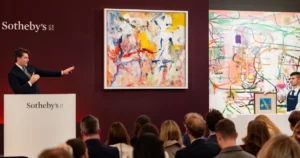
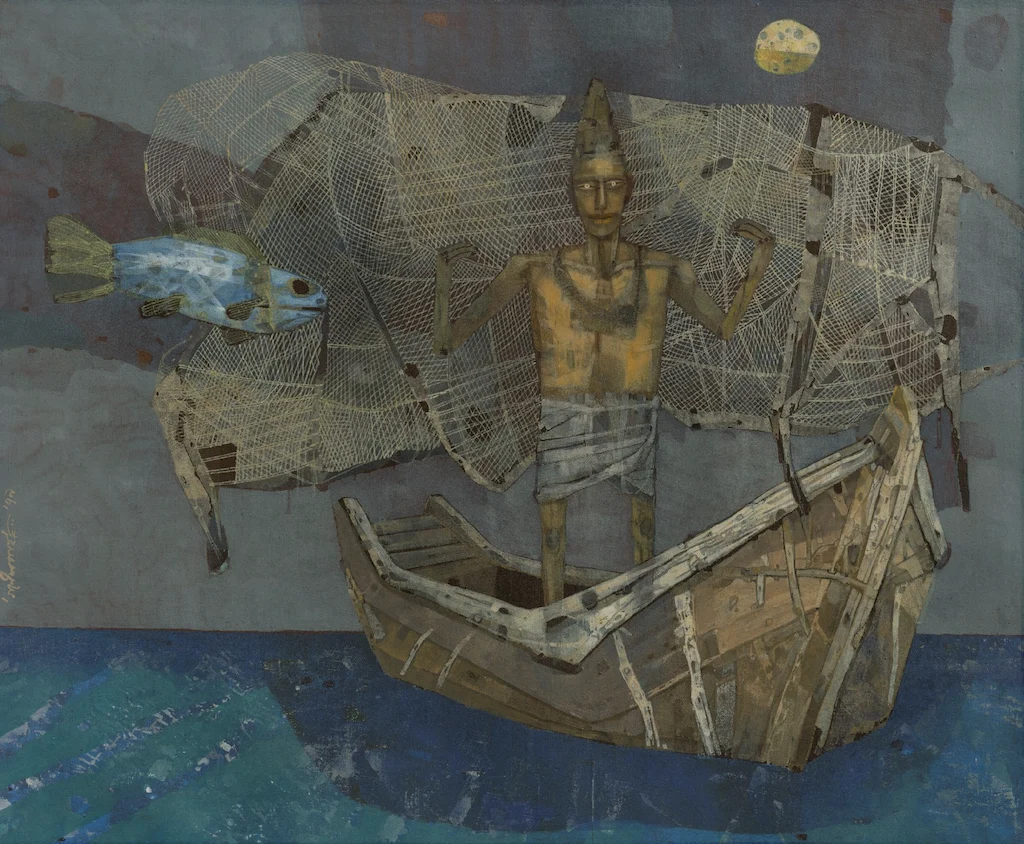
The current state of South Asian modern art is one of extreme duality. On one hand, the "Big Three"—Sotheby’s, Christie’s, and Bonhams—have reported unprecedented demand. This summer, London hosted a series of high-profile sales that cemented the category’s status. Christie’s first dedicated London auction of South Asian art since 2019, titled Sublime Shadows, brought in a staggering $25.5 million, achieving a 100% sell-through rate. The star of the show, Ganesh Pyne’s The Fisherman, sold for $5.22 million—more than ten times its low estimate—setting a world auction record for the artist.
On the other hand, the "menace" of forgery, as described by veteran Mumbai dealer Dadiba Pundole, is growing at a commensurate rate. Pundole, whose gallery represented many of India’s leading modernists during their lifetimes, estimates that as many as one in ten modern artworks sold through private channels in India today could be fraudulent.
The crisis is not limited to the "blue-chip" artists. While the works of the Progressive Artists’ Group (PAG) remain the primary targets, the "middle market"—artists whose works fetch between $20,000 and $100,000—is now being flooded with counterfeits. Forgers have realized that middle-market works often receive less scrutiny than multi-million-dollar masterpieces, making them easier to move through smaller galleries and online platforms.
II. Chronology: From Niche Interest to Global Commodity
To understand the current crisis, one must look at the rapid evolution of the South Asian art market over the last three decades.
1990s – Early 2000s: The Foundations
During this period, South Asian modern art was primarily a domestic interest within India and Pakistan, with a small but dedicated diaspora following. Prices were modest, and the risk of forgery was low because the financial rewards did not justify the effort required to produce a convincing fake.
2005 – 2015: The First Boom and the "Spurt" in Fakes
As the Indian economy liberalized and wealth grew, art became a status symbol. The "Progressive" movement—led by artists like Tyeb Mehta, Francis Newton Souza, and Vasudeo S. Gaitonde—began to see international auction success. Dadiba Pundole notes that this is when the "spurt" in forgeries began. "There have always been some fakes, but in the last 15 years values have gone up, so there’s been a spurt," Pundole told the Financial Times.
2020 – Present: The $100 Million Era
Post-pandemic, the market entered a period of "muscular results." The entry of high-net-worth individuals from the tech and finance sectors, coupled with a global push for more diverse art historical narratives, sent prices skyrocketing. In 2025, the market officially crossed the $100 million annual auction threshold. This peak has coincided with the most sophisticated forgery efforts seen to date, utilizing aged canvases, period-accurate pigments, and fabricated provenance documents.
III. Supporting Data: The Economics of Deception
The temptation for forgers is rooted in a simple mathematical reality: the cost of production versus the potential return.
- The Sadequain Precedent: The Pakistani modernist Sadequain is perhaps the most salient example of how forgeries can damage a market. Once a high-flyer whose works fetched six figures, his market has cooled significantly. Collector Hameed Haroon notes that an influx of fakes has led to a crisis of confidence. When buyers cannot distinguish the "real McCoy," they refuse to pay premium prices, leading to a stagnant or declining market for even genuine works.
- The Volume of Fakes: Salima Hashmi, a Lahore-based artist and academic, reports seeing images of 60 to 70 forged modern works offered for sale over WhatsApp every year. This "digital grey market" allows forgers to bypass traditional gatekeepers.
- The Middle-Market Shift: Charles Moore of London’s Grosvenor Gallery states that he is offered a likely fake by private sellers "every couple of weeks." He notes that while the "big names" were once the only targets, the rise in overall valuations means it now "pays to forge the middle-market artists too."
- The Documentation Gap: Unlike Western masters like Picasso or Monet, many South Asian modernists lack a catalogue raisonné (a comprehensive, annotated listing of all known works). This lack of a central "bible" for authentication creates a vacuum that forgers are eager to fill.
IV. Official Responses: Defensive Measures and Legal Hurdles
The art world’s defense against this "menace" is multi-layered, involving auction house specialists, veteran dealers, and scientific analysis. However, these defenses are often hampered by legal and cultural barriers.
Auction House Rigor
Manjari Sihare-Sutin, head of Sotheby’s South Asian Modern and Contemporary department, explains that her team acts as a primary filter. On average, Sotheby’s rejects two works ahead of every sale due to authenticity concerns. When documentation is missing, they rely on:
- Artist Archives: Access to unpublished letters, photos, and studio logs.
- Expert Networks: Consulting with the families of deceased artists and scholars.
- "The Trained Eye": The subjective but vital skill of connoisseurship—recognizing the specific brushwork, "hand," and soul of an artist developed over decades of observation.
The "Silence" of the Experts
One of the most significant hurdles in cleaning up the market is the risk of litigation. In India and Pakistan, criminal defamation laws are often used to silence experts who label a work as fake. Veteran Mumbai dealer Shireen Gandhy admitted to the FT that experts are often reluctant to challenge works openly. "You can’t say anything publicly," she said. "But if you know someone, privately you can say ‘Don’t touch it’." This "private warning" system protects the individual expert but allows the forged work to remain in circulation, potentially finding a less-informed buyer later.
Scientific Advancements
Some collectors are now turning to carbon dating and pigment analysis. However, forgers have become adept at sourcing old materials. A 1950s painting might be faked using a canvas stripped from a worthless 1950s decorative work, making chemical dating less reliable.
V. Global Context: A Systemic Issue
South Asia is not an island in this regard. The forgery crisis mirrors similar issues in other rapidly appreciating markets, most notably in China and Japan.
The Shanghai Scandal
Last month, a major fraud scheme was exposed in China, where two former managers of the Shanghai Jiahe Auction Co. were sentenced to over 12 years in prison. They orchestrated a scheme that led a collector to spend $74 million on over 40 counterfeit or overvalued objects. In one extreme case, a vase sold for $247,000 as an 18th-century Qianlong-era masterpiece was later valued at just $37—a modern reproduction.
The Beltracchi Legacy in Japan
Japan is still untangling the web left by Wolfgang Beltracchi, the notorious German forger. His works have been discovered in prestigious Japanese museum and corporate collections. Recently, a painting long thought to be a Moïse Kisling masterwork in the Yamada Bee Company Group collection was linked to Beltracchi. These cases highlight that even the most established institutional "eyes" can be deceived when the financial stakes are high.
VI. Implications: The Future of South Asian Art
The "menace" of forgery carries profound implications for the long-term health of the South Asian art market.
1. The Risk of a "Confidence Collapse"
As Dadiba Pundole warned, "It just takes one scandal" to knock the confidence in an entire corner of the market. If a major museum or a top-tier auction house is found to have sold a high-profile fake, it could trigger a sell-off or a freeze in buying activity, particularly among new collectors who are already wary of the market’s "Wild West" reputation.
2. The Digital Wild West
The shift toward online sales—which now account for 15% of the global art market—has removed the physical "filter" of the experienced dealer. Buying from a digital catalog photograph makes it nearly impossible to judge the texture, smell, and "age" of a work, playing directly into the hands of counterfeiters.
3. The Necessity of Institutionalization
For the South Asian market to mature, it must move beyond "private warnings" and toward institutional transparency. This includes the funding of catalogue raisonnés, the establishment of independent authentication boards, and the reform of defamation laws to protect good-faith expert opinions.
4. A New Era of "Buyer Beware"
For collectors, the message is clear: the era of the "bargain find" is largely over. In a $100 million market, provenance—the documented history of an object’s ownership—is as valuable as the paint on the canvas. Without a clear line of ownership stretching back to the artist’s studio or a reputable gallery, a work is increasingly viewed with skepticism.
Conclusion
South Asian modern art is currently enjoying its "Gilded Age." The international recognition of artists like S.H. Raza and Ganesh Pyne is a hard-won victory for a region with a rich but often overlooked modern history. Yet, this success is fragile. The "menace" of forgery is a direct byproduct of the market’s growth, and how the industry chooses to confront this shadow will determine whether the current boom is a sustainable rise or a speculative bubble waiting for a scandal to burst it. As the stakes rise, the "eye" of the specialist and the integrity of the dealer remain the only true safeguards against the proliferation of the counterfeit.