In the heart of Copenhagen, amidst the industrial charm of the Danish capital, the annual TechBBQ conference served as a microcosm for the existential crisis currently gripping the European technology sector. While the event featured the usual flurry of networking, pitch competitions, and rooftop soirées, the underlying discourse was markedly different from previous years. The conversation among investors, founders, and policy-adjacent operators had shifted from the technical marvels of Large Language Models (LLMs) to a more pressing, geopolitical inquiry: Who actually controls the engines of the intelligence revolution?
Under the thematic banner of "Emerging from Agency," the conference—which concluded on August 27—became a focal point for a growing European consensus that relying on U.S.-based and Chinese-backed infrastructure is a strategic vulnerability.
The Catalyst: A Wake-Up Call from Anthropic
The urgency of the debate was not merely academic. It followed a disruptive incident earlier this year when Anthropic, a leader in the generative AI space, rendered its "Mythos" and "Fable" models unavailable to users across Europe. For many European startups that had integrated these tools into their software development pipelines, the move was a sharp, painful lesson in "vendor lock-in."
Interviews conducted on the sidelines of TechBBQ revealed a fractured sentiment. One startup executive described the sudden lack of access as a significant operational bottleneck that paralyzed his software team for days. Conversely, others were more sanguine, suggesting that while reliance on foreign powers presents long-term geopolitical risks, the status quo remains tolerable for the time being. However, the prevailing mood was clear: the era of blind reliance on Silicon Valley is drawing to a close. The debate has shifted from "what can AI build?" to "who holds the power to switch it off?"
A Shift in Narrative: Human Agency vs. Machine Autonomy
Ellen de Brever, an angel investor and head of partnerships at the Novo Nordisk Foundation Cellerator, provided a poignant framing of the event’s central tension. "TechBBQ’s theme of agency felt particularly timely this year," she noted. "The debates weren’t about smarter machines, but about human judgment and who gets to stay in the driver’s seat."
De Brever emphasized that the current fervor surrounding AI agents—autonomous programs capable of executing tasks without human intervention—is fundamentally a story about human surrender. "It’s a story about humans deciding what to give up," she remarked. This sentiment resonated across various sessions, from discussions on the future of women’s health technology to the inaugural Nordic-Africa startup summit, where leaders explored cross-continental investment strategies. In every room, the subtext remained the same: Europe is searching for a path to sovereignty that doesn’t sacrifice human oversight for the sake of efficiency.
Privacy in the Age of Surveillance Capitalism
One of the most anticipated sessions of the event featured Signal President Meredith Whittaker, who sparred with the industry’s trend toward total integration. Whittaker offered a stark critique of the current AI trajectory, specifically the trend of embedding AI assistants directly into operating systems—a practice increasingly mirrored by tech giants like Apple and Microsoft.
Whittaker characterized this wave of innovation as a "data collection apparatus," arguing that AI labs often employ sophisticated marketing to distract users from the "collateral consequences" of mass data ingestion. Her stance was clear: the integration of AI into our foundational computing layers is not just a feature; it is an encroachment on personal sovereignty.
"There is still a huge market need for privacy," Whittaker asserted. "And particularly with the sovereignty concerns, we will have customers here." Her warning served as a reminder that for Europe, which has historically led the world in data protection regulations like GDPR, the path to AI maturity may be paved with privacy-first principles that differ drastically from the "move fast and break things" ethos of the U.S. West Coast.
The Geopolitical Stakes: Sovereignty as Resistance
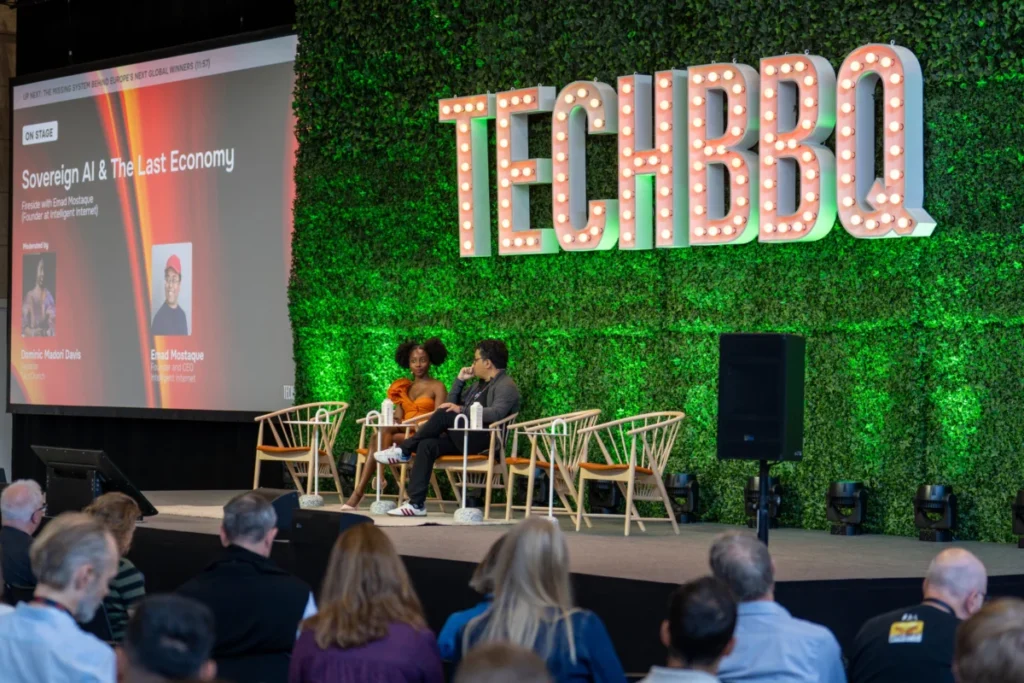
The conversation took a more ominous turn during a panel featuring Emad Mostaque, co-founder of Stability AI and Intelligent Internet. Mostaque framed the issue through the lens of power dynamics, defining sovereignty as "the ability to resist power being exerted over you."
He pointed to the extreme concentration of capital and compute in the hands of a few U.S. AI labs as an inevitable threat to national stability. "Inevitably, every country will be run by AI," Mostaque argued, adding, "The person that controls the AI controls the country." This perspective echoes the concerns of European regulators who fear that without a homegrown, competitive AI stack—comprising everything from specialized silicon to sovereign cloud infrastructure—European nations risk becoming digital vassals to foreign corporations.
Implications for the Future of Work and Democracy
The dialogue at TechBBQ also ventured into the societal ramifications of an agentic economy. Mia Negru, advocacy and engagement director for the nonprofit Life With Artificials, highlighted that the implications of this shift extend far beyond simple economic productivity.
"If intelligent agents perform cognitive work and robots increasingly perform physical work, we may be approaching something much bigger than another technological revolution," Negru observed. "We may have to rethink ownership, work, democracy, economic participation, and eventually even who gets to participate in society."
This sentiment suggests that Europe’s current introspection is not merely a reaction to external dependency, but a necessary preparation for a fundamental restructuring of the social contract. If the "means of production" (in this case, the weights and parameters of advanced AI models) are concentrated globally, the internal stability of the European democratic model could be at stake.
Beyond the Panels: The Human Element
Despite the heavy themes of sovereignty and control, TechBBQ maintained the vibrant, celebratory atmosphere for which it is known. From rooftop barbecues hosted by industry heavyweights like Nvidia, OpenAI, and AWS, to intimate cocktail hours at London’s Ada Ventures, the conference underscored the vital importance of human-to-human connection.
These settings provided a much-needed venue for founders to discuss the practical realities of building in a challenging environment. Whether debating the merits of growth capital in the European ecosystem or sharing breakthroughs in health tech, the attendees remained focused on the tangible.
As Ellen de Brever reflected on the conclusion of the event, she captured the irony of a tech conference focused on machine dominance: "In a room full of conversations about machines, the most memorable moments still come from the simplest thing: human connection, face-to-face, building relationships, sharing ideas, and reminding each other of what technology can never quite replace."
Conclusion: The Path Forward
The 2024 edition of TechBBQ did not provide a panacea for Europe’s AI sovereignty dilemma. There was no single answer to how the continent can reclaim its technological independence from the dual poles of the U.S. and China. However, the conference successfully crystallized the problem.
Europe’s path forward appears to be one of "principled agency." This involves a commitment to privacy, a skepticism toward the totalizing integration of AI into operating systems, and a concerted effort to foster an ecosystem that prizes sovereign infrastructure over convenient, yet precarious, rentals.
As the industry looks toward the next year, the message from Copenhagen is clear: The AI revolution will not be defined solely by the intelligence of the models themselves, but by the resilience of the societies that deploy them. For Europe, the goal is to remain the pilot, rather than the passenger, of the next technological age.