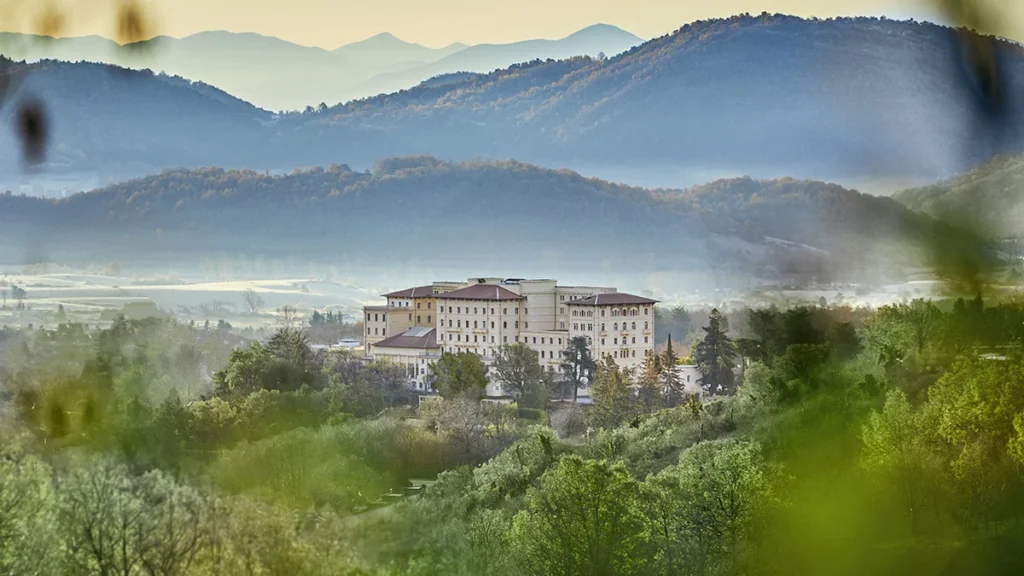
In the rolling, verdant hills of the Lazio region, just an hour’s drive from the frenetic energy of Rome, lies a sanctuary that defies the typical categorization of a "spa." Palazzo Fiuggi, a historic villa built in 1913 in the medieval town of Fiuggi—a locale fabled for its mineral-rich, healing waters—has evolved into a bastion of modern preventative medicine. Following a $35 million renovation and a 2021 relaunch, the property now stands as a high-end marriage of 19th-century grandeur and 21st-century bio-optimization.
For the uninitiated, the prospect of entering a medical wellness resort can be daunting. There are anxieties regarding the rigidity of the schedule, the potential for social isolation, and the looming fear of dietary restriction. Yet, as one ascends the winding, cedar-lined drive and the majestic villa emerges, the initial apprehension is swiftly eclipsed by a profound sense of anticipation. Here, five-star hospitality is not merely a service; it is the delivery mechanism for a rigorous, data-driven approach to longevity.
The Architecture of Healing: Main Facts and Philosophy
Palazzo Fiuggi represents a radical shift in the luxury hospitality landscape. With 102 suites and an expansive medical center, the resort operates under a simple yet ambitious mandate: to blend the comfort of a grand estate with the analytical precision of a top-tier clinic.
The infrastructure is formidable. Guests have access to a Dr. Barbara Sturm spa, a state-of-the-art gym housed in the villa’s former ballroom, multiple pools, a cinema, and a library. However, the true "amenities" are the medical suites. The resort’s "Food as Medicine" philosophy, curated by Michelin three-star chef Heinz Beck in collaboration with the resort’s medical team, is the bedrock of the experience. The property is designed to be a holistic ecosystem where every element—from the water in the springs to the biomechanical sensors in the gym—is calibrated to extend the human healthspan.

Chronology of a Transformation: The Guest Journey
Days 1–2: Assessment and Acclimation
The journey begins not with a massage, but with a clinical investigation. Upon arrival, the guest is subjected to a battery of tests: EKGs, ECGs, skin analysis, and comprehensive cardiology consultations. This is not a relaxing retreat in the traditional sense; it is a diagnostic deep dive.
The initial transition can be jarring. Wandering through frescoed halls and beneath ornate Murano-glass chandeliers, one might feel incongruous wearing a bathrobe or athletic gear. However, the aesthetic dissonance fades as the "palatial" nature of the resort gives way to its primary purpose: self-improvement. By the second day, the robe becomes a uniform of sorts, signaling a departure from the "normal" world of high-stress living.
Days 3–5: The Integration of Therapy
As the clinical data begins to populate, the program shifts toward restorative therapy. This phase includes a diverse array of treatments:
- Thalassotherapy and Hydrotherapy: Often accompanied by the humor of a staff that keeps the clinical environment approachable.
- Psammotherapy: The sensory experience of being enveloped in warm, therapeutic quartz sand.
- Binaural Sound Therapy: A technological approach to nervous system regulation.
Crucially, these are not disconnected appointments. The medical team works in a feedback loop; a session in the gym might inform a change in the nutritional plan, which in turn is monitored by the diagnostic team.

Supporting Data: The Science of Movement and Nutrition
Perhaps the most significant takeaway from a stay at Palazzo Fiuggi is the objective measurement of personal physiology.
Biomechanical Intelligence
The High Performance Method fitness program is a highlight for those seeking to understand their physical limitations. Through motion-capture technology on a treadmill, the staff identifies subtle, long-term issues: an uneven gait, weak ankles, or a lack of core engagement. For many guests, this is the "lightbulb moment" where chronic back pain or fatigue finally finds a logical, physical explanation.
The "Food as Medicine" Protocol
The dining experience is perhaps the greatest surprise. The menu, restricted to approximately 1,800 calories, is meticulously engineered to be anti-inflammatory and longevity-focused. The absence of alcohol, caffeine, and processed sugars is felt initially as a physical withdrawal, but by the third day, the body adjusts. The cuisine—ranging from veal to inventive preparations of edible flowers and field greens—challenges the American concept of satiety. It is a lesson in nutrient density versus caloric volume.
Official Insights: The Clinical Perspective
The medical team at Palazzo Fiuggi emphasizes that the data is not meant to alarm, but to empower. During the stay, guests receive a hardbound volume containing their complete diagnostic profile.

- The Findings: For many, the results are sobering. Common findings include minor heart-valve irregularities, thyroid anomalies that require monitoring, or, as in the case of many modern travelers, a problematic ratio of visceral fat to muscle mass despite a "healthy" B.M.I.
- The Strategy: The team focuses on actionable, long-term modifications. By presenting genetic screening and blood work alongside practical, daily dietary adjustments, the resort provides a blueprint that can be taken home.
The staff notes that the success of the program is measured by the guest’s ability to sustain these habits post-resort. The kitchen, for example, is so precise that every plate is photographed to ensure consistency—a level of detail designed to show guests exactly what a "healthy plate" should look like when they return to their own kitchens.
Implications: The Luxury of Clarity
As the residency concludes, the true value of the Palazzo Fiuggi experience becomes clear. It is not the chandeliers, the manicured gardens, or the five-star service that leaves the deepest impression. It is the clarity.
In a world saturated with wellness misinformation, the ability to obtain hard data about one’s own body—and to receive a tailored, expert-led plan to address it—is the ultimate luxury. The guests who frequent the resort are as eclectic as they are ambitious: real-estate lawyers, television personalities, and influencers, all united by the common goal of "a longer life, better lived."
The experience challenges the guest to redefine their relationship with their health. Upon returning home, the temptation to revert to old habits is high, but the memory of the diagnostic data acts as a powerful deterrent. When you know, with scientific certainty, that your visceral fat is increasing or that your posture is causing your back pain, the "normal" lifestyle in the U.S.—the caffeine-fueled mornings and processed-food dinners—suddenly feels less like a convenience and more like a liability.

For a starting price of roughly $8,400 for a seven-night stay, the cost is significant. However, for those looking to pivot their trajectory toward longevity, Palazzo Fiuggi offers something that money usually cannot buy: a precise, honest, and actionable understanding of one’s future. It turns out that the most sophisticated piece of equipment in the resort isn’t the DEXA scanner or the hydrotherapy tank; it is the realization that the body is a machine that requires, at the very least, a professional manual.